Last updated: November 20, 2026
Quick answer: Use airtight containers, dry scoops, clear labels, and a cool pantry to keep low histamine dry goods usable longer. In many kitchens, a 30-second habit after opening is enough to prevent the most common problems: moisture, pests, and stale food. This guide on how to store low histamine dry goods so they stay usable longer covers the container, label, and rotation habits that matter most.
Key Takeaways
- Seal opened dry goods right away so air and humidity do less damage.
- Keep grains, flours, and seeds off warm shelves and away from sun and sinks.
- Use clean, dry scoops every time; wet spoons turn good pantry food into a problem.
- Label opened packages with the date you opened them, not just the best-by date when possible.
- Rotate older bags to the front and inspect for bugs, smell changes, or dampness before you cook.
Store low histamine dry goods the right way
Low histamine dry goods last longer when you move them out of flimsy packaging and into a dry, sealed container the same day you open them. That keeps out moisture, pantry moths, and rodent access, which are the main reasons a bag of rice or oats stops being usable.
Because of that, the first step is simple: put the food somewhere safer than the opened package. A folded bag on a shelf near heat or steam usually gives you less control and a shorter usable window.
Picture this: you’ve opened a bag of oats, folded the top once, and set it back on a shelf near the stove. A week later, the oats smell flat and the bag has picked up grease, steam, or tiny bugs. That’s the problem this page fixes.
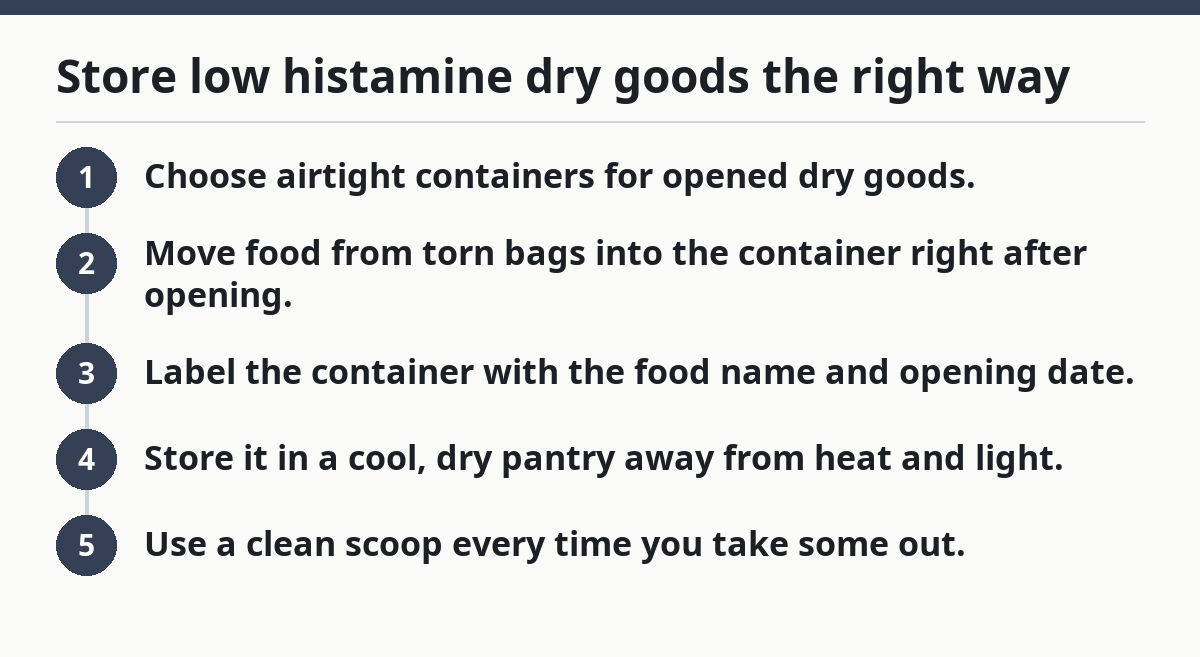
- Choose airtight containers for opened dry goods.
- Move food from torn bags into the container right after opening.
- Label the container with the food name and opening date.
- Store it in a cool, dry pantry away from heat and light.
- Use a clean scoop every time you take some out.
This routine is quick to repeat on a normal weeknight, even if you’re tired. A small system now prevents bigger waste later.
What containers work best for dry pantry foods?
Airtight containers with a tight lid are a good default for most low histamine dry goods, especially once the original package has been opened. Glass jars with sealing lids, rigid plastic containers made for food, and metal tins with a snug closure all do the job if they keep air and pests out.
Because the container is doing the heavy lifting, its shape matters too. A wide mouth makes scooping easier. A solid lid makes the seal more reliable. A hard shell also helps against pests.
Picture this: you’ve got rice, oats, and lentils in three half-open bags, and each one is slowly getting stale. A container with a wide mouth and a reliable seal turns that mess into something you can stack, label, and reach for fast.
- Best for small amounts: glass jars or smaller food containers.
- Best for bulk use: larger rigid bins with tight-fitting lids.
- Best for shelf visibility: clear containers, if your pantry stays dark enough.
- Best for rodent pressure: hard-sided containers that a mouse can’t chew through easily.
Here’s the catch: soft bags and twist ties are not storage. They slow nothing down. If your pantry has a pest problem, the container itself matters as much as the seal. A flimsy bag inside a cupboard is still easy prey.
Two standards matter more than brand names. First, the lid should close fully without gaps. Second, the container should be dry before you fill it. Even a little moisture can make flour cake, seeds clump, or oats develop a stale smell within days.
How should i store rice and oats after opening?
You should store rice and oats in airtight containers, in a cool pantry, with the opening date on the lid or front. That setup keeps them usable longer than leaving them in the original bag, especially if your kitchen gets warm or humid.
Because rice and oats are common pantry staples, they often sit open longer than people expect. A clear label helps you use the older container first and avoid guessing.
Picture this: you’ve opened a 2 kg bag of rice and a carton of oats, and you want both to stay good for weeks or months. The job is to keep air, moisture, and pests away while making the food easy to grab with dry hands or a dry scoop.
- Pour rice into a clean, dry airtight container.
- Transfer oats into a separate sealed container, not a mixed bin.
- Write the opening date on a label or piece of tape.
- Place the container on a shelf away from the stove, dishwasher, or sink.
- Keep the scoop dry and return it to a clean spot, not inside a damp drawer.
Rice and oats are common low histamine pantry staples because they’re plain and shelf-stable, but they still spoil in practical ways. Rice can absorb odors. Oats can go stale or pick up moisture. If a package has any sign of insects, damp patches, or a sour smell, move it out and don’t try to save it.
For long shelf life, simple beats clever. Don’t store the container on the floor, near a heat vent, or beside the kettle. Heat and humidity do more harm than most people expect. A pantry shelf at room temperature is better than a cabinet over a stove.
Keep moisture and bugs out of the pantry
Moisture control is what keeps dry goods truly dry. If the pantry gets humid, food may clump, lose texture, or attract pests even when the lid looks shut.
Since humidity can build up near sinks, dishwashers, and kettles, it helps to treat the whole shelf as part of the storage system. The container matters, and the room around it matters too.
Picture this: you open a container of flour and find it hard around the edges, or you see tiny moths near the back of the shelf. That usually means the storage space itself is part of the problem, not just the container.
- Keep bags off the floor and away from plumbing walls.
- Store away from the sink, dishwasher, and kettle where steam collects.
- Use containers only when dry inside and out.
- Close lids fully after every use, not “mostly.”
- Check the pantry monthly for webbing, pinholes, droppings, or damp smells.
The truth is, a good pantry does more for shelf life than a fancy jar. A warm cabinet above an oven can ruin good dry goods faster than an ordinary shelf in a cooler room. If your pantry sits in a humid kitchen, consider moving the most sensitive items—like flour, seeds, and crackers—to the driest cabinet you have.
Rodent protection is part of this too. Mice can get into soft packaging and chew through thin plastic. Hard containers cut that risk way down. For larger homes, commercial kitchens, or older buildings with pest pressure, metal tins or thick food-grade bins are a better choice than reused cereal boxes or folded bags.
Label opened packages so you use the oldest first
Labeling opened packages with the date you opened them is one of the easiest ways to cut waste. It also tells you which container to use first when you have two similar bags on the shelf.
Because the label is doing more than identification, keep it simple and visible. A date and a food name are enough to make rotation easier.
Picture this: you’ve got two jars of oats and three containers of flour, and none of them are marked. You end up guessing, which means the oldest one can sit there long enough to go stale before you notice.
Use a label that shows:
- the food name,
- the opening date,
- and, if helpful, the original package date or best-by date.
A strip of masking tape and a marker can work fine. So can a label maker if you like neat shelves. What matters is readability. If you can’t read it in 2 seconds, it’s not helping.
Rotating by date is the second half of the system. Put newer containers behind older ones. Use the oldest open package first. That habit matters more than chasing a perfect storage bin because dry goods rarely fail all at once. They get worse slowly, then suddenly. Rotation keeps that from surprising you.
What signs mean a dry good should be tossed?
Dry goods should be tossed if they smell stale, musty, rancid, or “off,” or if you see moisture, mold, webbing, droppings, or live insects. Don’t try to rescue a container that has been damp for days.
Once a package shows those signs, the problem is usually bigger than the top layer. A quick inspection is better than assuming the food is still fine.
Picture this: you open a pantry jar and the smell is wrong before you even look inside. That is the signal to stop. A clean-looking top layer does not mean the whole container is safe or still pleasant to eat.
Common warning signs:
- clumping that wasn’t there before,
- sour or oily odor,
- visible bugs or larvae,
- dust that looks like webbing,
- gray or fuzzy patches,
- a lid that no longer seals well,
- a damp base in the container.
This is where a lot of generic storage advice gets too casual. “Still dry” is not enough. Low histamine dry goods need to stay usable, which means the food still has to look normal, smell normal, and cook normally. If the jar smells stale, the meal may still be technically edible, but it won’t be a good pantry staple anymore.
For high-value bulk items, inspect every time you refill from the original bag. Once a package has sat open in a humid kitchen for a while, the clock moves faster than people expect.
Build a pantry setup that fits your kitchen
A good pantry setup uses a cool shelf, hard containers, and a simple rotation habit, not a special room or a dozen gadgets. Start with the cabinet you already have and make it harder for air, light, and pests to reach the food.
Because the goal is practical storage, you do not need a full remodel. You only need a layout that makes the right container easy to reach and the wrong one less tempting to use.
Picture this: you open a cupboard and everything is stacked by type, labeled, and easy to reach. That setup saves time on busy nights and stops old food from disappearing into the back corner.
A practical setup looks like this:
- one shelf for grains and oats,
- one shelf for flours and baking mixes,
- one shelf for seeds, nuts, and other sensitive dry goods,
- a small basket or bin for scoops and labels,
- a dry cloth nearby for wiping container rims.
If your pantry is near a dishwasher, oven, or sunny window, use the coolest shelf available. Avoid storing anything directly beside the wall if condensation collects there in winter. A 10-minute shelf cleanout once a month is enough for most homes: wipe crumbs, check seals, and look for pests.
The Hub article on Low Histamine Pantry Staples and Ingredient Substitutions — The Complete Guide covers what belongs in the pantry; this page is about keeping those dry goods usable after you buy them.
Avoid the mistakes that shorten shelf life
Leaving dry goods in the original package can shorten shelf life, because the bag is made for transport, not long storage. Once it’s open, it lets in air and pests more easily.
Because that shortcut is so common, it helps to replace it with one consistent habit: move the food into a dry container as soon as you can.
Picture this: you’ve got a “temporary” bag of flour folded twice and clipped shut, then you forget it for a month. That shortcut can cost you the whole bag if it picks up moisture or bugs.
Other common mistakes:
- using a wet measuring cup or scoop,
- storing containers above the stove,
- mixing old and new product in one unlabeled bin,
- opening bags with greasy hands,
- topping off a container without checking the old contents first.
The fix is boring, which is good. Keep a dry scoop with the container, don’t refill over food that has not been checked, and label every new opening. A 30-second habit beats a ruined bag of oats.
This is also where people overcomplicate things. You do not need vacuum sealing for every dry good, and you do not need to repackage everything into fancy jars. You need dryness, a tight seal, and a way to track age. That’s the whole system.
How should i store rice and oats after opening?
Store both in separate airtight containers, in a dry pantry, and label the opening date on the lid or front. Rice and oats do well in plain, stable storage, but they still absorb odors and moisture if left in opened packaging.
A clean, dry scoop matters here too. It keeps the container from taking on moisture every time you serve from it.
Use a clean, dry scoop each time. If you notice clumping, bugs, or a musty smell, don’t keep using the container.
What containers work for dry pantry foods?
The best container is one that stays dry, seals tightly, and is hard enough to help block pests. Glass jars, food-grade plastic bins, and metal tins all work if the lid seals tightly and the container stays clean.
Choose a size that matches what you actually use in a few weeks or months, not a giant bin that sits open too long. A container that’s too large can make rotation harder.
How do i keep pantry staples fresh?
Keep pantry staples fresh by sealing them well, storing them in a cool place, labeling the open date, and checking them before each refill. Dry goods stay usable longer when air, light, heat, and moisture are kept low.
Rotate older packages to the front and toss anything that smells off or shows pests. A quick monthly check is usually enough to catch problems before they spread.
Drafted with AI; not yet reviewed by a person.