Last updated: November 20, 2026
Quick answer: Use the fridge door for sealed condiments and other items you finish quickly, and keep most low-histamine food on the main shelf.
Key Takeaways
- Put sealed, fast-use items on the door; keep steadier-cold foods on the main shelf.
- Door space suits condiments and other quick-turn items.
- Main shelf space suits temperature-sensitive low-histamine foods.
- Sort items by cold need and how often you use them.
Low-histamine food belongs on the main shelf, not the fridge door, unless it’s a sealed condiment or another item you use often and finish quickly. This page sorts the trade-off between colder storage and easier access for What to Keep on the Fridge Door vs the Main Shelf for Low Histamine Food.
Fridge door for quick-use, sealed items; main shelf for temperature-sensitive low-histamine food.
Fridge Door vs Main Shelf: the short answer
The fridge door is for stable, sealed, frequent-use items; the main shelf is for foods that need steadier cold. That split matters because the door warms up every time it opens, while the back and middle shelves stay more consistent.
According to USDA food safety guidance, the safest fridge temperature is 40°F (4°C) or below. A fridge thermometer makes that easier to check. One cheap thermometer can show the warmest and coldest zones in a day.
Picture this: you open the fridge six times before lunch, and the milk shelf on the door feels cool but not steady. The fix is simple—put the foods that can tolerate that swing on the door, and move the fragile ones to the center shelf. A small fridge thermometer makes the split obvious in a day.
- Door: condiments, opened jars you use daily, drink bottles, backup sauces
- Main shelf: ready meals, leftovers, fresh proteins, dairy, and other temperature-sensitive low-histamine foods
- Best default: if you’re unsure, put it on the main shelf
Here’s the catch: low histamine is not just about the food itself. It’s also about how long it sits after cooking, how cold it stays, and how often it gets warmed by the door opening. A sloppy storage plan can raise risk fast.
What belongs on the fridge door?
The fridge door should hold sealed, fast-turn items that won’t suffer much from a few degrees of temperature swing. That usually means condiments, dressings, opened sauces, pickles if they fit your plan, and drinks you finish within a few days.
Picture this: you’re standing with a spoon in one hand and a container in the other, and you only need the mustard or a simple dressing. The door keeps those items in reach without pulling your coldest foods into the warmest spot. That saves time and keeps the rest of the fridge undisturbed.
Use the door for items that meet these tests:
- They are sealed well. A tight cap or lid matters more here than on the main shelf.
- They get used often. If you reach for it every day, the door saves steps.
- They are not your most delicate food. A shelf-stable bottle in the cold is fine; a fresh fish portion is not.
- You finish them fast. A half-used jar that lingers for 2 weeks belongs deeper in the fridge, not in the warmest zone.
The door is also the right place for backup condiments that support low-histamine meals, like a second bottle of oil-based dressing or a backup jar of a tolerated spread. Keep the front row shallow so you can see everything without moving five things to get one.
Pros of the door
- Easy access
- Good for frequent-use jars and bottles
- Helps keep the main shelf clear for sensitive foods
Cons of the door
- Warmest zone in the fridge
- Poor choice for leftovers, dairy, and fresh proteins
- Things can get bumped or tipped when the door shuts
The door is wrong for anyone who stores open, delicate foods there because it feels convenient. That habit costs temperature control. If you need the coldest, steadiest zone, use the main shelf instead. If you are unsure about your fridge layout, check the manual or ask a food safety professional or registered dietitian for advice.
What should stay on the main shelf for low histamine food?
The main shelf should hold temperature-sensitive low-histamine foods and anything you want kept as cold and steady as possible. That usually means cooked leftovers, ready meals, fresh meat or fish, dairy, and opened foods that spoil faster than a condiment.
According to the USDA, cooked leftovers should be used within 3 to 4 days. That makes the main shelf a better fit than the door for foods you want to chill evenly. The center or lower main shelf is the right place, because it stays cooler than the door and doesn’t swing as hard when someone opens the fridge. That matters for food quality and for a low-histamine routine that depends on short storage.
A simple rule works:
- Coldest main shelf zone: leftovers, cooked proteins, ready meals
- Middle of the main shelf: dairy, opened plant milks, prepared sides
- Back of the shelf: items you don’t want pushed around every day
If your fridge has a vent or a spot that freezes near the back, keep delicate items a few inches away from that blast. A frozen edge on a sauce container is still a problem, just a different one.
A thermometer helps here more than guesswork. Many fridges read one thing on the dial and another at shelf level. Put the thermometer on the shelf where your most sensitive food sits, not on the door, then check it after the fridge has been closed for a few hours. That tells you where your real cold zone lives.
Pros of the main shelf
- More stable temperature
- Better for leftovers and ready meals
- Less door-opening exposure
Cons of the main shelf
- Takes more effort to reach
- Can get cluttered fast
- Easy to lose small containers in the back
The main shelf is not for items you only use once in a while and keep forgetting to rotate. If a jar sits untouched behind three containers, you will miss it. That is a storage problem, not a shelf problem.
How do I split low histamine foods by access and temperature?
Split by how cold the food needs to stay and how often you use it. The colder and more fragile the item, the farther from the door it should go. The more often you reach for it, the closer it can sit to the front—if it can handle that position.
Picture this: you’re building a fridge routine after a grocery run and you have 4 ready meals, 2 condiments, and a few open containers. The right move is not “put the big items anywhere.” The right move is “place each item where its temperature risk and use pattern match.” That is the whole system.
Use this order:
- Put ready meals on the main shelf first. They are often the most time-sensitive.
- Place fresh proteins and leftovers in the coldest stable zone.
- Move daily condiments to the door. Mustard, dressing, and similar items can usually take the shift better.
- Keep backup jars deeper on the main shelf. They are not urgent.
- Put the thermometer where the sensitive foods live. If the shelf reads too warm, move items lower or farther back.
This split does two things at once. It keeps the most fragile foods cold, and it keeps the food you use every day easy to reach. As a result, you get fewer long door-open moments and less rummaging.
On the flip side, don’t let “frequent use” override food safety logic. A jar you open every morning still belongs on the main shelf if it is more sensitive than your condiment bottles. Convenience loses that argument.
A low-histamine kitchen usually works better when the fridge holds the food in the same order you eat it: first use, then next use, then backups. That is the layout that supports the hub on low histamine freezer and storage organization without turning this page into a full setup guide.
A simple fridge placement plan you can use today
The easiest plan is to reserve the door for condiments and the main shelf for meals and sensitive foods. That gives you a clean split without overthinking every item.
Picture this: you just unpacked groceries, and your fridge has a door, two main shelves, and a crisper drawer. You do not need a perfect system. You need one that survives a busy week and keeps the wrong foods out of the warmest spot. Start with the obvious zones, then fine-tune after one day with a thermometer.
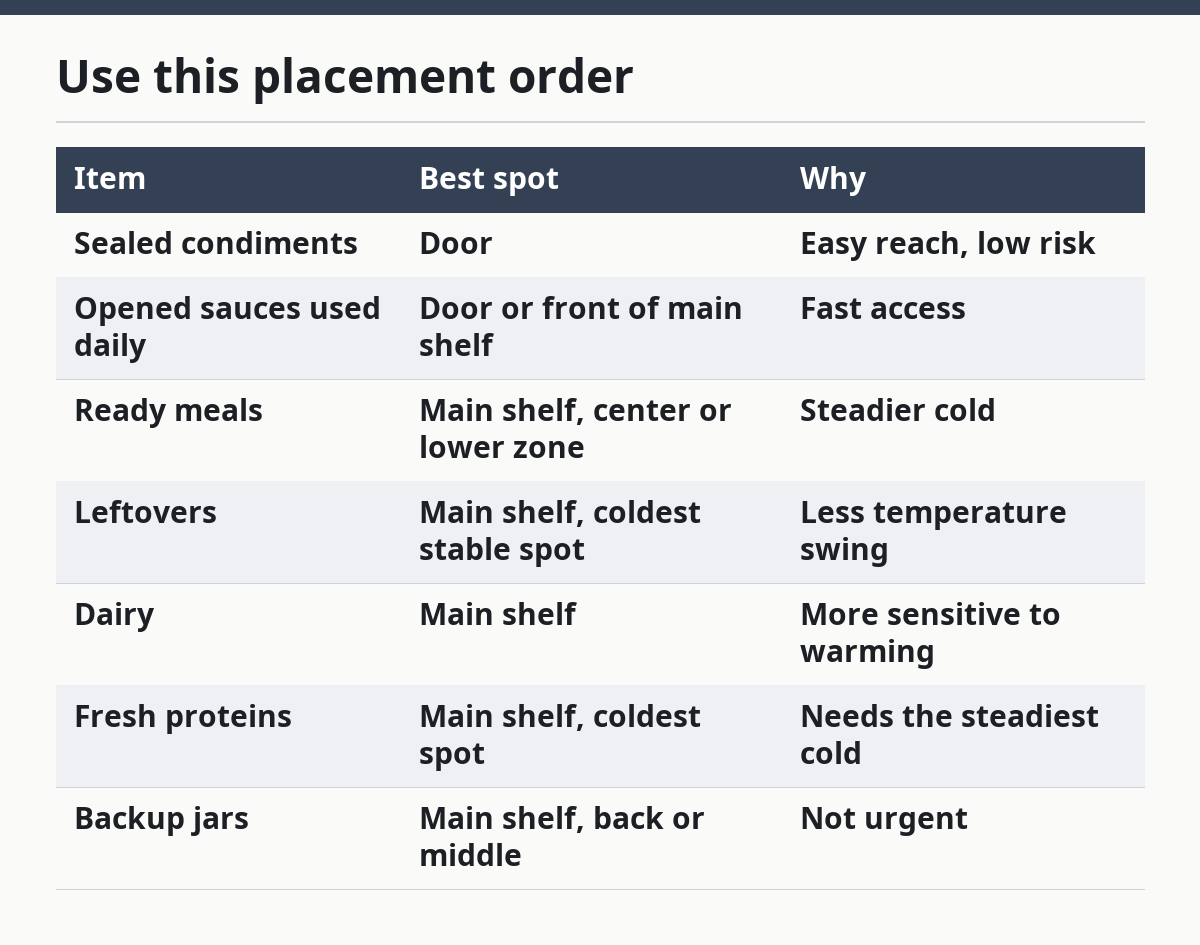
Use this placement order
| Item | Best spot | Why |
|---|---|---|
| Sealed condiments | Door | Easy reach, low risk |
| Opened sauces used daily | Door or front of main shelf | Fast access |
| Ready meals | Main shelf, center or lower zone | Steadier cold |
| Leftovers | Main shelf, coldest stable spot | Less temperature swing |
| Dairy | Main shelf | More sensitive to warming |
| Fresh proteins | Main shelf, coldest spot | Needs the steadiest cold |
| Backup jars | Main shelf, back or middle | Not urgent |
Now, build the habit in 3 moves:
- Clear one door shelf for daily items. Keep it shallow so you can see the whole row.
- Assign one main shelf section to low-histamine meals. Use containers that stack neatly and do not block air.
- Check the thermometer after 24 hours. If the door is too busy or the shelf is too warm, move items again.
A tray can help if small jars slide around, but don’t use a deep bin that hides food. Visibility matters because forgotten food is wasted food. A clear front row beats a clever system you can’t see.
Common mistakes that make the door the wrong place
The main mistake is treating the fridge door like a second shelf. It is not. It is the warmest, most disturbed zone in the fridge, and that makes it a poor home for anything temperature-sensitive.
Picture this: you tuck leftovers into the door because the center shelf looks crowded, then open the fridge 15 times that day. That shortcut costs you colder storage. The food may still be usable, but you have made its job harder for no good reason.
Watch for these errors
- Leftovers on the door. Cost: more temperature swing. Better move: put them on the main shelf, front and center.
- Half-used dairy on the door. Cost: warmer storage than needed. Better move: keep it on the main shelf.
- Too many backup jars on the door. Cost: clutter and lost visibility. Better move: store backups deeper.
- No thermometer. Cost: guessing. Better move: place a basic fridge thermometer where sensitive food sits.
- Tall bottles blocking smaller items. Cost: forgotten food behind them. Better move: keep the door shelf low and tidy.
Here’s the catch: the door is not “bad.” It is just the wrong place for the wrong food. If you use it for items that can handle the swing, it works fine. If you use it for ready meals and delicate food, it works against you.
This is also where people go wrong with low histamine food specifically. They focus on the ingredient list and forget the storage position. A good ingredient can become a poor fridge choice if it sits in the warmest spot for too long.
The best default setup if you only want one rule
A practical default is door for condiments, main shelf for everything else sensitive. That single rule is simple enough to follow on a tired night and strict enough to protect the foods that need steadier cold.
Picture this: you’re standing at an open fridge after work and just want the shortest rule that works. Use the door for sealed, frequent-use condiments and keep ready meals, leftovers, dairy, and proteins on the main shelf. If you need one sentence to remember, that is it.
This default is less useful for someone who stores mostly shelf-stable jars and almost no sensitive food. In that case, the main shelf can stay sparse, and the door may hold a bit more. But for a low-histamine fridge, the usual pattern is clear.
A good setup also changes with your fridge size. In a small fridge, the door fills quickly, so you need to be stricter. In a larger fridge, the main shelf can handle a better split between front and back zones. The rule stays the same; the amount of space you give each zone changes.
If you want the next step after placement, the hub on low histamine freezer and storage organization covers the broader system. This page is just the shelf decision—and that decision should now be simple.
Is the fridge door safe for all foods?
No, the fridge door is not safe for all foods. It is fine for sealed condiments, sauces, and other quick-use items, but it is a poor spot for leftovers, dairy, and fresh proteins because the temperature changes more each time the door opens.
Which items should stay on the coldest shelf?
Leftovers, ready meals, fresh proteins, and other temperature-sensitive low-histamine foods should stay on the coldest shelf. That spot gives them the steadiest cold and keeps them away from the warmer, more changeable door area.
What belongs in the front of the fridge?
Items you use often and need to see fast belong in the front of the fridge. Put daily condiments, opened sauces, and the next ready meal there, while keeping more fragile foods farther back on the main shelf where the cold is steadier.
Drafted with AI; not yet reviewed by a person.