Last updated: November 19, 2026
Quick Answer: The first-pass rule for Low Histamine Ingredient Selection and Label Reading — The Complete Guide is to choose plain, fresh, minimally processed foods and reject labels with fermented, aged, cured, smoked, or extract-based ingredients. In practice, that often means checking one package in under 1 minute and favoring foods with 5 or fewer ingredients.
Low histamine cooking gets easier when you learn which ingredients are usually the safest picks and which label clues mean “put it back.” This guide shows the shopping rules, the hidden ingredients, and the package terms that cause the most trouble, and it keeps the focus on Low Histamine Ingredient Selection and Label Reading — The Complete Guide from the first aisle to the checkout line.
The safest approach is often to choose plain, fresh, minimally processed foods and read labels for aged, fermented, cured, smoked, and extract-heavy ingredients, especially when you are trying to keep a meal under a short ingredient count.
Picture this: you’re in the aisle with a short grocery list and a food that looked fine last week suddenly did not. The guide below settles what to buy, what to skip, and how to scan a label in under a minute.
Key Takeaways
- Fresh, plain foods are usually easier to keep low histamine than packaged meals with long ingredient lists.
- Labels matter most for fermented, aged, cured, smoked, and extract-based ingredients, and it helps to check those choices with a clinician if you are managing symptoms or have multiple restrictions.
- “Natural flavors,” broths, vinegar, soy sauce, and yeast extracts are common trouble spots.
- A short ingredient list is helpful, but processing method matters just as much as ingredients alone.
- Frozen-at-peak foods often make more sense than “fresh” foods that sat around for days.
- If a label hides the source of a flavoring or broth, that is a warning sign.
- The safest shelf-stable items are often the ones with simple, named ingredients and no sauce packet, though individual tolerance still matters.
What low histamine ingredient selection actually means
Picture this: you’re holding two cartons of broth, both look plain, and both claim to be “simple.” One contains chicken, salt, and water. The other adds yeast extract, “natural flavors,” and celery extract. The first is easier to trust for low histamine ingredient selection because the source is clear and the additive load is low.
Low histamine shopping is not about chasing one perfect “allowed” list. It is about reducing the number of likely triggers: aging, fermentation, curing, smoking, slow storage, and mystery flavor systems. Those are the patterns that turn a short ingredient list into a bad bet.
The practical rule is simple:
- Pick foods that are fresh, frozen quickly, or plainly packaged
- Avoid foods that are aged, fermented, cured, smoked, or marinated
- Read beyond the front label and scan the full ingredient panel
- Watch for ingredients that hide a histamine-heavy process
Here’s the catch: a food can be “single ingredient” and still be a poor fit if it is old, smoked, or pre-seasoned. Freshness and processing beat marketing language every time.
The ingredients that are usually easier to choose
Picture this: you’re building a meal from scratch and want the least complicated path from cart to plate. The best low histamine picks are usually whole, plain foods with no sauce, no seasoning blend, and no long shelf life.
The cleanest choices tend to be:
- Fresh meat or poultry that is cooked soon after purchase
- Frozen meat, fish, fruit, or vegetables without sauce
- Plain rice, oats, quinoa, or millet
- Fresh apples, pears, blueberries, grapes, and melon, if tolerated
- Simple oils like olive oil or avocado oil
- Salt and herbs that are used alone, not in a blend
This is not because every item above is “safe” for every person. It’s because the label usually tells you what the food is, and nothing more.
A few practical notes help:
- Frozen can be better than “fresh” if the fresh version has sat in the case for days
- Plain grains are easier than flavored packets
- Single-ingredient oils are easier than dressings with vinegar, spices, and extracts
- Simple frozen vegetables often beat canned versions, which may include salt, acids, or flavoring
The truth is, a lot of food problems start after the farm. Storage, processing, and packaging are where low histamine diets get messy. Keep the ingredient panel short and the handling simple.
Which labels usually signal trouble?
Picture this: you’re turning a package around and seeing a wall of words you don’t cook with at home. That label is telling you the product went through more steps than a low histamine shopper usually wants.
The biggest warning signs are:
- Vinegar
- Yeast extract
- Soy sauce
- Miso
- Tempeh
- Kombucha
- Kimchi
- Sauerkraut
- Aged cheese
- Cured meat
- Smoked fish or meat
- Broth, stock, or bouillon with flavor enhancers
- Natural flavors
- Hydrolyzed protein
- Autolyzed yeast
- Protein isolate in a seasoned or flavored product
For a conservative approach, and especially if you are unsure how a specific ingredient affects you, it is reasonable to review these labels with a registered dietitian or clinician familiar with histamine intolerance.
Why these matter:
- Fermented foods can be high in biogenic amines
- Cured and smoked foods are common histamine traps
- Yeast and yeast extracts often show up in savory packaged foods
- “Natural flavors” can hide several ingredients that are not spelled out
- Hydrolyzed proteins are common in soups, seasonings, and snack foods, and they often travel with a more processed profile
Not every one of these ingredients is a problem in every case. Still, if you are trying to reduce histamine load, these are the first names to slow you down.
A useful habit: if the front says “savory,” “umami,” “smoky,” or “restaurant-style,” the back often tells the real story.
How do I read a label for low histamine foods?
Picture this: you have 45 seconds in the store and need a yes-or-no answer from the label. The fastest method is to read the ingredient list first, then the allergens, then the marketing claims on the front.
Here is the order that works best:
- Scan the ingredient list
- Look for fermentation, curing, smoking, or aging
- Check for sauces, flavorings, extracts, and broths
- Read the allergen statement for hidden soy, dairy, wheat, or fish
- Ignore front-of-pack claims until the back panel checks out
The first sentence on the package that matters is usually not the one in giant type. “Simple,” “clean,” and “natural” are marketing words. The ingredient panel is the evidence.
Use this quick filter:
- If there are 5 or fewer ingredients, keep reading
- If any ingredient sounds like a process, slow down
- If the food is shelf-stable but tastes like a meal, expect more additives
- If the label uses a generic term, ask what the source is
Examples of label clues that deserve attention:
- “Seasoning” can hide multiple components
- “Flavor” can mean more than one ingredient
- “Spices” is vague, though not always a problem by itself
- “Vegetable broth” may be fine or may be a salt-and-extract mix
- “Marinade” usually means extra acids, spices, and often vinegar
The best part is that you do not need to memorize every ingredient in the store. You need a short list of red flags and the patience to flip the package over before it goes in the cart.
The real difference between fresh, frozen, and packaged foods
Picture this: you’re choosing between a fresh chicken breast, a frozen one, and a pre-seasoned packet that promises dinner in 10 minutes. The frozen plain option usually wins because it gives you control without forcing you to gamble on age or sauce.
Here’s the cleanest comparison:
| Criteria | Fresh Plain Food | Frozen Plain Food | Pre-Seasoned Packaged Food | Winner for low histamine control |
|---|---|---|---|---|
| Ingredient clarity | Very high | Very high | Often low | Fresh plain food |
| Storage risk | Higher if it sits | Lower if frozen quickly | Variable | Frozen plain food |
| Additive load | Usually low | Usually low | Often higher | Fresh plain food |
| Convenience | Moderate | High | Highest | Pre-seasoned packaged food only for speed |
| Hidden acids/flavorings | Rare | Rare | Common | Frozen plain food |
| Cooking flexibility | High | High | Low | Fresh plain food |
| Best for beginners | Yes | Yes | No | Frozen plain food |
| Label complexity | Low | Low | High | Fresh plain food |
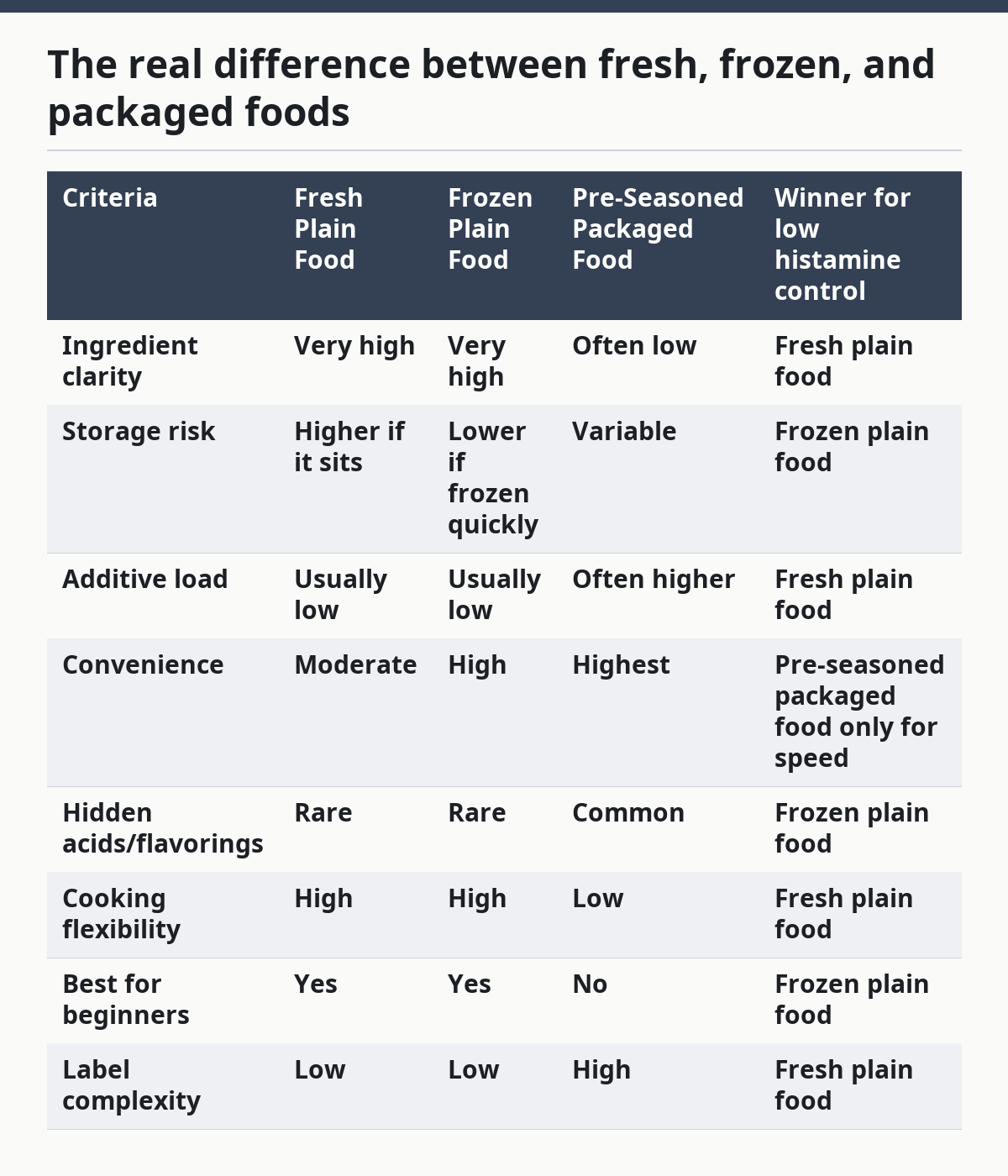
The position is simple: frozen plain food wins for most beginners because it reduces spoilage risk without adding a sauce packet, seasoning blend, or “natural flavors.” Fresh plain food can be great too, but it depends on how fast you cook it.
The downside is real. Fresh food can spoil fast, and some frozen foods come with hidden sauce, broth, or marinade. A frozen lasagna is not the same thing as frozen spinach.
What to buy instead:
- Plain frozen vegetables
- Plain frozen fruit
- Plain fish or meat with no seasoning
- Plain grains in dry form
- Unflavored oats and rice
What to skip:
- Anything with a sauce packet
- Anything “ready to heat” with a long ingredient list
- Anything that lists vinegar, soy, yeast extract, or flavor blends
Which grocery categories are easiest and which ones are risky?
Picture this: you’re planning a full week of meals, not just one dinner, and the grocery cart needs to stay predictable. Some categories are naturally easier because the package tells a simple story. Others hide the trouble in the processing.
The easiest categories are the ones where the ingredient list stays short and boring. The risky ones are the ones that depend on fermentation, aging, or flavor enhancement.
Easier categories
- Plain rice, oats, quinoa, millet
- Fresh or frozen fruit and vegetables
- Plain oils and salts
- Fresh meat, poultry, or fish cooked soon after purchase
- Eggs, if tolerated
Riskier categories
- Cheese, especially aged cheese
- Yogurt and kefir
- Vinegar-based condiments
- Deli meat and cured sausage
- Canned soups and stocks
- Sauces, dressings, and marinades
- Fermented vegetables and drinks
Why the split matters:
- A plain rice bag does not hide much
- A bottle of salad dressing often includes vinegar, sugar, flavorings, and emulsifiers
- A deli counter turkey slice may look plain but still be cured or flavored
- A soup can be built on stock, yeast extract, or tomato-heavy flavoring
Tomatoes are a separate issue for many people, and tolerance varies. The safer move is not to assume that a “light” or “healthy” label makes the food low histamine.
A good shopping cart is boring on purpose. That boredom is the point.
What about spices, herbs, and seasonings?
Picture this: you want food that tastes like food, not cardboard, and you’re staring at a spice rack with 20 bottles. Single herbs are often easier than blends because you can see exactly what you’re adding.
In general, plain herbs and single spices are easier to manage than mixed seasonings. The problem usually starts with blends, rubs, and seasoning packets that add garlic powder, onion powder, yeast extract, citric acid, or “natural flavor.”
Safer pattern:
- One herb at a time
- One spice at a time
- Simple salt
- Plain oil
- Fresh garlic or onion only if tolerated
Riskier pattern:
- Taco seasoning
- Poultry seasoning blends
- Soup base powders
- Marinade packets
- Everything-but-the-kitchen-sink rubs
Why single ingredients help:
- You can spot the trigger faster
- You can change one variable at a time
- You avoid hidden fillers and flavor enhancers
Here’s the catch: “spice” and “herb” are not automatically bad. The issue is dose, mix, and freshness. A tiny amount of cumin in a plain meal is a different story from a pre-mixed rub with six additives.
If you are sensitive, build flavor one ingredient at a time and keep a short list of what actually works for you.
What labels deserve a second look even if they seem harmless?
Picture this: you’ve found a carton that says “simple,” “organic,” or “all natural,” and the front feels reassuring. The back panel still needs a hard look because those words do not stop fermentation, aging, or flavoring.
The labels that often deserve a second look are:
- Natural flavors
- Spices
- Seasoning
- Broth
- Stock
- Flavoring
- Extract
- Marinated
- Smoked
- Aged
- Cultured
Why these words matter:
- They are broad enough to hide several ingredients
- They can point to processing that is less friendly for histamine reduction
- They do not always tell you the source or method
A package can be “organic” and still contain fermented ingredients. It can be “all natural” and still be loaded with vinegar, yeast extract, or broth concentrate. The label claim may be true and still be unhelpful.
Use this test:
- Can I name every ingredient?
- Can I tell how it was made?
- Does the food depend on fermentation, curing, smoking, or aging?
- Would I use these ingredients at home?
If the answer is no to any of those, the label needs more scrutiny.
One more thing: the shorter the ingredient list, the less room there is for surprise. That is not perfection. It is just better odds.
The honest side-by-side: build a low histamine cart or trust the front label?
Picture this: you’re deciding between two ways to shop. One takes a few more minutes but gives you control. The other is faster, but it depends on package promises that often hide the real ingredients.
The safer method is the one that starts with ingredients you can name yourself. The faster method is to trust front-of-pack language and assume the back panel will cooperate. That second method loses more often than it should.
| Criteria | Build from plain ingredients | Trust the front label | Winner for histamine control |
|---|---|---|---|
| Ingredient transparency | High | Often low | Build from plain ingredients |
| Speed at checkout | Slower | Faster | Trust the front label |
| Risk of hidden ferment ingredients | Lower | Higher | Build from plain ingredients |
| Risk of flavor enhancers | Lower | Higher | Build from plain ingredients |
| Meal flexibility | High | Low | Build from plain ingredients |
| Convenience | Moderate | High | Trust the front label |
| Best for beginners | Yes | No | Build from plain ingredients |
| Chance of hidden broth, vinegar, or extract | Lower | Higher | Build from plain ingredients |
The verdict is clear: build from plain ingredients if your goal is to reduce guesswork. Trusting the front label only works when the back panel is already short, specific, and free of the usual traps.
The drawback is obvious. This method takes more time, and it can feel repetitive. Still, the time buys you fewer surprises, and for low histamine shopping that matters more than slick packaging.
What should I do in the store when I only have one minute?
Picture this: you’re halfway through a grocery run, your phone battery is low, and you need a fast system that still works. The best one-minute method is the same every time: flip the package, read the ingredients, and reject anything with fermentation, aging, curing, smoking, or vague flavoring.
Use this store-floor checklist:
- Start with the shortest ingredient list
- Reject anything with vinegar, soy sauce, yeast extract, or broth
- Reject fermented, cured, smoked, or marinated foods
- Prefer plain frozen or plain fresh foods
- Pick products with named ingredients, not generic flavor systems
That keeps you out of trouble faster than trying to memorize every possible trigger. It also prevents the classic mistake: buying a product because the front says “simple” while the back lists seven processed additives.
A few quick examples:
- Plain oats: usually easy to assess
- Flavored yogurt: needs a closer look
- Crackers with “seasoning”: usually a red flag
- Plain frozen spinach: usually easier than a creamy spinach side dish
The catch is that speed shopping and histamine control do not love each other. Still, this checklist makes the trade-off manageable.
If a product is unclear, leave it on the shelf. That is not being picky. That is buying with a plan.
When should you avoid a product entirely?
Picture this: you have read the label, and the food still feels like a question mark. Some products are not worth the risk because their whole design depends on the exact ingredients low histamine shoppers try to avoid.
Avoid a product when it has one or more of these traits:
- It is fermented, aged, cured, or smoked
- It relies on broth, stock, extract, or flavoring
- It lists vinegar high on the panel
- It uses a seasoning blend instead of named ingredients
- It is a ready meal with a long shelf life and a short promise
Examples of foods that often fall into this bucket include aged cheese, deli meat, soy sauce, miso, sauerkraut, kombucha, and many packaged soups. Some people tolerate some of these in small amounts. Many do not. The label alone usually tells you enough to make a conservative call.
This is where a lot of readers get stuck: they want a clear yes or no from a package that was built to sound appealing. The honest answer is that some foods are not meant for a low histamine cart, and no amount of label reading changes that.
If the food’s main selling point is flavor intensity, it often has the wrong ingredient profile for this approach.
FAQ
What are the easiest low histamine ingredients to buy?
The easiest ingredients are usually plain, fresh, or frozen foods with very short labels. Rice, oats, plain fruits, plain vegetables, and unseasoned meat or fish are common starting points. The fewer processing steps, the easier it is to spot a problem.
Is “natural flavor” okay on a low histamine diet?
No clear rule makes “natural flavor” automatically safe. The term is broad and can hide ingredients or processes you may be trying to avoid. If the rest of the label is already complicated, I treat “natural flavor” as a reason to pause.
Are frozen foods better than fresh foods?
Sometimes, yes. Frozen plain foods can be better than “fresh” foods that have sat around or come pre-seasoned. The key is to choose frozen items with no sauce, no marinade, and no flavor packet.
Do I need to avoid all spices?
No. Single spices and herbs are often easier to manage than blends. The bigger problem is usually seasoning mixes, rubs, and packaged flavor packets that hide extra ingredients. Start simple and add one item at a time.
What is the biggest label red flag?
The biggest red flag is a product that depends on fermentation, curing, smoking, or flavor enhancers. Vinegar, yeast extract, soy sauce, broth, stock, and “natural flavors” are common clues that the food is more processed than it looks.
Sources
- U.S. Food & Drug Administration, Food Labeling & Nutrition: https://www.fda.gov/food/food-labeling-nutrition
- Cleveland Clinic, Histamine Intolerance: https://my.clevelandclinic.org/health/diseases/histamine-intolerance
- International Society of Allergy and Clinical Immunology (WAO/related guidance on food intolerance and symptom evaluation): https://www.worldallergy.org/
Drafted with AI; not yet reviewed by a person.