Last updated: November 20, 2026
The safest low histamine protein foods are usually very fresh meats, freshly cooked or frozen fish, eggs if you tolerate them, and a few plain plant proteins that do not sit around long. The main rule is freshness: histamine rises as food ages, especially in fish, leftovers, and anything cured, smoked, or fermented.
Key takeaways
- Freshness matters more than the protein label itself.
- Fish is the most timing-sensitive choice; leftovers are where trouble often starts.
- Eggs are simple for some people, but they are not automatic “safe” foods.
- Plant proteins can work well, but beans, soy, and fermented products are common trouble spots.
- If a food is aged, cured, smoked, pickled, fermented, or left in the fridge for days, treat it as a higher-risk choice.
What proteins are usually safest first?
The safest first choices are plain, fresh, simply cooked proteins with no marinade, no curing, and no long storage time. That usually means fresh chicken, turkey, lamb, beef, eggs for people who tolerate them, and fish that is cooked soon after purchase or kept frozen right away.
This is a practical answer, not a perfect one. Histamine intolerance is messy, and one person may react to chicken while another reacts to salmon or eggs. Still, the shortest path is to start with foods that are plain, fresh, and easy to trace.
A simple food safety rule helps here: the USDA says perishable food should not sit at room temperature for more than 2 hours, and fish should be kept cold quickly, because time and warmth raise risk. The FDA also treats fish as a food where handling and temperature matter a great deal. See USDA Food Safety and Inspection Service guidance on refrigeration and the FDA’s seafood safety pages for handling basics.
If the goal is a low-histamine plate, this is the order that usually makes sense:
- Freshly cooked meat with no sauce
- Eggs, if they are tolerated
- Fish cooked very soon after purchase, or frozen fish cooked from frozen
- Plain plant proteins with a short ingredient list
The part that gets missed most often is leftovers. A chicken breast can be a good choice on day one and a worse choice after a long stay in the fridge. For many readers, the “safe” protein is less about the species and more about how fast it reaches the pan.
Which meats are easiest to live with?
Fresh, plain meats are usually the easiest animal proteins to start with because they are simple, non-fermented, and easy to cook without extras. Chicken, turkey, beef, and lamb are the common starting points when the food is fresh and not processed.
The best fit is meat that is sold plain and cooked the same day or very soon after purchase. That gives the reader control over the ingredients and the storage time. A basic roast chicken breast or a plain turkey cut will usually be easier to manage than deli meat, sausage, bacon, salami, or anything smoked.
The weakness is storage. Meat that is pre-cooked, sliced, cured, marinated, or left as leftovers can become a problem even if it looked harmless at first. The label “natural” does not matter much if the food has vinegar, spices, yeast extract, or a long shelf life.
Meat also helps because it is easy to keep simple. A salt-only cooking method can be easier to tolerate than a spice rub with garlic, paprika, or chili. If a person is still figuring out triggers, the plain version is the cleaner test.
Avoiding these forms is usually wise:
- Deli meats
- Cured ham
- Sausage and hot dogs
- Smoked meats
- Meat in vinegar-based marinades
- Slow-cooked leftovers held for days
The real trade-off is convenience. Plain meat asks for more cooking and more planning, but it gives the most control. That is why it is a better fit for someone who wants a short ingredient list and can cook in batches without keeping food too long.
Why is fish the hardest protein to get right?
Fish is the hardest protein to get right because histamine can build fast when fish is not handled cold and quickly. Even a good fish choice can turn into a bad one if it is old, thawed too long, smoked, canned, or left over for days.
Freshness matters more with fish than with most meats. That is why many low-histamine plans treat fish as “buy it and cook it now” food, not “buy it and store it for the week” food. Frozen fish can be useful because freezing slows the problem, but the fish still needs careful thawing and quick cooking.
This is also where people get tricked by healthy-sounding choices. Tuna, mackerel, sardines, smoked salmon, and canned fish are common high-risk choices in low-histamine diets because they are older, processed, or both. A plain white fish cooked soon after purchase is usually a safer bet than a strongly flavored, shelf-stable option.
For handling, the FDA’s seafood safety guidance and USDA cold-storage advice both point in the same direction: keep fish cold, cook it promptly, and do not leave it out. If the fish smells strong, has been sitting too long, or came from a buffet or deli counter with an unknown timeline, skip it.
Fish works best for a reader who can cook it on the spot. It is a poor choice for anyone relying on meal prep for several days. If that is the setup, meat or a tolerated plant protein will usually be easier.
Do eggs belong on a low histamine plan?
Eggs can belong on a low histamine plan, but only if the person tolerates them. They are not fermented, cured, or aged, which makes them appealing, yet some people still react to eggs because of a true sensitivity or because eggs act as a personal trigger.
For a simple trial, plain eggs are the cleanest version. Boiled, poached, or lightly cooked eggs are easier to judge than a baked dish with sauces, cheese, or processed meat. If eggs cause symptoms, the reader should not treat that as a failure of the diet; it is just a sign that eggs are not a good personal fit.
The upside is convenience. Eggs are fast, cheap in the everyday sense, and easy to prepare without a long ingredient list. The downside is that they are not universally tolerated, and the yolk-versus-white question does not have one answer for everyone.
This makes eggs useful as a test food, not a rule. If a person has never had a problem with eggs, they can be a strong low-histamine protein option. If they have had any pattern of symptoms after eggs, the safer move is to leave them out and use another protein while the pattern is still being sorted out.
Which plant proteins work best?
Plain tofu, certain legumes, and some seeds can work, but plant proteins are less predictable than fresh meat because processing and fermentation change the risk. The best plant options are usually the least processed ones with the shortest ingredient list.
For many readers, the easiest plant choices are plain cooked lentils, beans, or peas if they are tolerated individually. Tofu may work for some people, but fermented soy products such as tempeh, miso, and soy sauce are usually poor choices on a low histamine plan. Nuts and seeds can be fine for some and irritating for others, so they belong in the “test carefully” bucket.
The biggest mistake is assuming plant-based means automatically safer. A hummus bowl with lemon, garlic, and tahini may look mild, but each of those ingredients can be a problem for someone with histamine issues. A simple lentil dish with salt and a tolerated oil is a better test.
Plant proteins are the best fit for someone who wants a meat-free option and can tolerate whole foods. They are not the best fit for a reader who reacts to legumes, soy, or spices. They also take more label-reading because many meat substitutes are full of yeast extract, flavorings, or fermented ingredients.
The honest side-by-side
Fresh meat wins for control, fish wins for quality only when timing is tight, eggs win for convenience if they are tolerated, and plant proteins win when the ingredient list stays very short. The right choice depends on how sensitive the reader is and how much cooking they can handle.
| Criteria | Fresh meats | Fish | Eggs | Plant options | Winner for [condition] |
|---|---|---|---|---|---|
| Ease of finding a plain version | High | Medium | High | Medium | Meats |
| Sensitivity to time in storage | Medium | Very high | Low to medium | Medium | Eggs |
| Best when cooked the same day | Yes | Yes, strongly | Yes | Yes | Fish |
| Best for meal prep | Medium | Poor | Medium | Medium | Meats |
| Most likely to include hidden additives | Medium | Medium | Low | High | Eggs |
| Most likely to be fermented or cured | Low | High in processed forms | Low | High | Meats or eggs |
| Best for a very short ingredient list | High | High | High | Medium | Meats or eggs |
| Best for a meat-free plate | No | No | No | Yes | Plant options |
| Best for people who need the simplest first trial | Yes | No | Maybe | Maybe | Meats |
| Most fragile choice in real life | No | Yes | No | No | Fish |
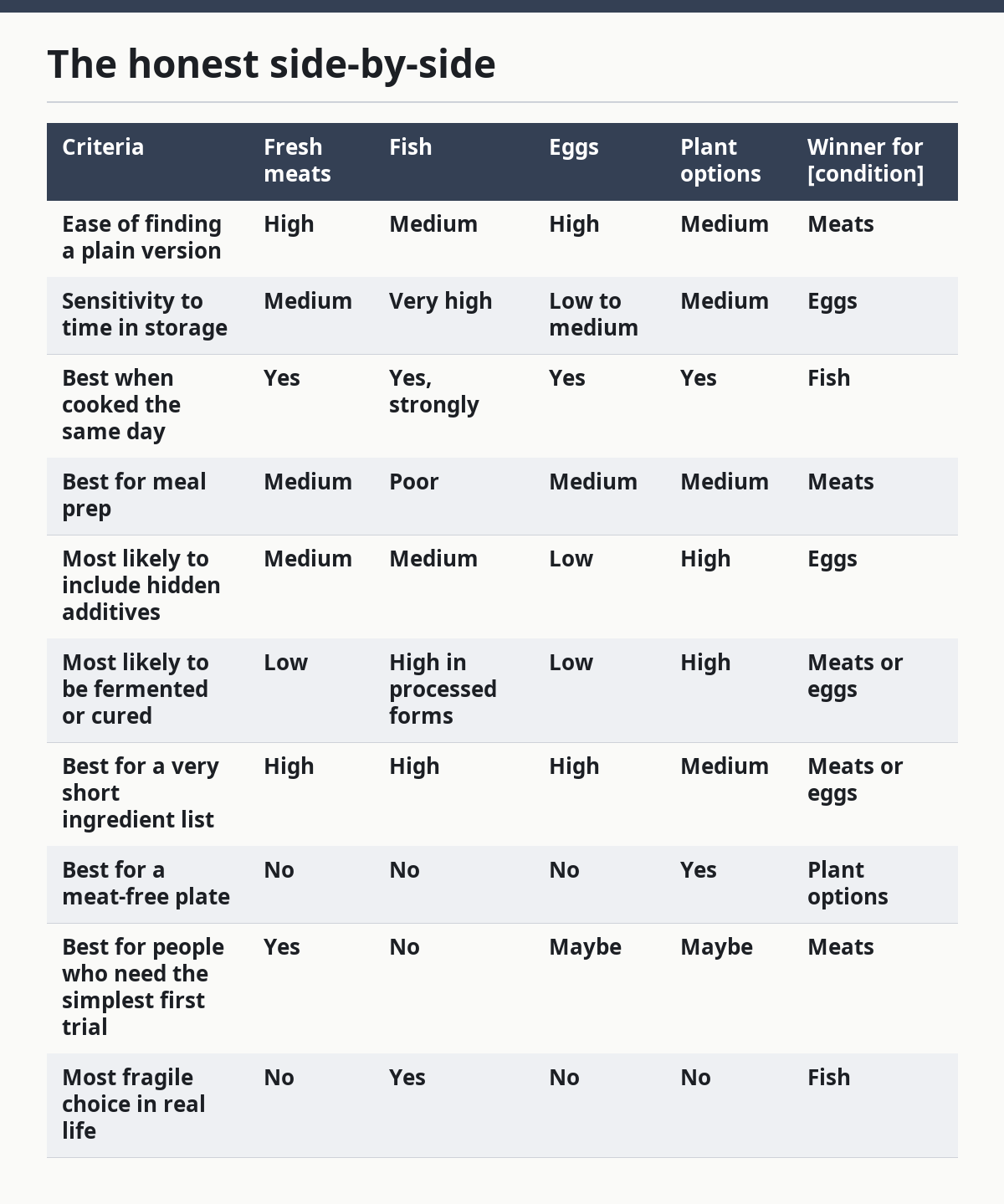
This table makes the call plain: if the reader wants the least complicated start, plain fresh meat usually wins. Fish only wins when the person can buy it fresh and cook it right away. Plant proteins are useful, but they need more label-checking than most people expect.
What makes a protein a bad fit even if it is “low histamine”?
A protein becomes a bad fit when it is aged, cured, smoked, fermented, heavily seasoned, or held too long after cooking. That is true even if the base food looked safe at the store.
The clearest warning signs are simple:
- Deli case meat
- Canned or smoked fish
- Vinegar-heavy marinades
- Soy sauce and miso
- Long-cooked leftovers
- Ready-made protein bowls with unknown sauces
These are not just minor details. They change the food from a plain protein into a mixed product with a higher chance of histamine trouble. A reader who keeps reacting after “healthy” meals should look at storage time and additives before blaming the whole food group.
One more point matters here: low histamine is not the same as low symptom. A person can eat a food that is technically lower in histamine and still react because of fat content, spice, temperature, or a separate food sensitivity. That is why a food diary helps more than guesswork.
What if histamine symptoms still show up?
If symptoms continue, the reader should cut the list back to one or two plain proteins and review storage, cooking, and add-ins before changing everything else. Sometimes the problem is not the protein source at all; it is leftovers, sauces, or a hidden fermented ingredient.
A practical reset is easier than a long food list. Pick one fresh meat, one tolerated starch, and one or two simple vegetables, then keep the rest steady for a short stretch. That makes it much easier to see which item is driving the reaction.
This is also the point where a clinician can help, especially if symptoms are frequent, severe, or confused with allergy. Histamine intolerance, food allergy, mast cell disorders, and other conditions can look alike from the kitchen side.
FAQ
Are eggs low histamine?
Eggs can be a low histamine option for some people, but they are not safe for everyone. Plain eggs are usually easier to judge than egg dishes with sauce, cheese, or processed meat.
Is fish okay on a low histamine diet?
Fish can be okay if it is very fresh, kept cold, and cooked promptly. Fish that is smoked, canned, or left over for long periods is a common problem food.
What meat is best to start with?
Plain fresh chicken, turkey, beef, or lamb is usually the easiest place to start. The best choice is the one that is unprocessed and cooked soon after purchase.
Are beans and lentils low histamine?
Beans and lentils can work for some people, but they are less predictable than plain meat. They are best tried in simple recipes with a short ingredient list, not in fermented or heavily seasoned dishes.
Why do leftovers bother me more?
Leftovers can bother people because histamine can rise as food sits, even in the fridge. If a food is tolerated fresh but not the next day, storage time is a likely reason.
Drafted with AI; not yet reviewed by a person.