Last updated: November 20, 2026
Quick answer: the safest practical window is 2 hours, or 1 hour in hot conditions, for packed low histamine meals. In Low Histamine Meal Packing and Portable Eating — The Complete Guide, the goal is not just “low histamine food”; it is food that stays low histamine long enough to reach your desk, car, school, or train without turning into a trigger.
Key takeaways
- Low histamine packing is mostly a timing job, not a recipe job.
- Freshly cooked food, fast cooling, and temperature control matter more than fancy containers.
- Cold meals fit most workdays better; hot meals help when you can keep a thermos truly hot.
- Leftovers are a common trap because histamine can rise as food sits, even in the fridge.
- A short, repeatable menu beats a perfect menu you cannot pack twice.
- If symptoms are severe, mixed, or unclear, a clinician or registered dietitian should help you sort food triggers from other problems.
What makes a packed meal low histamine?
A packed meal is low histamine when the ingredients are low risk, the food is fresh, and the storage time stays short. That means choosing foods that are less likely to build histamine, then handling them so they do not sit warm for long.
Histamine is a natural compound that can rise in some foods as they age, ferment, or stay in the danger zone for too long. That is why a “safe” chicken bowl can become a problem if it was cooked yesterday, cooled slowly, and left in a bag for hours. For people with histamine intolerance or a sensitive mast-cell pattern, the meal often matters as much as the ingredient list.
The simplest rule is this: pack food that was cooked or prepared recently, keep it cold at 40°F or below, or keep it hot if the container can truly do that, and eat it within a safe time window. The FDA’s food safety guidance says perishable food should not sit out more than 2 hours, or 1 hour when the temperature is above 90°F, which is a useful floor for packed meals. For more on safe holding temperatures, the FDA and USDA food safety pages are worth reading: FDA food safety guidance and USDA food safety and inspection guidance.
The hidden mistake is assuming “low histamine” means only skipping a few foods. It also means avoiding old leftovers, long transport times, and slow cooling. A meal can look clean on paper and still be a bad bet at lunchtime.
Which portable eating setup works best?
A cold pack wins for most people because it is easier to keep food out of the danger zone, while a thermos wins when the meal is meant to stay hot and can stay hot all the way through lunch. The right setup depends on whether you can control temperature for the full trip.
| Criteria | Cold pack lunch | Thermos meal | Winner for this condition |
|---|---|---|---|
| Food safety margin | Strong if kept at 40°F or below | Strong only if it stays properly hot | Cold pack for long, unpredictable commutes |
| Meal variety | Very high: bowls, salads, wraps, yogurt alternatives if tolerated | Narrower: soups, stews, rice, soft vegetables | Cold pack for more menu options |
| Texture after storage | Crisp foods stay better | Soft foods hold best | Cold pack for crunch; thermos for comfort foods |
| Prep speed | Fast if using a batch of fresh components | Fast if the whole meal suits one vessel | Tie |
| Leak risk | Moderate, depending on dressing and sauces | Low if lid seals well | Thermos for thin liquids |
| Best travel length | Good for a workday with ice packs | Good for a short trip if preheated well | Cold pack for uncertainty |
| Eating ease | Easy to portion and assemble | One-container eating, less assembly | Thermos for one-handed meals |
| Risk of boredom | Lower because the structure changes easily | Higher because one format repeats | Cold pack for variety |
| Biggest drawback | Needs ice packs and a cooler bag | Can fail if it loses heat before lunch | Cold pack if no fridge access |
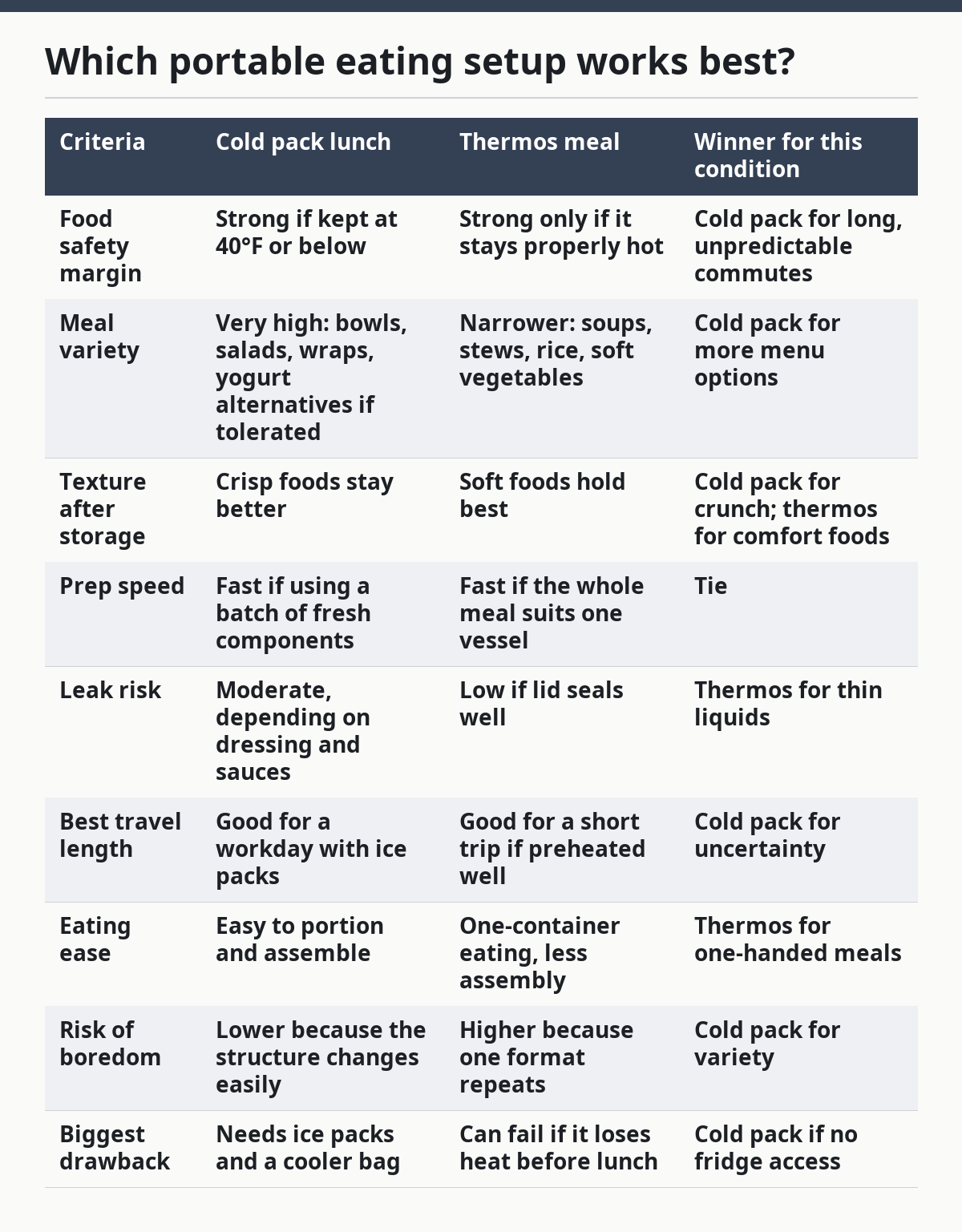
The cold pack setup is the safer default for many people because it gives more room for ingredient variety and less chance of a warm surprise. A good insulated bag with an ice pack is usually the easiest answer for office days, school runs, and car commutes. The trade-off is that wet foods and dressings can get messy unless they are packed separately.
The thermos setup wins when you want a hot meal and you can keep it hot from kitchen to table. That means preheating the thermos, filling it with a meal that holds heat well, and avoiding a container that loses temperature in 30 minutes. If the food will be lukewarm by noon, the thermos may not have done the job well enough for a low histamine lunch.
What should go in the bag first?
The first things in the bag should be temperature controls, then the food, then the extras. If you pack the ice pack or hot thermos last, you are already making the meal more fragile.
For a cold meal, start with an ice pack in the bottom or side of the bag, then add the sealed main box, then the dry add-ons. Keep the bag small enough that the contents stay tight together. A big half-empty bag holds warm air, and warm air shortens the safe window.
For a hot meal, preheat the thermos with hot water for several minutes before filling it. Then put the cooked meal in while it is still hot enough to keep the container warm. If the meal has separate parts, pack the driest item in the thermos and keep toppings or sauces in a smaller side container.
The simplest packing sequence is:
- Chill or cook the food quickly.
- Portion it into one lunch-sized container.
- Add a separate small container for dressing, oil, or salt.
- Put in an ice pack or preheated thermos.
- Place the whole setup in an insulated bag.
- Eat it within the same day.
That sequence sounds plain, but it solves the real failure points. Most portable meal problems come from heat, moisture, and time, not from the main ingredient list. A plain chicken-and-rice box can be a fine low histamine lunch at 11:30 a.m. and a poor choice at 2:30 p.m. if it sat on a desk.
Which foods pack well without turning tricky?
The best low histamine portable foods are usually plain, simple, and stable for a few hours, while the worst are aged, fermented, leftover-heavy, or saucy. That is the blunt version, and it is the one that helps most.
Freshly cooked proteins, plain rice, potatoes, and many simple vegetables are often easier to manage than cured meats, aged cheese, vinegar-heavy dressings, or slow-cooked leftovers, but individual tolerance varies, so it is wise to consult a clinician or registered dietitian if symptoms are severe or unclear. The exact trigger list varies from person to person, which is why a food diary can matter more than an internet chart. A meal that is fine for one reader may be a problem for another within the same day.
A practical low histamine lunch often looks boring on purpose:
- freshly cooked chicken or turkey, if tolerated
- rice or potatoes
- cucumber, carrots, or other simple vegetables, if tolerated
- olive oil, salt, or a tolerated herb
- fruit that the person already knows is safe
The thing to avoid is stacking too many “maybe” foods in one container. A lunch with chicken, tomato, avocado, fermented sauce, and leftover grains may be too much guesswork. A lunch with one protein, one starch, and one vegetable tells you far more about what your body is reacting to.
If you want more variety, change the shape, not the risk level. Turn the same basic ingredients into a bowl one day, a wrap the next, and a cold potato salad with a simple oil dressing on a third day. The menu changes enough to stay interesting without turning into a chemistry project.
How do you keep histamine from creeping up during the day?
You keep histamine risk down by shortening the time between cooking and eating, cooling food fast, and avoiding repeat reheating. That is the part many generic low histamine articles miss.
Food safety rules and low histamine goals overlap, but they are not identical. A food can be technically safe to eat and still be a bad fit for someone who reacts to older food. That is why batch-cooking for three days can backfire even if the fridge is cold enough. The longer the food sits, the more likely it is to cause trouble for a sensitive person.
A few habits matter a lot:
- Cook in smaller batches.
- Cool leftovers quickly in shallow containers.
- Freeze extra portions soon after cooling if you know you will not eat them right away.
- Reheat once, not again and again.
- Keep sauces separate until the meal is about to be eaten.
That last point matters because sauces are where many “healthy” lunches go wrong. Tomato-based sauces, vinegar, mustard, soy sauce, and fermented add-ins can all be difficult for some people. A clean oil-and-salt dressing is often easier to manage than a bottled mix with a long ingredient list.
The drawback is obvious: this way of eating takes more planning than grabbing whatever is in the fridge. If your schedule is chaotic, choose a smaller rotation of meals and repeat them. A short list you can actually execute beats a long list you never pack.
What do you do when you only have 10 minutes in the morning?
You use a repeatable 10-minute pack routine and stop trying to invent lunch before coffee. The goal is not culinary variety; it is a lunch you can trust on a bad morning.
The easiest routine is a three-part template:
- one fresh protein
- one starch
- one vegetable or tolerated fruit
If the protein is already cooked, the morning job is only assembly. If it is not cooked, make the protein the night before and cool it fast. A real low histamine plan is built around future you, not ideal you.
Here is a practical decision rule:
- If you have a fridge at work, pack a cold meal.
- If you do not have a fridge, use an insulated bag and ice pack.
- If the day includes a long car ride, choose a thermos or plan a meal that can be eaten within the same safe window.
- If you are symptom-sensitive after lunch, choose the blandest version first and test one change at a time.
A 10-minute routine works best when the container setup is the same every day. One main box, one small sauce cup, one ice pack, one spoon or fork. If your packing system changes every morning, you are adding friction you do not need.
The honest downside is monotony. Repeating the same lunch 4 or 5 days a week can feel dull. That is a small price compared with guessing at lunch and spending the afternoon trying to remember what you ate.
What are the biggest mistakes people make?
The biggest mistake is treating leftovers like fresh food, and the second biggest is trusting a container instead of the clock. A good lunch box cannot rescue old food.
Here are the most common errors:
- packing food that was cooked too long ago
- letting the bag sit in a warm car
- using one large container with no cooling help
- pouring dressing in too early
- packing a meal that is already borderline for the person’s trigger list
- reheating the same portion more than once
One especially common trap is “healthy meal prep” built on Sunday and eaten all week. That system works for some people and fails badly for others with histamine issues. If symptoms flare on day 3 or day 4, the timing may be the problem, not the ingredient.
Another mistake is forgetting that drinks matter. Fermented drinks, aged teas, and some flavored bottled drinks can be part of the trigger pattern. A plain water bottle is often the most practical portable drink choice, even if it is boring.
The fix is not perfection. It is shorter storage, fewer ingredients, and a container plan that matches the commute. If lunch must survive a 2-hour train ride and another 2 hours on a desk, the food choice has to be stricter than if you are eating at home 15 minutes after packing.
When does the plan need to change completely?
The plan needs to change completely if symptoms stay unpredictable, if food reactions are severe, or if the meal prep burden is making eating harder instead of easier. At that point, the issue may be bigger than “low histamine lunch ideas.”
Choose a different approach if any of these are true:
- you react to many foods, not just a few
- you cannot keep meals cold or hot long enough
- your workday makes timing unreliable
- you need medical guidance to sort out allergy, intolerance, or another cause
- meal prep is leading to skipped meals or anxiety around food
A clinician or registered dietitian can help sort out whether the problem is histamine intolerance, a separate food allergy, reflux, IBS, or something else. That matters because the wrong label leads to the wrong food list, and the wrong food list leads to more frustration.
Sometimes the real answer is not “more packing tricks.” It is a simpler schedule, a workplace fridge, a different lunch break, or a short elimination plan supervised by a professional. If the portable food system is making daily life worse, that is a signal to simplify, not push harder.
What is the best low histamine portable eating setup?
The best low histamine portable eating setup is the one you can repeat safely every day, not the one that sounds smartest on paper. For most people, that means a cold lunch in an insulated bag with an ice pack, built from freshly cooked food and eaten the same day.
A thermos wins when the meal really needs to stay hot and the container can hold that heat long enough to matter. A cold pack wins when you need more food variety, better texture, and fewer temperature worries. If the food will sit warm, travel too long, or stay in the bag until late afternoon, neither setup is good enough.
The practical rule is simple: choose the setup that matches your commute and your symptoms, then keep the menu plain enough to repeat. Low histamine eating is much easier when the container plan is boring and the food is fresh.
Can I pack leftovers for lunch if they are still cold?
Yes, but only if “leftover” still means fresh enough for your body and the food was cooled and stored well. For many people with histamine issues, the problem is not spoilage; it is the age of the food and how many times it has been handled.
If you know leftovers trigger you, freeze extra portions soon after cooling and reheat once when needed. If you tolerate leftovers, keep the storage time short and the cooling fast. A lunch made from yesterday’s food may work for one person and fail for another, so your own pattern matters more than a generic list.
Do I need a thermos for low histamine meals?
No, a thermos is useful, but it is not required. A cold lunch in an insulated bag is often easier to manage and gives you more meal choices.
A thermos helps when you want soup, stew, rice, or another warm meal and can keep it hot all the way to lunch. If it loses heat fast, it stops being a benefit. For many people, the cold setup is the more reliable choice because the temperature target is simpler.
What is the safest rule if I only remember one thing?
Use the 2-hour rule and keep food either cold or hot the entire time. If the food has been out too long, sat in a warm car, or drifted into “maybe okay” territory, do not assume it is still a good low histamine choice.
That one rule will not solve every trigger problem, but it removes the biggest portable eating risk. The shorter the time between cooking and eating, the better the odds that the meal stays both safe and tolerable. If symptoms are complex, get professional advice before making the menu more restrictive.
Drafted with AI; not yet reviewed by a person.