Last updated: November 20, 2026
Key Takeaways
- A use-first shelf gives short-date foods one fixed home, so you stop searching the whole fridge first.
- Keep the shelf to one layer when you can.
- Put the items at highest risk of being missed on that shelf.
- Pair the shelf with a front-of-shelf rule and one reminder you can see in under 2 seconds.
A use-first fridge shelf is the core of How to Keep a Low Histamine Fridge Shelf for Ingredients You Need to Use First because it keeps short-dated ingredients in one visible spot so you use them before they slip into the back and get forgotten. Put the soonest-to-spoil items in front, in one shelf zone, with a clear label and one simple rule: use these first. The steps below settle what to put there, how to mark it, and how to keep it from turning into a junk pile. For food safety, follow your own label dates and storage plan, and see the FDA and USDA guidance on refrigerated foods and leftovers.
What a use-first shelf does for low histamine food
A use-first shelf gives your short-date foods a fixed home, so you stop hunting through the whole fridge for the items that need attention first. It is not a full fridge system; it is a priority placement zone for open packages, leftovers, and ingredients that should be used within 1 to 3 days based on their own label or your storage plan.
Picture this: you open the fridge at 7 p.m., need dinner fast, and see three items that all need action. A use-first shelf makes that choice obvious. The foods on that shelf are the ones you grab before anything tucked behind them. If you mix it with everything else, it stops working. For low histamine food storage, this matters because the shelf must stay separate from long-life items.
Use this shelf for:
- Open packages that need quick attention
- Short-dated ingredients with a known “use by” or “best before” date
- Foods that you plan to finish within the next 24 to 72 hours
- Items you want to keep visible instead of buried behind milk or jars
Do not use it for:
- Long-life staples that can sit for weeks
- Random overflow from the pantry
- Foods with no clear plan for use
For low histamine food storage, that distinction matters more than fancy bins. A shelf only works if it stays obvious, and the American Academy of Allergy, Asthma & Immunology notes that food management works best when the system is clear and consistent.
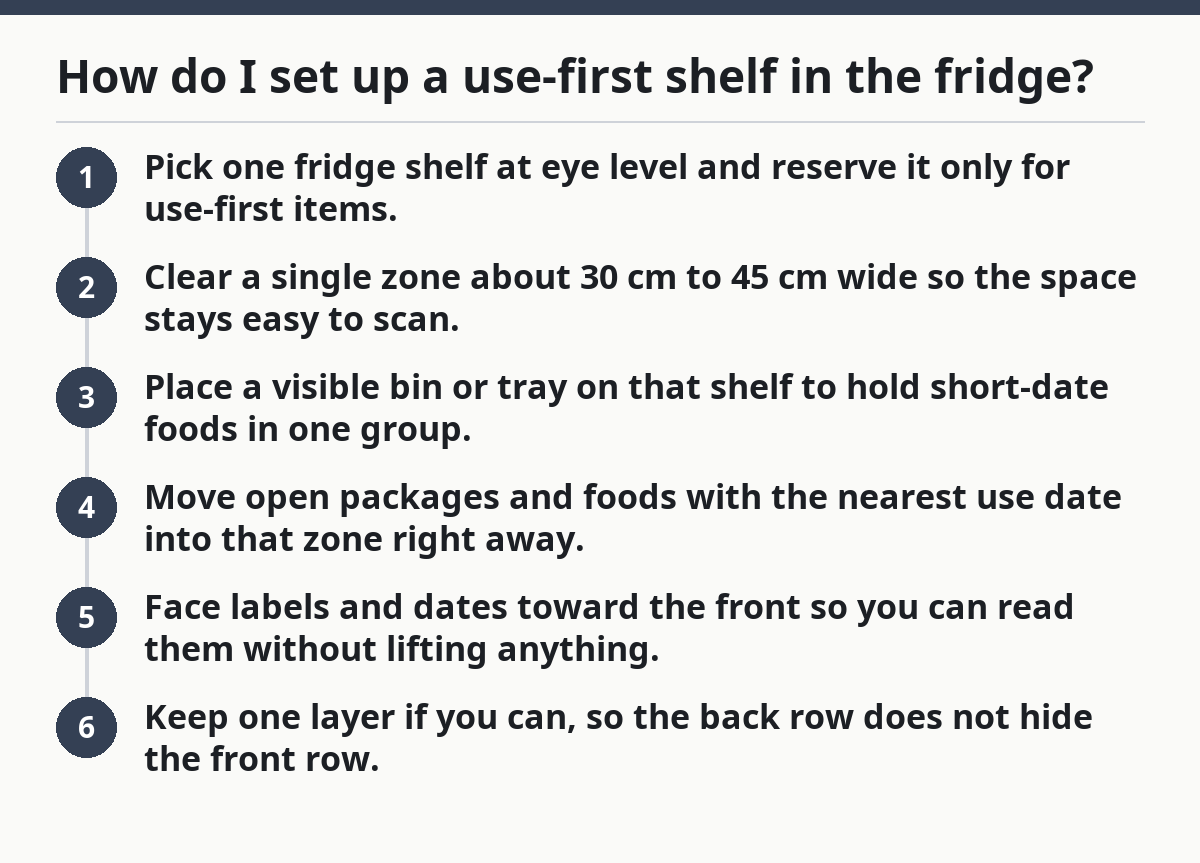
How do I set up a use-first shelf in the fridge?
Set up a use-first shelf by choosing one shelf at eye level, clearing a 30 cm to 45 cm wide space if your fridge allows it, and making that space the only place for ingredients you need to use soon. Keep the shelf one layer deep if possible. That way, nothing hides behind anything else.
Picture this: you are standing with a container in one hand and the fridge door open in the other. You need a spot that tells your brain, in one glance, “use this first.” That spot should be easy to reach, not down near the crisper where you forget what is there. A shelf at eye level is often the easiest to use.
Follow these steps:
- Pick one fridge shelf at eye level and reserve it only for use-first items.
- Clear a single zone about 30 cm to 45 cm wide so the space stays easy to scan.
- Place a visible bin or tray on that shelf to hold short-date foods in one group.
- Move open packages and foods with the nearest use date into that zone right away.
- Face labels and dates toward the front so you can read them without lifting anything.
- Keep one layer if you can, so the back row does not hide the front row.
A shallow bin works better than a deep one because deep bins invite stacking. If your shelf is narrow, skip the bin and use a plain tray. The result should be a shelf that looks full of purpose, not full of mystery. USDA FoodKeeper and FDA food storage guidance both support clear date awareness and prompt use of refrigerated foods.
What belongs on the shelf first?
The shelf gets the foods that will cost you the most if they get missed. That means short-dated ingredients, open packages, and anything you already know will be used in the next 1 to 3 days. On a low histamine plan, that usually means the foods you opened first should sit in front first.
Picture this: you have cooked rice, an opened carton of milk, half a cucumber, and a container of leftover chicken in the same fridge. You do not need a complex system; you need a simple order. The foods with the shortest remaining life go on the use-first shelf before the rest of the fridge gets touched.
Use this priority order:
- Foods with a clear use-by date nearest to today
- Open packages that have already been started
- Leftovers you plan to finish within 24 hours
- Ingredients that are easy to forget because they are small or tucked into a bag
- Anything labeled for use soon in your own notes
If a food has an allergen tag, keep that visible too. Keep dairy, egg, wheat, soy, fish, shellfish, peanuts, and tree nuts easy to identify when they are present. If you use an allergen-friendly substitute — for example, oat milk instead of dairy milk, or sunflower seed butter instead of peanut butter — keep the substitution label on the front. A good shelf does not make you guess.
This shelf helps even when you are tired. It removes decision friction.
How do I stop forgetting ingredients in the refrigerator?
You stop forgetting ingredients by pairing the shelf with a front-of-shelf rule and one visual reminder that you can see in under 2 seconds. The trick is not memory; it is placement. If the item is in back, it vanishes. If it is in front, it stays in your face.
Picture this: you open the fridge after work, grab nothing, and close it again because the useful things were hidden. A reminder fixes that better than another note on the counter. The reminder should be tied to the shelf, not the whole fridge, so it points your eyes to one zone. The FDA recommends keeping refrigerated foods properly stored and checked so they are used before they spoil.
Use one or more of these:
- A bright label on the bin that says USE FIRST
- A strip of removable tape on the shelf edge
- A dry-erase note on the fridge door that points to the shelf
- A small card listing the next 2 or 3 items to finish
Keep the reminder simple. If it takes more than one glance, it is too much. A bright label beats a long checklist because it works at a distance.
Avoid these mistakes:
- Writing tiny dates you cannot read
- Using a deep bin that buries the oldest item; if that keeps happening, consider a shallower tray or ask a food safety professional for storage advice
- Putting the shelf next to regular storage, then treating it like overflow
- Leaving empty containers on the shelf after the food is gone
Those mistakes cost you attention. The fix is small: clear the empty container the same day, and reset the shelf in under 5 minutes.
A simple label system that actually gets used
A label system works when it tells you what, when, and why in one look. For a low histamine fridge shelf, the label needs to show the food name and the date or time you plan to use it. You do not need a fancy template; you need a label that survives cold, moisture, and a rushed hand.
Picture this: you are holding a container with one hand and a marker with the other. You want to write something that will still make sense two days later. That means short words, big print, and a date format you use every time. Pick one format and stick with it.
Use this format:
- Food name
- Use by date
- Optional note: first meal, lunch, or tonight
Example:
- Chicken soup — 11/10 — tonight
- Rice — 11/11 — lunch
- Oat milk — 11/12 — first
A label also helps with mixed foods and substitutions. If a recipe includes milk, egg, or nuts, write that on the front if the ingredient is easy to miss. That matters if you are avoiding a common allergen and need a quick visual check.
Do not write a full paragraph. A full paragraph gets ignored. One line gets used.
What mistakes make a use-first shelf fail?
A use-first shelf fails when it becomes storage instead of a decision tool. The biggest mistake is overloading it. Once there are too many items, the shelf stops signaling urgency and starts looking like any other shelf. That is why a one-shelf zone beats a whole-fridge approach.
Picture this: you start with one tray for short-date foods, then add a carton, then a jar, then “just one more thing.” A week later the shelf tells you nothing. The point is to keep the shelf small enough that you can scan it in one glance.
Common mistakes and the cost:
- Too many items — the urgent foods disappear in clutter
- No front-facing labels — you miss dates and repeat purchases
- Mixed categories — a use-first item sits beside long-life food and gets ignored
- No reset habit — empty containers stay there and block the next round
The fix is not more space. It is a reset. Every time you put away groceries, spend 2 minutes checking what moved into the use-first zone. If the shelf is already crowded, move the least urgent item out, not the most urgent one in.
On the flip side, a shelf that stays half-empty is easier to trust. Empty space is useful here.
How to keep the shelf useful week after week
You keep the shelf useful by resetting it at two moments: when groceries come in and when the fridge gets a quick evening check. That rhythm keeps the shelf tied to real use, not wishful thinking. A short reset beats a long cleanup once the food is already forgotten.
Picture this: Sunday groceries arrive, and the fridge is half full already. You need a fast way to decide what goes on the shelf now and what can wait. The shelf should always hold the items with the nearest deadline, not the newest purchase. That sounds simple, and it is.
Use this weekly pattern:
- Move the newest short-date items into the shelf first
- Check for anything that now needs to be used within 24 to 72 hours
- Pull out foods that no longer need the prime spot
- Clear empty packaging right away
- Refresh the label if the use date changes
If you share a kitchen, keep the rule visible. A paper note on the shelf edge or bin works better than a verbal reminder that gets missed. This is also where the shelf supports the larger low histamine food storage and leftovers system: the shelf handles urgency, while the rest of the fridge handles ordinary storage.
The verdict is simple: a use-first shelf works when it stays small, visible, and boring. Boring is good.
What is a use first shelf in the fridge?
A use first shelf is one shelf zone set aside for foods you need to use before the rest. It keeps short-date ingredients, open packages, and other urgent items in one visible place. The point is not storage capacity; it is speed of access.
How do I organize foods I need to use soon?
Put the soonest-to-use foods in one shelf zone, face the labels forward, and keep the pile shallow. Use a bin or tray if it helps, but do not stack so high that the back row disappears. A shelf that takes 2 seconds to scan is doing its job. The USDA FoodKeeper app can help you check storage and use timelines.
How do I stop forgetting ingredients in the refrigerator?
Use one bright reminder and one shelf rule. Put the urgent foods in the same front area every time, then mark that area with a clear label such as “USE FIRST.” If you change the spot, you will forget it again. Consistency matters more than cleverness.
Drafted with AI; not yet reviewed by a person.