Last updated: November 20, 2026
A DMCA policy is the page that tells people how to report copyright infringement, what details a notice must include, and what happens after a takedown request. Quick answer: a DMCA policy should give users a clear reporting path, name the copyright contact, and explain the 5 core notice details a valid DMCA notice usually needs. For most site owners, the real question is not “Do I need one?” but “What must it say so a notice is taken seriously?” I can judge that question against the DMCA rules in 17 U.S.C. § 512 and the U.S. Copyright Office guidance, not guesswork.
Key takeaways
- A DMCA policy is a process page, not a promise to remove everything people complain about.
- A proper notice needs enough detail to let the host find the material and verify the claim.
- A weak notice can stall the removal process, while a sloppy counter-notice can restore content.
- The DMCA is mainly for copyright claims, not for defamation, privacy complaints, or bad reviews.
- If a site hosts user uploads, a missing or vague policy can make the response process messy fast.
What is a DMCA policy?
A DMCA policy is a public notice that explains how a site handles copyright complaints under the Digital Millennium Copyright Act. On a practical level, it tells users where to send a takedown notice, what facts to include, and what the site will do after it receives one.
The legal backbone is in 17 U.S.C. § 512, and the U.S. Copyright Office keeps guidance on DMCA notices here: U.S. Copyright Office DMCA page. A generic “send us a message” page is not enough if the site wants a clean process for copyright claims, and a copyright policy page can help organize that process.
A good policy is not long for the sake of length. It should name the copyright contact path, explain that the complaint must identify the work and the allegedly infringing material, and warn that false claims can carry consequences. That is the part many generic articles miss: the policy protects the host as much as the rights holder, and it works best when paired with a clear terms of service page.
What must a DMCA notice include?
A valid DMCA notice must include enough facts to identify the copyrighted work and the material that is claimed to infringe it. The U.S. Copyright Office explains that a notice generally needs the copyrighted work, the location of the material, contact details for the complaining party, a good-faith statement, and a statement under penalty of perjury that the complaint is accurate.
If any of those pieces are missing, the notice can be delayed or rejected. That matters because people often send a short message like “remove this image” and expect instant action. A host that follows the statute will usually need more than that, and a DMCA notice template can help people gather the required details before they file.
Here is the core distinction:
| Criteria | DMCA notice | Ordinary platform report or direct request | Winner for this condition |
|---|---|---|---|
| Legal basis | Copyright law under 17 U.S.C. § 512 | Site rules or customer support policy | DMCA notice for copyright claims |
| What it targets | Alleged infringement of copyrighted work | Many issues, including spam or policy violations | Platform report for non-copyright issues |
| Detail required | Specific work, URL, contact info, good-faith statement, perjury statement | Often less formal | Platform report for simple moderation issues |
| Speed of action | Can trigger formal review if complete | Depends on the site’s own queue | Platform report for routine housekeeping |
| Risk of false claim | Higher, because the statement is formal | Usually lower | Platform report if the issue is not copyright |
| Counter-response | Counter-notice process may apply | Usually no formal counter-notice | Platform report if you want less legal formality |
| Best use | Unauthorized copying of text, images, video, or audio | Harassment, spam, broken posts, policy violations | Depends on the problem |
| Weakness | Easy to botch if the facts are thin | May not produce a copyright-specific remedy | Platform report for non-copyright cases |
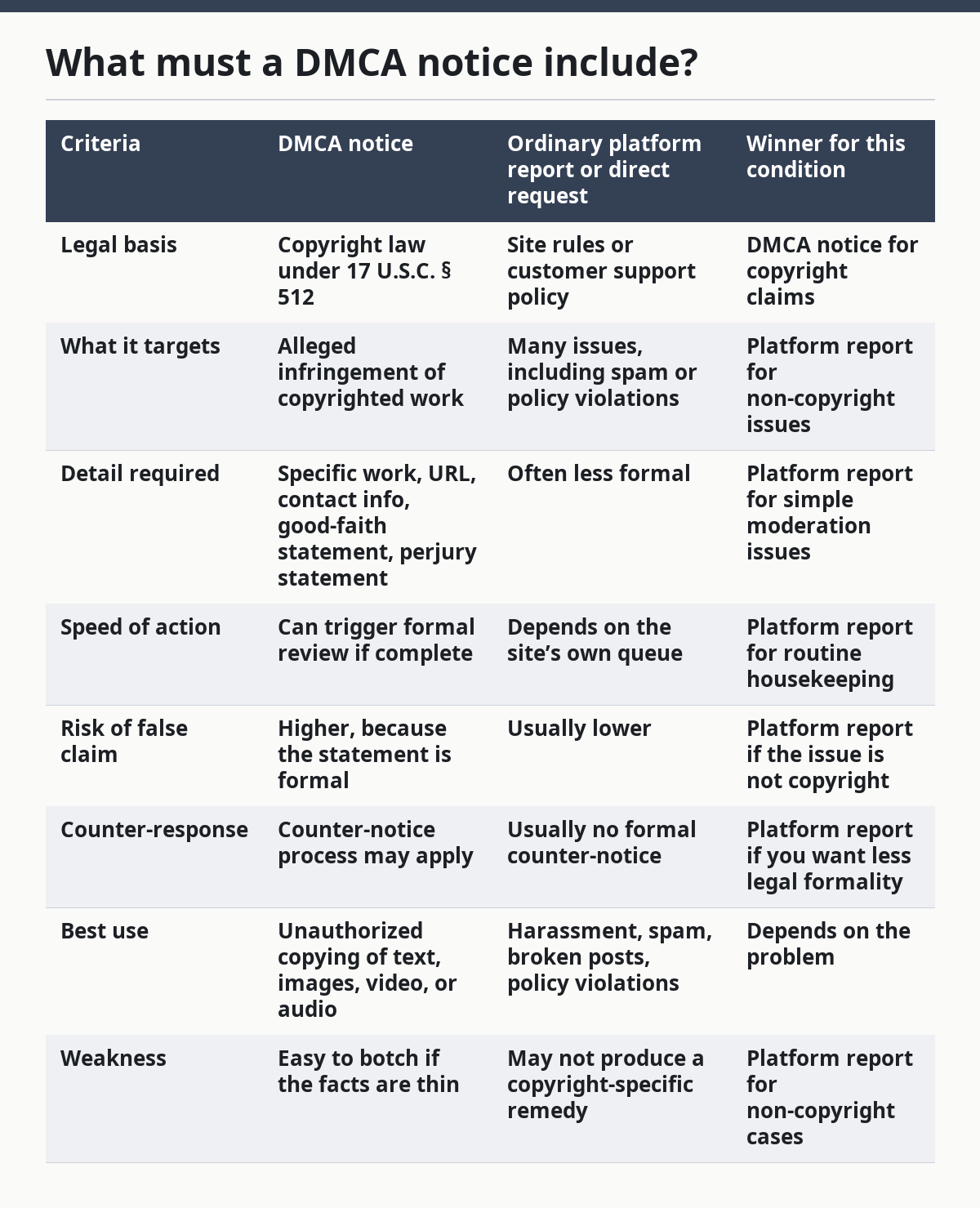
The main trap is using a DMCA notice for the wrong problem. A post that is rude, unflattering, or false may still not be a copyright issue. If the complaint is really about defamation, privacy, trademark, or impersonation, a DMCA form is the wrong tool unless copyrighted material is also involved.
What happens after a site gets a DMCA complaint?
A site usually reviews the notice, checks whether it contains the required facts, and then decides whether to remove or disable access to the material. If the notice is incomplete, the process can stop there, and the complainant may need to send a corrected version.
If the material is removed, the uploader may send a counter-notice if they believe the takedown was mistaken or unlawful. That is the part many readers forget: DMCA is not a one-way street. The statute builds in a response path, and that is why sloppy notices can backfire.
Because of that, a site owner who treats every complaint the same way may over-remove content; if the site is making legal judgments, a qualified lawyer or other professional should review the process and the wording. The U.S. Copyright Office and Cornell Law School both lay out the statutory structure in useful detail: Cornell Law School, 17 U.S.C. § 512.
When should you use a DMCA notice?
A DMCA notice wins when the problem is unauthorized copying of a copyrighted work and you need a formal removal process. That means text, images, video, audio, or similar creative material that is being reposted without permission.
It is the wrong tool for most disputes that people casually call “copyright” but are not really copyright. A copied brand name, a fake review, a bad screenshot of a product page, or a privacy complaint may need another process. If the issue is not about a copyrighted work, a DMCA notice can waste time and weaken the credibility of the complaint, which is why a report abuse page or other site form may be the better route.
The clean rule is simple: use DMCA when the complaint depends on copyright ownership and specific copied material. Use the site’s ordinary reporting channel when the problem is a rule violation rather than infringement. That split saves time and reduces the chance of filing the wrong kind of claim.
What makes a DMCA policy weak?
A DMCA policy is weak when it is vague, hard to find, or missing the facts a notice needs. If the page only says “copyright complaints go here” and gives no contact method, no required details, and no counter-notice path, it leaves both sides guessing.
The other common flaw is overpromising. A site should not say it will remove anything “immediately” or guarantee a takedown without review. That kind of language sounds helpful, but it creates false expectations and can lead to bad removals or inconsistent decisions.
There is also a serious downside to copying boilerplate without checking whether it fits the site.
A one-size-fits-all template can miss the contact route, the repeat-infringer language, or the review steps that actually matter for the site in question. For a site with user uploads, those details matter more because the notice volume and response workload can rise quickly.
What should a site owner change first?
A site owner should fix the notice path first, then the wording, then the internal process. The public page needs a clear copyright contact, a list of the facts a notice must contain, and a short explanation of the counter-notice option if the site accepts user uploads.
Then the site owner should fix the operational side. Someone has to receive the notices, date-stamp them, and decide whether the complaint is complete before any material comes down. Without that step, the policy is just text on a page.
The strongest policy is plain about limits. It should say that the site handles copyright claims under the DMCA, not every legal complaint on earth. That clarity helps the right people use the right channel, and it keeps the policy from becoming a catch-all inbox.
When does the answer change?
The verdict changes in a few specific situations. If the site hosts user uploads, a real DMCA policy matters more because the complaint volume and counter-notice risk are higher. If the site only publishes its own content, the policy can be shorter, but it still helps to publish a contact method for rights holders.
If the issue is not copyright at all, stop using DMCA language and switch to the proper channel. Trademark, defamation, privacy, and harassment complaints follow different rules. If a notice might trigger legal consequences, a qualified lawyer should review the wording before it is sent, especially where privacy complaints or defamation issues overlap with copyright concerns.
If the site gets repeated complaints about the same kind of content, the policy also needs an internal triage rule. A single mailbox without sorting usually turns into delays, and delays create more conflict than the original post. That is why some teams route complaints through a legal requests inbox instead of a general support queue.
Which option should you use?
Choose a DMCA notice if the material is copyrighted, copied without permission, and you need a formal removal request under 17 U.S.C. § 512. Choose the site’s normal reporting form if the issue is spam, abuse, policy violation, or another non-copyright problem. Neither fits if the claim is vague, unsupported, or about the wrong legal category.
FAQ
What is the difference between a DMCA policy and a DMCA notice?
A DMCA policy is the site’s public rules for handling copyright complaints. A DMCA notice is the actual complaint a rights holder sends when they believe a work has been copied without permission.
Can I use DMCA for anything I want removed?
No. A DMCA notice is for copyright claims, not for every piece of content you dislike. If the problem is defamation, privacy, harassment, or a platform rule violation, another reporting path is usually the right fit.
Does every website need a DMCA policy?
No, but any site that hosts user content should strongly consider one. A policy gives the site a clear process for notices and counter-notices, which helps reduce confusion and inconsistent decisions.
What happens if a DMCA notice is incomplete?
The site may ignore it, ask for missing details, or hold it until the notice is fixed. A notice that lacks the required facts is often slower to act on than a complete one.
Can the uploader respond to a DMCA takedown?
Yes. The DMCA includes a counter-notice process for people who believe the removal was mistaken or improper. That is why a policy should explain both sides, not just the complaint form.
Drafted with AI; not yet reviewed by a person.