Last updated: November 20, 2026
Quick Answer: Compare two brands of the same low histamine ingredient in 15 seconds by checking the ingredient panel, the processing terms, and the package date. For How to Compare Two Brands of the Same Low Histamine Ingredient, the simplest label is often the safer shelf choice.
Key Takeaways
- Compare the panel, process, and storage cues; pick the simpler brand.
- Two brands can differ in raw material, handling, and packaging support.
- The most useful details are the ingredient line, preservative callouts, package date, and processing form.
Two brands of the same low histamine ingredient can look identical and still behave differently on your shelf. Compare the ingredient panel, the processing, and the packaging first—that usually tells you more than the front label. The steps below settle what to check before you buy the second bag, jar, or bottle.
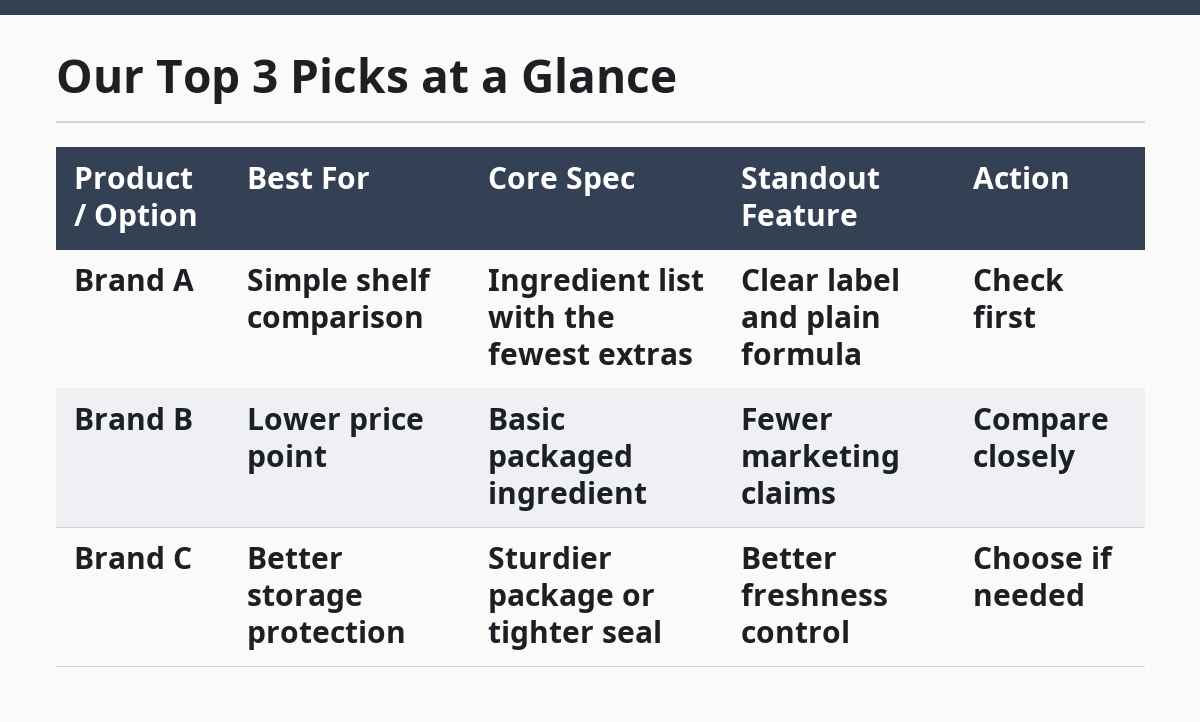
Our Top 3 Picks at a Glance
-
1 Best Overall: the brand with the shortest ingredient list and the least processing.
-
2 Best Budget Pick: the brand that stays plain without adding fillers or preservatives.
-
3 Best Heavy-Duty / Upgrade Pick: the brand with the better container, seal, or freshness protection.
| Product / Option | Best For | Core Spec | Standout Feature | Action |
|---|---|---|---|---|
| Brand A | Simple shelf comparison | Ingredient list with the fewest extras | Clear label and plain formula | Check first |
| Brand B | Lower price point | Basic packaged ingredient | Fewer marketing claims | Compare closely |
| Brand C | Better storage protection | Sturdier package or tighter seal | Better freshness control | Choose if needed |
How do you compare two brands of the same low histamine ingredient?
You compare them by reading the ingredient list, checking the brand’s processing style, and judging the package for freshness clues. If both are the same ingredient on paper, the real difference is usually in what was added, how it was handled, and how well the container protects it.
Picture this: you’re standing in a store aisle with two bags of the same packaged food, and both say the ingredient is plain enough. The faster choice is not the one with the loudest label. It’s the one with the clearest panel, the fewest additives, and the least room for spoilage. Here’s the catch:
- Read the ingredient panel and look for one main ingredient, then stop at any extra item that is not needed for that ingredient.
- Check the preservatives and additives, especially if one brand uses acids, flavorings, anti-caking agents, or stabilizers while the other does not.
- Compare the processing terms such as “dried,” “fermented,” “cultured,” “raw,” “blanched,” or “pasteurized,” because those can change how the ingredient behaves in a low histamine plan.
- Inspect the package for opacity, a good seal, and a clean lot code or best-by date, since light, air, and long shelf time can matter.
- Pick the shorter path when both are close: the shorter list and simpler handling usually make the safer shelf choice.
The better question is not whether the label looks clean, but whether it stays clean through the whole shelf life. A 15-second label check often tells you enough to avoid the obvious mismatch.
What should I compare on similar packaged ingredients?
You should compare the panel, the process, and the storage cues—then give the edge to the brand that does less. For a packaged ingredient, the cleanest choice is often the one with a short ingredient list and the fewest steps between the source and your pantry.
Picture this: one jar says only the ingredient name, while the other adds an acid, a stabilizer, and a natural flavor. The jars may sit side by side at the same price, but they are not equal. The label often tells you more than the brand name does.
- Ingredient list: One line is better than five when the product should be plain.
- Additives: Watch for preservatives, anti-caking agents, and flavor systems that do not belong in the base ingredient.
- Processing language: Drying, milling, fermenting, canning, or pasteurizing can change how the ingredient is handled and stored.
- Container type: Glass, opaque tubs, and well-sealed pouches usually protect the product better than flimsy or half-open packaging.
- Date marks: A best-by date and a lot code help you judge turnover and age.
For label reading, the FDA food labeling pages and USDA labeling guidance are useful references. They help you read the label correctly, even though they do not make the low histamine call for you.
A quick label-check order that works
Use this order every time you compare two brands at the shelf.
- Start with the ingredient line and confirm the product is actually the same item, not just a look-alike.
- Scan for extras and mark anything that changes the base formula.
- Read the process words and note whether one brand is treated, cultured, or preserved differently; if you are unsure, consult a professional and check the label guidance from the FDA or USDA.
- Look at the package and check whether light, air, or moisture can reach the product easily.
- Choose the simpler option if the low histamine fit is otherwise even.
A plain package can still hide a less useful product. A plain label can also hide a better one. That’s why this order matters.
Why the same ingredient can still act differently
The same ingredient can act differently because two brands may use different raw material, different handling, and different storage support. On the shelf, that shows up as one brand with a cleaner panel and another with more steps, more additives, or more packaging risk.
Picture this: you’re comparing two brands of olive oil, rice flour, coconut yogurt, or canned fish. The front of the pack may look almost identical. The rear panel is where the story changes—one may be filled from a simpler process, while the other uses extra treatment to stretch shelf life or change texture. If you are unsure which version fits your needs, consult a professional and cross-check the label with FDA or USDA guidance.
A brand can differ in three ways that matter here:
- Raw source: The base crop, milk, oil, or fish may come from a different supply chain.
- Handling: Drying, fermenting, aging, curing, or heat treatment changes how the ingredient is finished; if that matters for your plan, consult a professional and review the label.
- Protection: A dark bottle, vacuum pack, or tight lid can guard freshness better than a thin bag or loose cap.
That is why “same ingredient” does not mean “same fit.” For low histamine shopping, the question is not just what the ingredient is. It is how much processing sat between the source and the shelf.
Which label details matter most?
The most useful label details are the ingredient line, the preservative callouts, the package date, and the form of processing. If you only have 30 seconds in the aisle, those four clues do most of the work.
Picture this: you’re holding two brands and trying not to miss the one hidden problem. You do not need to memorise every label law. You need to sort the obvious winners from the obvious risks.
Use this compare-and-decide list:
- Short ingredient list: Best when the ingredient should be plain.
- No unnecessary additives: Better when there are no fillers, flavorings, or stabilizers.
- Simple processing: Better than fermented, cured, aged, or heavily treated versions; if you are not sure how a product was made, consult a professional and check authoritative label guidance.
- Freshness clues: Better if the package is intact, the seal is firm, and the date is current.
- Clear identity: Better if the label tells you exactly what the product is, not a glossy version of it.
A common mistake is chasing the “natural” claim and ignoring the panel. That costs you time and can hide the very extras you were trying to avoid. The fix is simple: trust the ingredient list first, then the front label second.
If the two brands are still tied after that, pick the one with fewer moving parts. Less handling usually means fewer unknowns.
Common mistakes when comparing two brands
The biggest mistake is comparing the brand story instead of the ingredient facts. A clean-sounding claim on the front can distract you from a messy panel on the back.
Picture this: you’re in a hurry and you choose the brand with the prettier bag. That costs you because packaging design says almost nothing about low histamine suitability. The panel does.
Three mistakes show up again and again:
- Treating all additives as equal. Some are harmless in context, but unnecessary extras make a plain ingredient less plain; if you are unsure about an additive, consult a professional and verify it against FDA guidance.
- Ignoring processing words. A “simple” ingredient that is fermented, aged, or heavily treated is not the same as a plain version; check authoritative label guidance if the terms are unclear.
- Buying the oldest package on the shelf. A product that has sat too long may be a worse fit even if the panel looks clean.
On the flip side, do not reject a brand just because it has a longer label if the extra items are part of a needed protection system, like a shelf-stable package or a seal that helps the product keep well. The point is not to worship the shortest label. It is to choose the product with the least unnecessary risk.
How do I choose between two brands if both seem okay?
Choose the brand with the cleaner panel, the simpler processing, and the better package. If both are still close, buy the one that gives you the fewest unknowns, because that is the safest way to keep a low histamine pantry from drifting into guesswork.
Picture this: both products look acceptable, and you’re tempted to freeze the decision on price alone. Price matters, but it is not the main filter here. The clearer match to your ingredient standard should win, even if it costs a little more.
A practical tie-breaker works like this:
- Pick the shorter ingredient list if the ingredient is meant to be plain.
- Prefer fewer additives if one brand uses a cleaner formula.
- Choose the fresher package if one has a clearer date or tighter seal.
- Avoid the more processed version if the product has any fermented, cured, or aged path.
- Buy the brand you can repurchase easily if you need consistency from week to week.
One source worth bookmarking is the U.S. FDA food labeling page, because label rules and ingredient names matter more than front-of-pack language. If a label is confusing, that confusion is itself a clue.
The truth is, the best brand is often the one you can read fastest. A product that forces you to squint at the back panel is already asking for more caution than it should.
When should you skip both and keep shopping?
Skip both when neither brand gives you a clean enough panel, a clear enough process, or a fresh enough package. If one brand has a simpler ingredient list but the other has better packaging, and neither feels trustworthy, keep looking.
Picture this: you’ve found two options, but one is loaded with extras and the other is badly packaged. That is not a win. That is a sign to move to a third brand or a different store.
Do not buy either brand if you see:
- A long list of extras on a product that should be simple
- Unclear processing terms that hide what changed
- Broken seals, damaged lids, or torn bags
- Outdated or missing date marks
- A package style that seems poor at blocking light or air
This is where a shelf-level comparison helps more than a broad food list. The goal is not to make every brand fit. The goal is to stop spending money on a package that will make you doubt the ingredient later.
The main guide to low histamine ingredient shopping and selection covers the bigger picture. This page is for the side-by-side shelf decision, where the details decide the cart.
How do I choose between two brands if both seem okay?
Choose the one with the shortest clean path from source to shelf. That usually means a short ingredient list, fewer additives, and packaging that protects freshness better. If one brand is easier to read and easier to repeat next time, that is often the better long-term pick.
What should I compare on similar packaged ingredients?
Compare the ingredient panel, the processing terms, the preservatives, and the package condition. Those four points tell you more than the front label. If both brands still look close, pick the one with fewer extras and a fresher-looking seal.
Which label details matter most?
The ingredient list matters most, then the processing words and the date or lot code. A simple panel with clear packaging is usually easier to trust than a product with vague marketing and a crowded back label. When in doubt, the shorter and cleaner label usually wins.
Drafted with AI; not yet reviewed by a person.