Last updated: November 20, 2026
Key Takeaways
- You do not need to decode every line.
- You need a quick reading habit that spots problem words before you rebuild the order at the table.
- You do not need a long speech.
- You are looking for plates that start simple, finish simply, and do not depend on a dark sauce or long prep chain.
A restaurant menu can hide low histamine traps in plain sight. Quick answer: in about 2 minutes, you can check a restaurant menu for low histamine options by scanning for plain dishes, then flagging sauces, marinades, broth, and anything cured, aged, fermented, or reheated. The steps below show how to check a restaurant menu for low histamine options before you order.
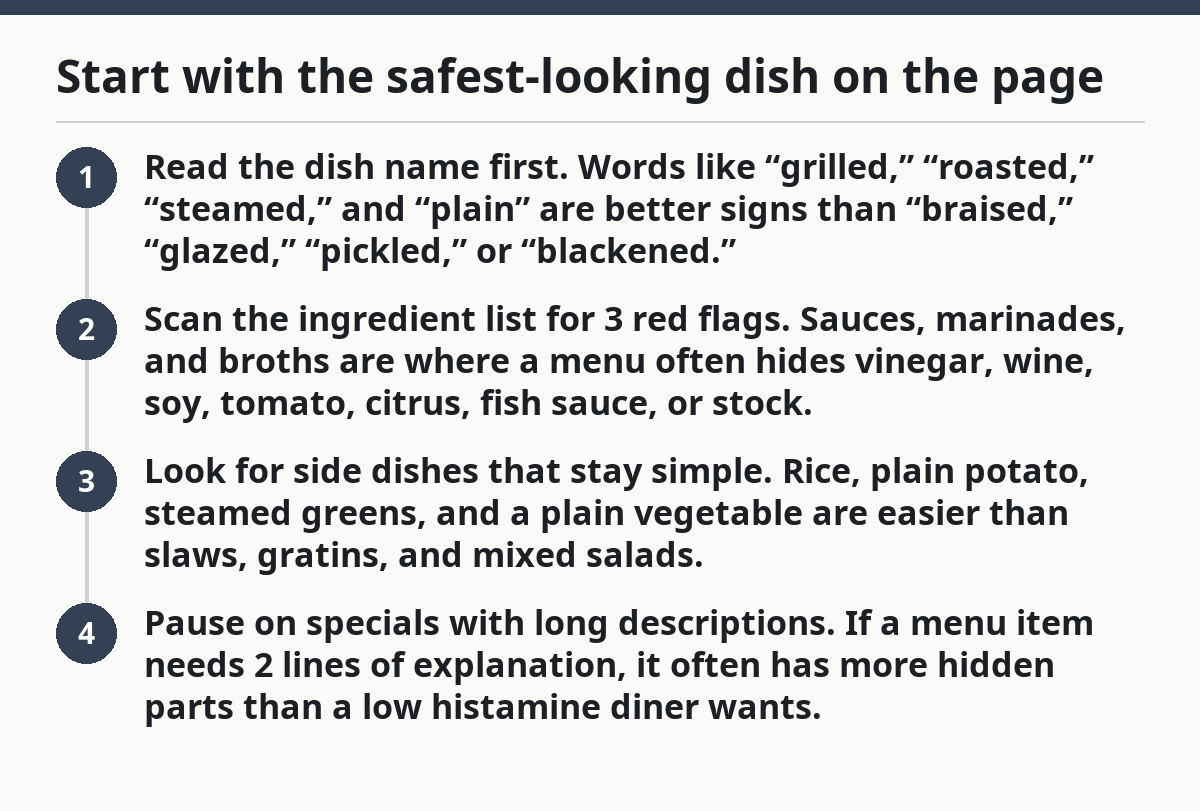
Start with the safest-looking dish on the page
Picture this: you open the menu on your phone, and the dishes look friendly enough at first glance. You do not need to decode every line. You need a fast filter that tells you which plates are built on plain protein and simple sides, and which ones come dressed in trouble.
For a menu check, the best first pass is usually the simplest one: plain, fresh, and short-ingredient. A grilled chicken breast, plain rice, steamed vegetables, and a baked potato are easier to vet than a bowl with four sauces and a garnish list.
Here’s the catch:
- Read the dish name first. Words like “grilled,” “roasted,” “steamed,” and “plain” are better signs than “braised,” “glazed,” “pickled,” or “blackened.”
- Scan the ingredient list for 3 red flags. Sauces, marinades, and broths are where a menu often hides vinegar, wine, soy, tomato, citrus, fish sauce, or stock.
- Look for side dishes that stay simple. Rice, plain potato, steamed greens, and a plain vegetable are easier than slaws, gratins, and mixed salads.
- Pause on specials with long descriptions. If a menu item needs 2 lines of explanation, it often has more hidden parts than a low histamine diner wants.
This is where many people get tripped up. “Chicken” sounds safe, but chicken in a marinade, chicken in broth, or chicken with pan sauce is a different story. The menu name alone is never enough.
How do I spot risky menu wording fast?
Since time is often short, you need a reading habit that catches the problem words before you get stuck rebuilding the order at the table.
The quickest filter is to treat certain words as a warning light, not a hard stop, and to consult a professional if you are unsure about your own triggers or severity. A menu can still be usable if you can remove the risky part, but those words tell you where to ask questions.
Watch for these menu words, and consult a professional or a clinician if you need help interpreting them:
- Aged
- Cured
- Fermented
- Marinated
- Pickled
- Smoked
- Braised
- Glazed
- Stewed
- Reduced
- House sauce
- Pan jus
- Broth
- Stock
Those words matter because they often point to histamine-heavy ingredients or long cooking methods. A soup may look harmless, but a broth base can carry onion, celery, wine, tomato, or leftover stock. A steak may look safe, but a marinade can sit on it for hours.
Not every risky word means “never order this.” It means “stop and inspect.” If the item is otherwise plain, you may be able to ask for the sauce on the side, the marinade left off, or the broth swapped out. If the item is built around the risky part, move on.
Safe-sounding words that still need checking
Some menu words sound calm and clean but still hide ingredients. “Lightly dressed” can mean vinegar. “Seasonal” can mean a fruit reduction. “Chef’s choice” can mean you get whatever is already prepped.
When the wording is vague, ask for the ingredient list or skip the item. A low histamine choice should not depend on guessing.
Read the sauce, marinade, and broth before you trust the dish
Picture this: the main item looks fine, but the taste comes from what was poured over it. That is where low histamine meals often go sideways, because sauces, marinades, and broth are where restaurants hide the ingredients that do the most damage.
The truth is, a dish name can be harmless while the liquid around it is not. A grilled fish plate might be served with salsa, a cream sauce, or a citrus glaze. A rice bowl might be built on broth. A chicken entrée may sit in a marinade for 12 hours before it ever reaches heat.
Use this quick check:
- Find the liquid component. Look for sauce, dressing, glaze, gravy, broth, stock, jus, or marinade in the description.
- Ask what it contains. Vinegar, wine, tomatoes, citrus, soy sauce, chili, and fish sauce are common troublemakers.
- Ask how it is made. A sauce made fresh to order is different from one held all day in a warm pan.
- Ask whether it can be served dry. Many kitchens can plate protein and vegetables without the finishing sauce.
One useful phrase is: “Can I get this without the sauce, marinade, or broth, and with plain seasoning only?” That wording is direct, short, and easy for a server to repeat to the kitchen.
A common mistake is thinking “no sauce” solves everything. It does not if the meat was marinated, the rice was cooked in broth, or the vegetables were finished in a reduction. You want the base, not just the topping.
What questions should I ask the server before ordering?
Picture this: you have found a dish that looks close enough, but the menu is still vague. You do not need a long speech. You need 3 or 4 sharp questions that tell you whether the kitchen can make the plate plain enough for you.
Ask the server about the parts that usually carry histamine load: sauce, marinade, broth, stock, and leftovers. A good server can often answer quickly, and if they cannot, they can check with the chef.
Use this short set:
- “Is the protein marinated?” This matters for meat, fish, tofu, and tempeh.
- “Does the rice, soup, or vegetable dish use broth or stock?” A broth base changes the whole plate.
- “Can you leave off the sauce and dressing?” Many dishes are only risky because of the finish.
- “Are any ingredients fermented, cured, or pickled?” That catches items hidden inside salads, condiments, and garnishes, though a clinician can help you tailor the question to your own limits.
If the menu says “chef’s special,” “market vegetables,” or “today’s fish,” ask one more question: “What exactly is in it?” That protects you from surprise add-ons like capers, olives, anchovy, miso, or vinaigrette.
The best part? You do not have to sound difficult. You are asking for ingredient facts, not negotiating a favor. A kitchen that can’t tell you what is in the dish is telling you enough.
A plain-words script that works
Try this exact script if you want to keep it short: “I need the plain version. No sauce, no marinade, no broth, and no vinegar-based dressing if possible.” It is clear, polite, and specific.
If the server says no, you have your answer. Move to another item instead of trying to force the one that needs too many changes.
Which menu items are usually safest at restaurants?
Picture this: you want one decision that does not turn into six follow-up questions. You are looking for the kind of plate that starts simple, finishes simply, and does not depend on a dark sauce or a long prep chain.
The usually safer choices are the dishes that can stay plain from the kitchen line to the plate. That often means a fresh protein, a simple starch, and one vegetable, with every add-on stripped away.
Good candidates often include:
- Plain grilled or baked chicken, if it is not marinated
- Plain rice with no broth
- Steamed vegetables
- A baked potato with salt only
- Plain eggs, if the kitchen prepares them without seasoning mixes
- A simple side salad with oil only, if vinegar is left off
These are not automatically safe. The risk is in what is added behind the scenes. A grilled chicken breast can be coated in spice blend. Rice can be cooked in stock. Eggs can come with cheese, ham, or sauce. Even a side salad can arrive with tomatoes, olives, pickled onions, or a bottled dressing.
A better rule is this: the shorter the path from ingredient to plate, the easier the check. A plate with 2 or 3 obvious items is easier to control than one with a named sauce and a list of “house toppings.”
On the flip side, the dishes I would skip first are soups, stews, casseroles, pasta with sauce, cured meat plates, pizza, and anything labeled “specialty.” They often depend on broth, tomato, vinegar, cheese, aged meat, or fermented condiments.
Common hidden triggers on menus
Picture this: the menu looks plain, but one ingredient buried in the fine print changes the whole order. That is the trap with low histamine eating out — the trigger is often not the main food, but the background ingredient that seems too small to matter.
The most common hidden triggers show up in 5 places: sauce, marinade, broth, dressing, and garnish. A dish can look clean and still carry tomato, vinegar, wine, soy, citrus, cured meat, or fermented ingredients.
Watch for these hidden triggers:
- Vinegar in dressings, slaws, ketchup, and pickles
- Wine in pan sauce, gravy, or risotto
- Tomato in soups, stews, pizza sauce, salsa, and some dressings
- Soy sauce or miso in marinades, glazes, and stir-fries
- Broth or stock in rice, soups, sauces, and braises
- Cured meat like bacon, salami, prosciutto, or pepperoni
- Cheese on top of pasta, burgers, salads, and baked dishes
- Leftover protein that has been held and reheated
One mistake costs more than bad flavor: it can turn a seemingly safe meal into a hard reaction. That is why “I’ll just pick around it” usually fails. If the sauce soaked into the food or the broth built the base, picking it off does not fix the plate.
The cleanest approach is to read for hidden ingredients, not just visible ones. If a menu uses words like “house-made,” “signature,” or “chef’s blend,” ask what is in it. If you cannot get a clear answer, choose the plainer option.
For a broader system on shopping and ingredient vetting, the hub guide to low histamine ingredient shopping and selection expands the same filter beyond restaurant menus. See also the low histamine food list and the low histamine meal prep guide for related planning.
A simple menu check you can use in under 2 minutes
Picture this: you are in line, your phone is dim, and you need a fast yes-or-no method. You do not need a perfect system. You need one that works in under 2 minutes and stops you from guessing.
This 4-part check is enough for most menus:
- Pick the plainest dish. Choose a meal with a clear protein and simple sides.
- Circle the liquid parts. Sauce, broth, dressing, glaze, marinade, jus, stock.
- Flag the danger words. Aged, cured, fermented, pickled, smoked, reduced.
- Ask 2 questions. “Can this be served plain?” and “What’s in the sauce or broth?”
If the answer is clear and the kitchen can make the changes, you have a workable order. If the answer is vague, that is not a mystery to solve. It is a signal to choose another dish.
A menu check is not about perfection. It is about reducing the number of unknowns before you eat. The less guessing you do, the less likely you are to end up with a plate you cannot trust.
What should I ask a server about histamine?
Ask about sauce, marinade, broth, stock, and dressing first. Those are the parts most likely to carry vinegar, wine, soy, tomato, or other triggers. If the server can tell you exactly how the dish is made, you have a much clearer read than the menu alone gives you.
Which menu items are usually safest at restaurants?
Plain grilled or baked protein, plain rice, steamed vegetables, and a baked potato are usually the easiest items to check. They are not automatically safe, but they give you fewer hidden ingredients to inspect. Skip anything built around sauce, broth, or cured meat if you want the clearest read.
How do I spot hidden triggers on a menu?
Look for the words sauce, marinade, broth, stock, dressing, glaze, pickled, cured, fermented, smoked, and reduced. Those terms often hide the ingredients that matter most. If the dish description is vague or the menu uses “house-made” language, ask what is inside before you order.
Drafted with AI; not yet reviewed by a person.