Last updated: November 20, 2026
Key Takeaways
- Plain packages with short ingredient lists are usually the easiest low histamine frozen produce choices.
- Ice glaze is a thin freezer coating and is usually normal on frozen produce.
- The simplest prepared produce options wash, chop, or portion produce without added flavorings.
- Read frozen vegetable labels in the same order each time: front panel, ingredient list, then extra callouts.
Low histamine frozen produce and prepared produce aisle options are easiest to use when they stay plain, single-ingredient, and free of sauces or seasoning packets. This guide on What to Look for in Low Histamine Frozen Produce and Prepared Produce shows what the label should say, what to skip, and how to spot the hidden extras that make a bag less predictable.
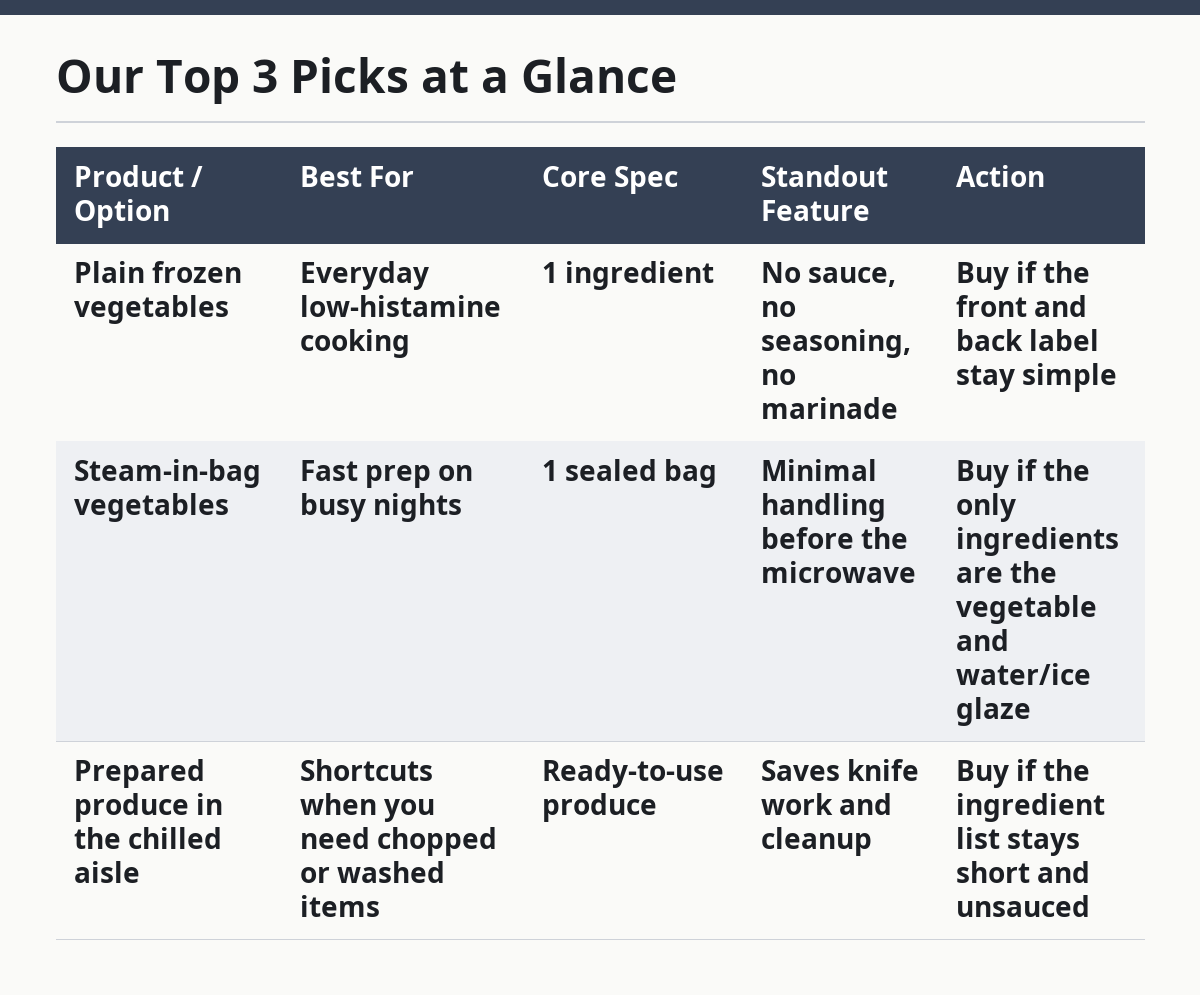
Our Top 3 Picks at a Glance
| Product / Option | Best For | Core Spec | Standout Feature | Action |
|---|---|---|---|---|
| Plain frozen vegetables | Everyday low-histamine cooking | 1 ingredient | No sauce, no seasoning, no marinade | Buy if the front and back label stay simple |
| Steam-in-bag vegetables | Fast prep on busy nights | 1 sealed bag | Minimal handling before the microwave | Buy if the only ingredients are the vegetable and water/ice glaze |
| Prepared produce in the chilled aisle | Shortcuts when you need chopped or washed items | Ready-to-use produce | Saves knife work and cleanup | Buy if the ingredient list stays short and unsauced |
What to check first on any frozen bag or prepared tub
The safest choice is usually the plainest package with the shortest ingredient list. That means a bag of frozen peas, broccoli, spinach, or mixed vegetables without sauce, cheese, butter, garlic dressing, or a spice blend.
Because frozen produce labels can move fast in the aisle, start with the ingredient panel, not the front image. The front can say “garden,” “steamable,” or “lightly seasoned” and still hide a sauce packet.
Look for these details:
- One ingredient only or a very short list
- No sauce packet
- No seasoning blend
- No vinegar, citrus, tomato, chili, or fermented add-ins
- No “marinated,” “teriyaki,” “garlic herb,” or “creamed” wording
A short list matters because prepared produce often gets dressed up to look convenient. On this page, convenience is fine only when it does not come with a second ingredient set hiding in the same bag.
Plain wins.
If you want a fast rule, use this one.
- Good: “broccoli,” “green beans,” “peas,” “spinach”
- Risky: “vegetables with sauce,” “seasoned vegetables,” “stir-fry mix with seasoning”
- Better: ingredient list that fits on one line
- Worst: a package with a separate packet labeled sauce, glaze, or seasoning
The best part is not perfection. It is predictability. That is the real job here.
What does ice glaze mean, and should I care?
Ice glaze means the produce has a thin coating of ice to protect it in the freezer, and that is usually normal. The catch is that you want ice glaze, not extra ingredients hidden in the glaze or a package that feels half frost, half freezer burn.
Because freezer handling matters here, a bag that feels heavy with snow inside can be a warning sign. It may have thawed and refrozen, or the seal may not have held well. For low histamine shopping, that matters because you want produce that looks stable from the start.
Use this quick check before you buy:
- Scan the ingredient list for plain produce first.
- Look at the bag shape for clumps, deep frost, or crushed corners.
- Check the seal so the top is fully closed and not pinched open.
- Avoid extra packets unless they are clearly unnecessary and unopened.
- Pick the freshest-looking box or bag from the shelf, not the one that looks frosted over.
A thin frost on frozen vegetables is normal. Heavy crystals, torn seams, or a package that feels soft at the corners is a different story.
Here’s the catch: an ice glaze can be fine while a sauce packet ruins the whole item. That is why the label matters more than the freezer burn look. One tells you what is inside. The other only hints at handling.
A prepared aisle shortcut is worth buying only when it saves time without adding extra ingredients you now have to manage. That is the whole trade-off.
Which prepared produce shortcuts are easiest to trust?
The easiest prepared produce options are the ones that do one job: wash, chop, or portion the produce without adding flavorings. That means pre-washed greens, chopped vegetables, and steam-in-bag vegetables can fit better than mixed kits with dressing or seasoning.
Because the goal is speed without losing control, the prepared aisle works best when the package still reads like produce, not a meal starter.
Look for these prepared forms:
- Pre-washed spinach or salad greens
- Chopped onions, peppers, or stir-fry vegetables
- Steam-in-bag vegetables
- Plain sliced mushrooms
- Single-ingredient fruit cups with no syrup
The useful shorthand is simple: if you can see the vegetable form and the ingredient panel stays short, it has a better chance of fitting a low histamine routine. If the package includes dressing, croutons, dried fruit, cheese, or “flavor” in a packet, skip it.
Common pitfalls:
- Fruit cups in syrup add sugar and extra ingredients you may not want.
- Veggie mixes with herbs or seasoning can hide garlic, onion powder, or chili.
- Pre-cut trays can look convenient but often come with dips.
- Steam bags with sauce turn a produce purchase into a seasoned dish.
If you want a clean shortcut, buy the version that still needs your own salt, oil, or cooking step. That keeps control in your hands.
The truth is, the prepared aisle is not the problem. The problem is assuming “ready to use” means “safe for your plan.” Those are not the same thing.
How to read frozen vegetable labels without getting tricked
Frozen vegetable labels are easiest when you read them in the same order every time: front panel, ingredient list, then any extra callouts. The package can say “simple,” “fresh frozen,” or “steamable,” but the ingredient panel decides the real story.
Because the front of the bag can be misleading, compare the wording line by line before you decide. One bag may say “broccoli florets.” Another may say “broccoli florets with seasoning and butter sauce.” That second bag is not a vegetable shortcut anymore. It is a mixed product with more moving parts.
Use this order:
- Front panel: does it sound plain?
- Ingredient list: is it one ingredient or many?
- Allergen box: does it mention milk, soy, wheat, or other add-ins?
- Preparation notes: does it mention sauce, packet, or seasoning to add?
- Storage instructions: does the package imply a thaw-and-serve style that changes the product?
A label can be honest and still be a poor fit. “Steam-in-bag” means easy prep, not low histamine by itself. “Mixed vegetables” can be fine if the mix is only vegetables, but it gets risky when the mix includes sauce, marinades, or spices that crowd the list.
Two solid label habits help a lot:
- Prefer words you can picture. Broccoli, peas, carrots, green beans.
- Distrust flavor words. Savory, zesty, garlic, herb, sweet chili, teriyaki.
A short label is not magic. It just leaves fewer surprises. That matters more in this aisle than in most other grocery sections.
What should I avoid in frozen produce blends?
Frozen produce blends are easiest to avoid when they mix vegetables with sauces, cheese, butter, garlic, onion, vinegar, or seasoning packets. Those blends are built for flavor first and control second.
Because blended vegetables can look simple from the front, read past the image before you trust the bag. You may see a colorful vegetable mix in a 1-pound bag and assume it will work because it looks healthy. Then you spot a separate packet, a creamy sauce, or a seasoning mix with multiple spices. That is the turn you want to avoid.
Avoid these common blend types:
- Vegetables with cheese sauce
- Butter-seasoned mixes
- Garlic herb blends
- Stir-fry kits with sauce
- Creamed vegetables
- Mixed produce with dried fruit and syrup
The hidden problem is not just the sauce packet itself. It is the way blends often bury a few ingredients you may want to avoid in one place—onion powder, garlic powder, citric acid, vinegar, or spice mixes that are hard to sort out.
A plain vegetable blend can still be useful if it stays plain. For example, a bag of carrots, peas, and green beans with no sauce is a different thing from a “vegetable medley” with a glaze.
Skip the bundle.
That is the fastest rule.
- Better: plain peas and carrots
- Worse: peas and carrots with seasoning
- Better: steam-in-bag broccoli with no packet
- Worse: broccoli florets in cheese sauce
On the flip side, if you know you do well with one simple ingredient, a single-vegetable bag is often the easiest path. It gives you the least guesswork and the easiest cleanup.
A simple buying routine for the aisle
The best routine is a 20-second scan: label, ingredients, packet, and condition. If any one of those four looks messy, put the item back and keep moving.
Because the aisle can feel overwhelming, you do not need to read every package like homework. You need one repeatable habit that works every time you shop the frozen and prepared produce aisle.
Do this in order
-
Read the ingredient list first.
Look for a single vegetable or fruit, or a very short list. If the list runs long, expect add-ins. -
Check for sauce or seasoning packets.
If you see a packet, ask whether the bag still works without it. If not, leave it. -
Look for plain package wording.
Words like “plain,” “cut,” “washed,” “steam-in-bag,” or the vegetable name itself are better signs than flavor names. -
Inspect the package condition.
Avoid torn seals, deep frost buildup, crushed corners, or limp-looking prepared produce in the chilled case. -
Choose the form you can use fast.
Pick chopped, washed, or steamable items only when they stay plain enough for your plan.
This routine works because it cuts the choice down to what matters: ingredient control. A package can be convenient and still be a bad fit if it comes with garlic, butter, or a sauce you did not plan to use.
Where this guide fits in the bigger shopping plan
This guide helps you choose frozen vegetables and prepared produce without guessing at the label. It does not try to cover every frozen food, every storage rule, or every individual portion strategy.
Because the frozen and prepared produce aisle is only one part of shopping, this page fits best when you want a fast decision and then want to move on. For the broader shopping framework, the hub on low histamine ingredient shopping and selection carries the larger map.
Use this page when you need to judge:
- plain frozen vegetables
- steam-in-bag vegetables
- prepared produce in the chilled aisle
- blends with or without sauce packets
- label clues that show hidden extras
Do not use it as a blanket rule for all frozen foods. A frozen entrée, a leftover container, and a plain vegetable bag are different purchases with different risks. That separation keeps the advice useful instead of muddy.
The best low histamine pick in this aisle is usually boring on purpose. That is not a flaw. It is the point.
Are frozen vegetables okay on a low histamine diet?
Yes, frozen vegetables can be a good fit on a low histamine diet when they are plain and the ingredient list stays short. The safest choices are usually single-ingredient bags with no sauce, seasoning, or packet. If the bag is a mix, check that every part of it is still just vegetables.
What prepared produce items are easiest to use?
The easiest prepared produce items are pre-washed greens, chopped vegetables, plain steam-in-bag vegetables, and simple sliced produce with no dressing. These save time without forcing you into a sauce or seasoning mix. If the package includes a dip, glaze, or flavored coating, it stops being a simple shortcut.
What should I avoid in frozen produce blends?
Avoid frozen produce blends with cheese sauce, butter sauce, garlic, onion, vinegar, or seasoning packets. Those extras make the product less predictable and harder to fit into a low histamine routine. Plain vegetable blends are the safer type; flavor-heavy blends are the ones that usually cause trouble.
Drafted with AI; not yet reviewed by a person.