Last updated: November 19, 2026
Quick Answer: Use three zones, keep a weekly reset, and spend under 5 minutes putting food away. How to Rotate Low Histamine Food So Nothing Gets Forgotten is simple when the oldest item stays in front and the newest item goes in back. Low histamine food gets forgotten when the oldest items hide behind fresh ones and the freezer turns into a stack of guesses. Use a simple rotation system: oldest in front, newest in back, and a weekly reset. The steps below show how to keep low histamine food visible, used on time, and easy to track.
Set up a rotation system that fits one freezer shelf
Picture this: you open the freezer after work, and three containers look the same except for the dates. One is safe to use soon, one can wait, and one should have been eaten last week. A rotation system stops that mess before it starts.
The cleanest setup uses three zones on one shelf or bin: use soon, use next, and backup. Put the oldest food in the front left or front row, then move newer food behind it. If you also use storage bins, give each bin one job so it does not become a mixed pile. The simplest rotation order is usually easy to keep doing on a tired day. It should take under 5 minutes to put away new food.
- Use soon: food with the oldest date
- Use next: food from the middle date range
- Backup: recently frozen items that should stay at the back
A generic freezer rule like “first in, first out” sounds fine, but low histamine storage needs faster movement. If an item sits out of sight, it is as good as gone.
The trick is to make the order visible at a glance. Clear bins help. So does putting one bold label on the front edge of each bin: “Eat first,” “This week,” or “Backup.” A marker that writes on freezer labels without smearing matters here more than cute containers do.
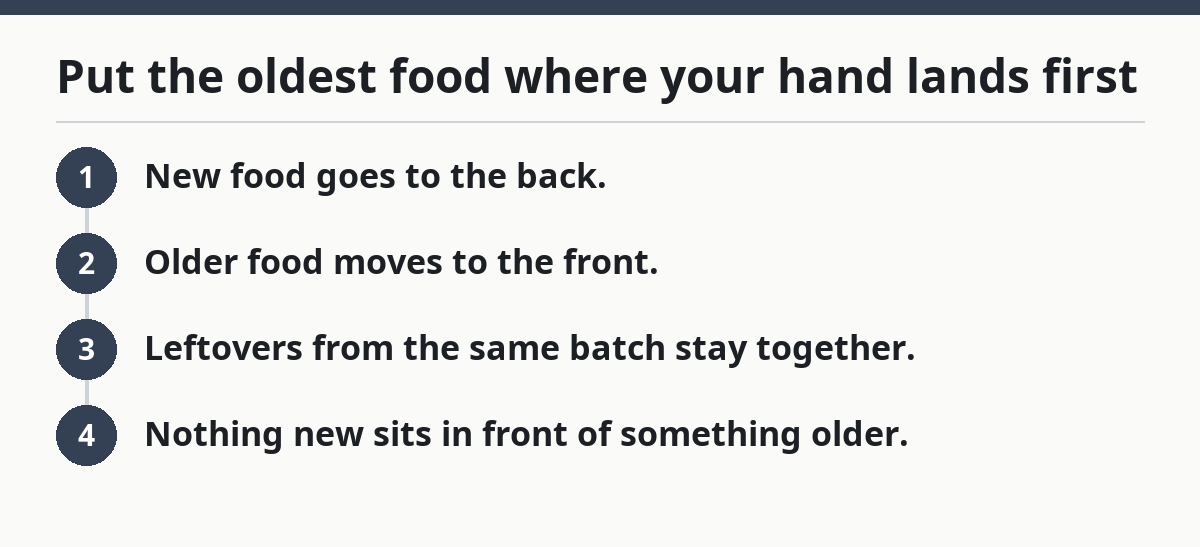
Put the oldest food where your hand lands first
The oldest item should be the easiest to grab. Front placement does that without extra thinking. If you have to pull three containers forward to reach one, the system has failed.
Use this simple rule:
- New food goes to the back.
- Older food moves to the front.
- Leftovers from the same batch stay together.
- Nothing new sits in front of something older.
That keeps the rotation order visible even when you are tired, distracted, or cooking twice in one week.
How do I keep older low histamine food from disappearing?
Old food stays visible when the label, container, and shelf position all point to the same answer. If one of those fails, the item gets forgotten fast.
Here’s the catch: dates alone do not save food if the writing is tiny or hidden under frost. A freezer label on the lid plus a second mark on the front edge works better than a single sticker on top. That way you can read it without lifting a stack. Use a marker, not a pencil that fades, and write the freezer date, not just the meal name.
A good label should answer three things in one glance:
- What it is
- When it went in
- What zone it belongs to
If you keep a spreadsheet, match the shelf order to the file order. Put the oldest items at the top of the list or in the first rows, not buried under new entries. A basic spreadsheet with three columns — item, date frozen, and zone — is enough for many homes. You do not need a fancy app if you will not open it.
The best visibility approach is often to reduce hiding places. Use one shallow bin instead of a deep pile when you can. If you must stack containers, put the shorter ones in front and the tallest at the back so the front row does not become a wall.
Make the front row tell the truth
The front row should show you what needs to be eaten first. If a newer box blocks an older one, move the newer box immediately.
Use this check when you finish putting food away:
- Can you read every front label without lifting anything?
- Can you see at least the next item behind the front one?
- Does the oldest food still sit at eye level or hand level?
If the answer is no, the row needs a reset.
What is the easiest meal rotation order for freezer food?
The easiest meal rotation order is oldest first, same meal group together, and no random reshuffling. That keeps low histamine meals moving instead of drifting around the freezer for months.
Picture this: you cook a batch of rice, turkey, and vegetables on Sunday. On Monday you freeze three portions. On Wednesday you freeze two more. If you do not assign an order, the Wednesday portions may get eaten first just because they sit on top. A rotation system fixes that by giving every batch a place and a date.
Use this order:
- Put the oldest batch in the “use soon” zone.
- Keep the same meal together if it belongs to one recipe.
- Move new meals behind the older ones.
- Pull from the front before opening the back section.
That order works whether you keep food in bins, a freezer drawer, or a shelf. It also keeps the meal plan honest. You see what already exists before you cook again.
A simple spreadsheet can help with this step if you make it match the freezer. List the food in the same order you would eat it. If Tuesday’s meal is listed after Friday’s meal, the file is lying to you. The file should reflect the shelf, not the other way around.
On the flip side, don’t rotate by “favorite” meals. That usually means the same 2 or 3 foods get eaten while the rest age out of sight. Rotate by date first. Flavor can decide the next meal only after the oldest item has had its turn.
Batch meals need their own lane
Batch meals are easiest to forget because they look identical. A row of plain containers can hide one old batch in the middle.
Give batch meals a lane of their own:
- one bin for cooked proteins
- one bin for complete meals
- one zone for odds and ends
That keeps a cooked item from getting buried under a fresh batch of the same shape.
How do I refresh my freezer inventory without starting over?
A freezer inventory refresh should take 10 minutes or less and should update only what changed. If you rebuild the whole list from scratch every time, you will stop doing it.
The truth is, rotation works best when the inventory stays small and current. Once a week is enough for many people who freeze meals often, though a busier kitchen may need a quick check every 3 to 4 days. The point is not perfect records. The point is catching the old item before it becomes invisible.
Use this refresh routine:
- Open the freezer and scan the front row first.
- Move anything newer that is blocking older food.
- Remove anything already eaten.
- Add new food to the bottom or back of the list.
- Mark the next meal you will use.
If you keep a spreadsheet, update it at the same time you move the food. Do not wait until later. Later means forgotten. The list should take less time to fix than it takes to re-cook food you lost track of.
A monthly full reset can help if the freezer gets crowded. During that reset, check the shelf order, toss damaged labels, and make sure the oldest items are still in front. If you only do one thing, do this: compare the shelf to the list and make sure they match.
A 5-minute refresh beats a perfect system you never use
The easiest rotation system is the one you can keep on a tired night. A short check done regularly protects more food than a detailed list you avoid.
Use this quick standard:
- one look at the front row
- one look at the list
- one move for any item out of place
That tiny routine keeps forgotten food from building up.
Common rotation mistakes that waste low histamine food
The biggest mistake is hiding older food behind newer food. That turns the freezer into a storage dump instead of a rotation system.
Another common mistake is writing labels that are too vague. “Chicken” does not tell you which batch should go first. “Chicken, 10/12, front bin” does. If you cannot read the label in two seconds, the label is too weak. A marker label on the lid plus a front-edge note fixes that.
A third mistake is mixing all food in one deep bin. That looks tidy for a day, then creates a pile where the oldest item sinks to the bottom. Use shallow bins or separate shelf zones instead. Deep piles cost you visibility, and visibility is the whole job.
The last mistake is letting the spreadsheet drift away from the freezer. If the file says one thing and the shelf says another, you will trust neither. Update the list when you move the food, not after the fact. A stale inventory is worse than no inventory because it feels trustworthy.
If an item is hard to see, it is hard to eat on time. That is why rotating shelf order matters more than a perfect color code.
Which tools make rotation easier without adding clutter?
The simplest tools are freezer labels, a marker, storage bins, and a basic spreadsheet. You do not need a full organizer system to keep low histamine food moving.
Freezer labels help because they turn a date into something you can see instantly. A marker helps because the writing stays readable longer than a soft pencil mark. Storage bins help because they keep the front row from collapsing into a pile. A spreadsheet helps because it gives you one place to check before you cook again.
Picture this: you are putting away food after dinner, and the freezer is already cold and crowded. The easier the tool, the more likely you are to use it right then. Simple tools survive that moment.
If you already use a hub page for low histamine freezer and storage organization, this rotation system should sit under it as the habit piece. The hub can handle the wider setup; this page keeps the food moving so nothing gets lost in the back. See also low histamine freezer storage, low histamine meal prep, and low histamine kitchen basics.
Keep the tools where the freezer lives
Tools only work if they stay near the freezer. Store labels, marker, and a spare bin in the same kitchen spot.
A small setup like this is enough:
- labels in one drawer
- marker clipped to a bin
- spreadsheet saved on your phone
- one spare storage bin ready for overflow
That setup reduces friction. Less friction means better rotation.
Key Takeaways
- Put older food in front, newer food behind.
- Use one visible zone for food that must be eaten first.
- Match your spreadsheet to the shelf, not the other way around.
- Readable labels beat pretty containers.
- A short weekly refresh keeps forgotten food from piling up.
How do I use older food first?
Use the oldest item in the front row before anything newer. If two items are close in date, choose the one that has been hidden the longest or the one with the clearest label. The rule is simple: front first, back later.
How often should I check my freezer inventory?
Check it once a week if you freeze food regularly. If your freezer turns over fast, a quick look every 3 to 4 days may work better. The check does not need to be long; it just needs to catch misplaced items before they disappear.
What is the easiest rotation method for meal prep?
The easiest method is oldest in front, newest in back, with one bin or shelf zone for each stage. That keeps the system visible and fast. If you want one habit to keep, make the front row the next thing you eat.
Drafted with AI; not yet reviewed by a person.