Last updated: November 19, 2026
Quick Answer: A low histamine freezer storage organization system works best when you can scan it in 10 seconds, freeze food in small portions, and keep a dated first-in, first-out layout. Your low-histamine food plan can break down when the freezer turns into a mystery box and old food sits too long. The fix is a dated, first-in-first-out freezer system with fast cooling, shallow portions, and strict labeling. The steps below show how to stop histamine creep, cut waste, and keep meals safe enough to use with confidence.
This article, Low Histamine Freezer and Storage Organization — The Complete Guide, focuses on the container, the label, and the thaw. I write on food storage and kitchen systems, so I know where low-histamine plans usually break.
Key Takeaways
- Freeze food in small, flat portions so it cools fast and thaws fast.
- Label every package with the food name and freeze date; guessing is how old food lingers.
- Keep a “use first” zone near the front of the freezer and freeze new food in the back.
- Use airtight, freezer-safe containers or bags that seal well and resist freezer burn.
- Don’t rely on smell alone. Histamine issues can’t be judged by scent, and spoilage is not the same thing as histamine load.
- Cooked leftovers belong in the freezer quickly after cooling, not after a long stretch in the fridge.
- A low-histamine freezer works best when it is boring, labeled, and easy to scan in 10 seconds.
Why freezer organization matters so much on a low-histamine plan
For example, you’re tired, you open the freezer, and three bags of chicken look the same. One is safe enough for tonight. One is two weeks older. One has been there so long you’ve stopped trusting it. That mess is the problem, not the freezer itself.
A low-histamine freezer works because it shortens the time food sits around before you eat it. Histamine rises as food ages, especially in protein foods, so the goal is not just freezing. The goal is freezing fast, storing neatly, and using older food first.
The usual mistake is treating the freezer like a dumping ground. If you are not sure whether an item is still safe, consult a qualified food-safety professional or registered dietitian. The freezer can help, but it is not a substitute for judgment. See the USDA Food Safety and Inspection Service guidance on freezing and thawing for basics on safe storage.
The basic rule is simple:
- Cool food fast.
- Portion it small.
- Label it clearly.
- Put the oldest food where you can see it.
- Eat or discard anything that has lost its date.
The truth is, the freezer only helps if you can answer three questions in one glance: What is it? When did it go in? Where does it belong next?
What a low-histamine freezer setup should hold
Therefore, if you want dinner to take 5 minutes to pack instead of 20, the freezer setup has to be ready before the food is cold.
A good low-histamine setup is not fancy. It is a small system built around labels, portion containers, and clear zones. The pieces below matter more than decorative bins or a pretty spreadsheet.
Use these basics:
- Freezer-safe containers with tight lids for soups, sauces, and stews.
- Freezer bags for flat portions of meat, broth, or cooked grains.
- Masking tape or freezer labels so dates stay readable.
- A marker that writes clearly on cold-safe surfaces.
- One shallow bin for “use first” items.
- One backup bin for raw ingredients, if you store them separately.
Here’s the catch: you do not need to buy special gear for every food. You need a system that keeps food flat, visible, and easy to date. A plain bag that freezes in a thin sheet is often better than a bulky container that hides half a meal behind frost.
Once the setup is in place, it saves time every week.
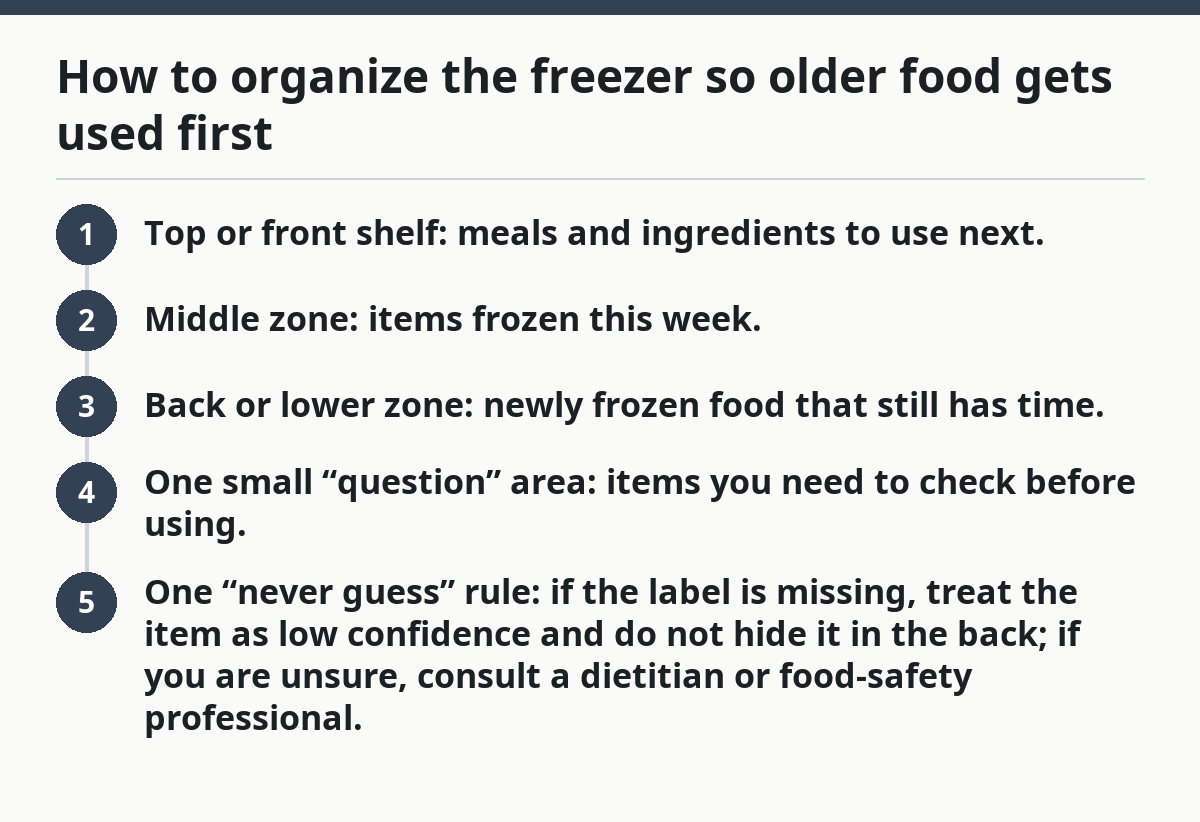
How to organize the freezer so older food gets used first
Because of that, the front row should hold the food you need to eat next. A low-histamine freezer should make the oldest food easiest to reach, not the hardest.
The simplest method is first in, first out. New food goes behind older food. Old food sits in the front or in one shallow bin. If a package arrives with an older date, it takes priority, even if it is not the prettiest container.
Use this layout:
- Top or front shelf: meals and ingredients to use next.
- Middle zone: items frozen this week.
- Back or lower zone: newly frozen food that still has time.
- One small “question” area: items you need to check before using.
- One “never guess” rule: if the label is missing, treat the item as low confidence and do not hide it in the back; if you are unsure, consult a dietitian or food-safety professional.
A dated inventory helps even in a small freezer. It can be written on paper, kept in a phone note, or taped to the door. The format can be plain:
- Item
- Portion size
- Freeze date
- Use-by target
Keep the list short. If it takes more than 2 minutes to update, you won’t keep it going.
The right containers, bags, and labels for low-histamine storage
Meanwhile, you may be choosing between a glass container, a plastic tub, and a bag of soup laid flat like a sheet. The right choice is the one that freezes fast, seals well, and lets you read the date at a glance.
For low-histamine storage, the most useful containers are the ones that reduce air exposure and keep portions small. That matters because freezer burn is not the same thing as histamine, but it does ruin food quality and makes old food harder to trust.
Use this rule of thumb:
- Soups and stews: shallow, freezer-safe containers.
- Cooked meat or fish: flat freezer bags or small airtight boxes.
- Broth: small containers or bags with room for expansion.
- Single servings: thin portions you can thaw in one sitting.
- Bulk ingredients: split into use-sized portions before freezing.
Labels should carry three things at minimum: what it is, when it was frozen, and how much is inside. If you make “chicken soup” in three batches, write which batch it is. If you freeze a sauce for one dinner, say so. Vague labels like “dinner” and “soup stuff” do not help on day 12.
Avoid containers that trap you later:
- Boxes that stack so tightly you can’t pull one out.
- Lids that pop loose in the freezer.
- Clear containers with unreadable frost.
- Oversized bins that encourage you to overfill them.
A useful container is not the one with the most features. It is the one that gets opened, read, and used.
How to freeze leftovers without making histamine worse
Next, remember that you’ve just finished dinner, and the last thing you want is another task. That is exactly when the freezer rules matter most, because leftovers left out too long are a bad fit for a low-histamine plan.
The main target is speed. Food should cool quickly, then get into the freezer in a form that freezes evenly. A big pot of stew left in one deep bowl is slow to cool and slow to freeze. Split it first.
Use this workflow:
- Portion the food into shallow containers or bags.
- Let steam drop off before sealing.
- Label right away.
- Put the containers in a single layer so cold air can reach them.
- Move them to their final spot once frozen solid.
If a dish contains high-risk ingredients for your diet, such as fish or long-cooked protein, be even stricter about timing and portion size. A small amount frozen promptly is easier to manage than a large batch you keep rediscovering later.
Specifically, the best practice is boring and specific:
- Cool quickly.
- Freeze quickly.
- Reheat once.
- Eat it soon after thawing.
Do not keep reheating the same dish over and over. Each extra cycle makes tracking harder, and tracking is half the battle.
What to keep in the freezer and what not to trust there
In particular, the freezer is best for foods you can portion cleanly and identify clearly later. It is not a fix for food that has already sat too long or for containers you can’t date. Freezing does not erase poor handling.
Good freezer candidates include:
- Soups made from fresh ingredients and frozen fast
- Cooked rice or grains in small portions
- Cooked meats portioned right after cooling
- Some breads or baked items, if they fit your plan
- Fruit and vegetables you know you’ll use in a controlled way
Be cautious with:
- Mystery leftovers
- Food with no label
- Large mixed dishes you won’t finish in one thaw
- Anything that was left in the fridge past your own limit
- Items you keep moving around because you “might” want them later
The phrase “freeze it and worry later” is a trap. If the food already looks tired, smells off, or has an unknown timeline, freezing does not make it a clean choice. It only pauses the problem.
Here’s a simple gate:
- Label present?
- Date present?
- Portion usable?
- Food still within your own low-histamine window?
If one answer is no, treat it carefully. When the answer is uncertain, consult a registered dietitian or food-safety professional.
Can a freezer reduce histamine problems, or just delay them?
Yes, a freezer can help, but it does not erase histamine already present in food. That is the part many beginners miss, and it leads to false confidence.
Freezing mainly slows further change. It helps when food is frozen soon after cooking or purchase. It helps less when food has already sat in the fridge for too long. It cannot turn risky leftovers into fresh ones.
That means the freezer is a timing tool, not a cleanup tool. If you want the system to work, the food has to enter the freezer early enough to matter. The container, label, and date are part of that protection.
A few habits matter more than most people think:
- Freeze food as soon as it is cool enough.
- Keep protein portions small.
- Use the oldest food first.
- Do not thaw and refreeze unless you have a clear, safe reason.
- Keep freezer doors closed when possible so temperature stays steady.
The catch is that a low-histamine kitchen needs more discipline than a normal meal-prep routine. You can’t “sort it out later” with this setup. Later is where the trouble starts.
For food safety guidance, the USDA’s Food Safety and Inspection Service has clear freezing and thawing advice, and the British Dietetic Association’s low-histamine resources are useful for people building a diet plan around symptom control. If symptoms are severe or the diet is medically complex, a registered dietitian can help you tailor the plan. For additional storage basics, see the FDA and USDA consumer food storage guidance.
The freezer zones that make daily use easier
So dinner is easier when the freezer has a clear map. If your freezer is arranged well, you can find the right item without moving three frozen bricks and a bag of peas.
I recommend thinking in zones, even for a small freezer. Zones stop the system from collapsing into one pile. They also make it easier to notice what needs to be used next.
A practical zone setup looks like this:
- Use now zone: meals frozen earlier in the week.
- Mid-week zone: items with newer dates.
- Bulk zone: unopened or long-term ingredients.
- Backup zone: foods you keep for emergencies or low-energy days.
- Review zone: anything missing a label or needing a decision.
If your freezer is tiny, the zones can be mental instead of physical. But if you can use bins, do it. A shallow bin works better than a deep one because you can see the bottom layer. Deep bins hide food, and hidden food is forgotten food.
Rotate every time you add something new. Move older packages forward. That takes 30 seconds and saves much more later.
The best freezer layout is not pretty. It is readable.
A simple storage system that actually holds up week after week
Therefore, if you want a system you can follow when you’re tired, not just when you feel organized, the rules have to be short enough to remember on a bad day.
The most durable low-histamine freezer system has four parts:
- Standard portions so you don’t keep guessing serving size.
- Visible dates so older food stands out.
- One front-of-freezer zone for priority items.
- A weekly reset that takes a few minutes.
Your weekly reset can be small:
- Check for unlabeled food.
- Move older items to the front.
- Remove anything you no longer trust.
- Update the list or note.
- Group similar items together.
Do it on the same day each week if you can. The exact day does not matter as much as the habit.
The real win is this: when the freezer is organized, low-histamine eating becomes less emotional. You are not deciding dinner from scratch while hungry and tired. You are choosing from a short, dated list.
That is the whole point.
The mistakes that cause the most trouble
Finally, a full freezer can still feel unusable. That usually comes from a few repeat mistakes, not from bad luck.
The most common errors are simple:
- Freezing food in large, slow-cooling containers
- Forgetting to date packages
- Mixing new food in front of old food
- Using containers that are hard to read
- Keeping too many “maybe later” items
- Thawing more than you can eat at once
Those mistakes create two problems at the same time. First, they make food harder to track. Second, they increase the chance that food sits too long before you use it. On a low-histamine plan, that is exactly what you want to avoid.
A good test is this: can someone else look at your freezer and know what to use first in 10 seconds? If not, the system is too loose.
Fixing it does not require a full overhaul. Usually, one or two bins, better labels, and smaller portions change the whole freezer.
The best low-histamine freezer habits for real life
Therefore, when you are busy, low on energy, and not in the mood for kitchen rules, the system has to survive that day too.
The best habits are the ones that reduce effort:
- Freeze in meal-size portions.
- Keep a marker next to the freezer.
- Date food before it goes cold and hard.
- Use clear bins for priority items.
- Keep the door map simple.
- Refill the front zone after every grocery trip.
If you eat the same few meals often, standardize them. Use the same bag size or container size every time. That makes portions predictable and helps you notice if something is off.
One more useful habit: never let the freezer become storage for “I’ll figure it out later.” That sentence is expensive in a low-histamine kitchen.
The simple rule is this: if you can’t identify it fast, it doesn’t belong in easy reach.
What a beginner should do this week
Since you want a start date, not a theory, the best freezer system is the one you can begin on a Sunday afternoon without special tools.
Start here:
- Empty one shelf or one drawer.
- Toss anything unlabeled or unidentifiable.
- Gather labels, a marker, and a bin.
- Freeze leftovers in smaller portions.
- Place the oldest food in front.
- Write down what you froze.
- Pick one weekly review day.
That is enough to get started. You do not need a perfect inventory on day one. You need a system that makes the next meal easier than the last one.
If you want one simple target, aim for a freezer you can scan in under 10 seconds and a label you can read without opening packages.
FAQ
How long can low-histamine freezer meals stay frozen?
Frozen meals can stay frozen for a long time from a food-safety standpoint, but low-histamine planning is usually more selective than basic safety guidance. The real issue is not only whether food is frozen, but whether it was frozen quickly and tracked well. Keep your own short-use system and rely on date labels.
Should I freeze leftovers the same day I cook them?
Yes, that is usually the safest habit for a low-histamine kitchen. Freeze leftovers after they cool enough to package, rather than leaving them in the fridge for days. Smaller portions freeze faster and are easier to reheat once.
Is glass or plastic better for freezer storage?
Both can work if they are freezer-safe and seal well. Glass is useful for soups and sauces, while bags and lightweight plastic containers are often better for flat portions and tight spaces. Choose the container that keeps air out and makes dating easy.
Can I thaw and refreeze low-histamine food?
That is usually a poor habit for this kind of storage system. Thawing and refreezing makes tracking harder and can reduce trust in the food. Freeze in smaller portions instead, so you only thaw what you need.
What is the biggest mistake people make with a low-histamine freezer?
The biggest mistake is treating the freezer like a memory aid instead of a system. If food has no date, no zone, and no priority, it gets lost. Lost food is the food most likely to sit too long or be wasted.
Drafted with AI; not yet reviewed by a person.