Last updated: November 19, 2026
Key Takeaways
- Cool and store low histamine food fast; room temperature makes spoilage and histamine concerns rise.
- Rice, vegetables, and meat should stay out no longer than 2 hours, less in warm rooms.
- Begin cooling leftovers as soon as the meal ends, using shallow containers and a clear fridge path.
- Low histamine meal timing works best when you plan before eating, not after the meal.
Low histamine food should not sit out longer than 2 hours, and if the room is hot, the safe window is shorter.
This guide explains when to cool, cover, and refrigerate prepared low histamine food before it turns into a leftover problem.
The short answer for prepared low histamine food
Prepared low histamine food should be cooled and put away fast, because time at room temperature helps both bacteria and histamine concerns get worse. If your kitchen is warm, food needs attention even sooner.
The practical rule is simple: don’t leave cooked food on the counter while you finish the evening. Pack it up, cool it in shallow containers, and get it into the fridge once steam is gone.
For low histamine eaters, the problem is not just spoilage. Rice, vegetables, and meat can all become a bad bet if they sit around too long, even when they still smell fine. Smell is a weak test here.
That matters because the same meal can be safe for one person’s stomach and rough for another’s histamine threshold. So the safest routine is the boring one.
- Cool quickly
- Cover lightly
- Refrigerate promptly
- Discard leftovers on a short timeline
The rest of this page settles the how and why, with help from general food-safety guidance from the USDA Food Safety and Inspection Service and FoodSafety.gov.
How long can cooked rice, vegetables, and meat sit out?
Cooked rice, cooked vegetables, and cooked meat all follow the same basic room-temperature rule: no more than 2 hours out in normal conditions, and less if the room is hot.
That matters because “low histamine” does not give food a free pass. A rice bowl sitting open for 4 hours is still a leftover risk, even if it looks plain and harmless. The same goes for a tray of roasted carrots or a pan of chicken.
Use the stricter version of the rule when any of these are true:
- the room is warm
- the food is in a deep pot and still steaming
- the serving dish was out during a long meal
- you’re saving the food for later, not serving it now
If you need a hard stopping point, think in terms of one meal, not an afternoon. Once dinner drags on past the table, the food should start its trip to storage. A food thermometer helps when you’re cooling large batches, because the center of the food cools slower than the edges.
The food type changes the risk shape, not the need to act.
That’s the part people miss.
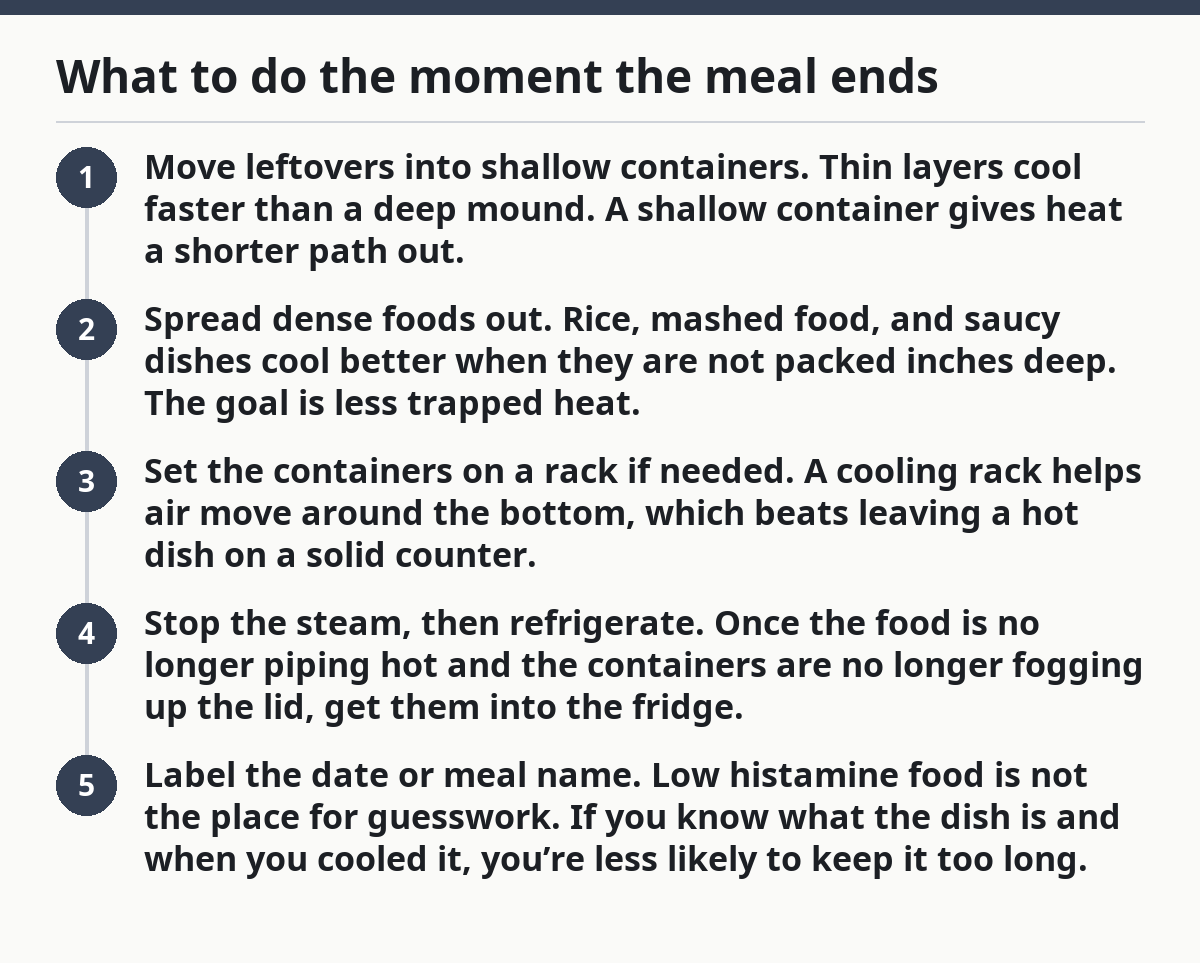
What to do the moment the meal ends
You should start cooling prepared low histamine food as soon as the meal is done, using shallow containers and a clear path to the fridge.
Picture this: you’ve finished dinner, there’s still a pan of rice on the stove, and the vegetables are sitting in the serving dish. The clock is already running. The food does not need a dramatic cleanup first; it needs fast cooling first.
-
Move leftovers into shallow containers.
Thin layers cool faster than a deep mound. A shallow container gives heat a shorter path out. -
Spread dense foods out.
Rice, mashed food, and saucy dishes cool better when they are not packed inches deep. The goal is less trapped heat. -
Set the containers on a rack if needed.
A cooling rack helps air move around the bottom, which beats leaving a hot dish on a solid counter. -
Stop the steam, then refrigerate.
Once the food is no longer piping hot and the containers are no longer fogging up the lid, get them into the fridge. -
Label the date or meal name.
Low histamine food is not the place for guesswork. If you know what the dish is and when you cooled it, you’re less likely to keep it too long.
A shallow pan beats a deep bowl, because it cools faster.
The point is not perfection. The point is to shorten the time between “cooked” and “cold” without leaving food exposed while you fuss over it.
Why low histamine meal timing matters
Low histamine meal timing matters because the safest plan starts before the first bite, not after the last spoonful.
If you know dinner will be eaten in stages, serve only what you need and leave the rest sealed in the fridge until you’re ready. That keeps a full tray from sitting out for an hour while someone goes back for seconds or the kitchen gets cleaned up.
The easiest pattern is this:
- cook in smaller batches
- serve one round
- save the rest cold until needed
- reheat only the portion you plan to eat, if reheating is part of your routine on another page
This is where low histamine meal prep tips pay off. A prepared meal that stays in 2-hour chunks is easier to manage than one big dish that lives on the counter until everyone wanders back through the kitchen. If you want the whole system, that hub is where the wider prep plan belongs.
If you’re wondering whether plain rice or plain chicken can sit out a little longer, the answer is still no, not as a habit. Plain food may have fewer ingredients, but the room-temperature clock does not care.
The best part is that once the habit is built, it takes almost no extra effort. Shallow container, fridge, done.
Common mistakes that cost you freshness
The biggest mistake is leaving the whole pot out “to cool naturally.” That costs time, and time is the problem. A deep pot stays warm in the middle for far too long, which is exactly what you do not want with prepared low histamine food.
Another mistake is trusting smell or appearance. Food can look fine and still be a poor choice after sitting out too long. Histamine issues make that gamble worse, not better.
A few other habits cause trouble:
-
Covering food too early.
Tight lids trap heat. Let the steam drop first, then cover and refrigerate. -
Using a deep serving bowl.
A tall pile of rice or vegetables cools slowly, even if the top feels cold. -
Leaving food out during cleanup.
Dishes, conversation, and phone calls stretch the safe window without anyone noticing. -
Mixing fresh food into old leftovers.
That resets nothing. It just makes the older food harder to track.
What to do instead is plain: portion sooner, cool in a shallower shape, and put a clock on the leftovers. If you are not sure whether a dish has crossed the line, the safer move is to throw it out.
Waste hurts less than a bad night.
When should you cool, cover, and refrigerate?
You should cool, cover, and refrigerate prepared low histamine food as soon as it is no longer needed for the meal, not after the kitchen is fully reset.
Picture this: the table is cleared, the stove is off, and there is still a bowl of cooked vegetables and a tray of rice waiting on the counter. That is the moment to act. Waiting for “later tonight” is how food drifts past the safe window.
Use this order:
- Cool first in a shallow container or on a cooling rack
- Cover next once the steam drops
- Refrigerate last once the food is no longer dangerously hot
A food thermometer is useful when you have a large batch and want a clearer check on the center of the food. If the middle is still very warm, the whole batch is not ready to park in the fridge with a tight lid.
The key trade-off is this: you want to get food cold fast, but you do not want to trap a lot of heat under a sealed cover. That is why shallow containers matter so much. They make the cooling step shorter without asking you to do anything fancy.
This is not a place for exacting rituals. It is a place for a short, repeatable sequence.
How to tell when food should be thrown away
You should throw food away when you do not know how long it sat out, when it spent too long at room temperature, or when it has a texture or smell that makes you hesitate.
Picture this: the container has been on the counter through a phone call, a cleanup, and a second round of tea. You cannot remember when it came off the stove. That uncertainty is already the answer.
Use these cues:
-
You lost track of time.
If you cannot say it stayed within the safe window, don’t keep it. -
It was out for hours.
Past the 2-hour mark, the risk climbs fast. -
The food was kept warm but not hot.
A lukewarm pot is a poor holding pattern. -
It smells sour, odd, or stale.
Smell is not a perfect test, but a bad smell is enough to stop.
For low histamine eaters, the bar is not “still edible.” The bar is “worth the risk.” Those are not the same thing.
If you need a backup rule, keep only what you can clearly track from plate to fridge. Anything else gets messy fast, and food safety does not reward guesswork. For broader handling, a trusted source like the USDA Food Safety and Inspection Service has plain-language guidance on the room-temperature clock, and FoodSafety.gov keeps the common time-and-temperature rules in one place.
The simplest safe routine to follow every time
The safest routine is to serve, eat, cool, and refrigerate without letting cooked food linger on the counter.
Picture this: dinner is over, and you still have rice, cooked vegetables, and meat to save. You do not need a long process. You need a repeatable one that takes a few minutes and works on a normal weeknight.
Use this pattern:
- Serve only what you need.
- Get leftovers into shallow containers.
- Use a cooling rack if the container is hot.
- Cover once steam has dropped.
- Move the food into the fridge promptly.
- Eat or discard leftovers on a short timeline you can track.
The routine is plain because the risk is plain. Room temperature is the wrong place for prepared low histamine food to linger, even when the meal started out clean and simple. If you want the bigger planning picture, the hub on low histamine meal prep tips belongs next in your path.
The rule of thumb is boring on purpose.
Boring keeps dinner safer.
Can I leave cooked food out before refrigerating it?
Yes, but only briefly, and not as a habit. Cooked food should be cooled and refrigerated as soon as the meal is over, with the practical limit at 2 hours or less at room temperature. If the room is hot, shorten that window. Shallow containers help the food cool faster before it goes into the fridge.
What foods spoil fastest at room temperature?
Cooked rice, cooked vegetables, and cooked meat are all poor candidates for long time on the counter. Foods with moisture, protein, or starch give bacteria a better place to grow than dry shelf-stable foods do. For low histamine eating, that means a plain meal is not automatically a safe one just because it has few ingredients.
How do I know when food should be thrown away?
Throw it away when you cannot confirm it stayed within the safe time, when it sat out too long, or when its smell or texture seems off. If you are unsure whether cooked food stayed under the 2-hour limit, the safest choice is to discard it. Uncertainty is a warning sign, not a challenge.
Drafted with AI; not yet reviewed by a person.