Last updated: November 20, 2026
Quick answer: for many histamine-sensitive eaters, the safest approach is to cool food fast, refrigerate it at 4°C / 40°F or colder, and use or freeze leftovers within 1 to 2 days. Histamine-Friendly Food Storage and Leftover Control — The Complete Guide focuses on keeping leftovers friendlier with fast cooling, short storage, and smaller batches. I’ll show you which foods are risky, how long to keep them, and how to store them without guessing.
Key Takeaways
- Leftovers are not automatically unsafe, but they do get harder on sensitive people the longer they sit.
- The biggest wins are simple: cool food quickly, portion it small, and use it fast.
- Fish, meat, tomato dishes, eggplant, and long-stored mixed meals are common troublemakers.
- A fridge at 4°C / 40°F or colder matters more than fancy containers.
- Freezing early usually beats “I’ll finish it tomorrow.”
- Reheating helps with food safety, but it does not reset histamine.
- If symptoms are severe or unpredictable, a registered dietitian or clinician should guide the plan.
Why leftovers are tricky for histamine-sensitive eaters
Leftovers are tricky because histamine can build while food sits, even when the food still looks and smells fine. For someone who reacts to histamine, the problem is often not spoilage in the usual sense — it’s the slow chemical change that starts after cooking and keeps going in the fridge.
Picture this: you cooked a pot of stew on Sunday, ate one bowl, and planned to finish the rest over three days. The stew is still cold, still smells fine, and still looks normal. That does not mean it stayed equally well-tolerated the whole time.
A few points matter most here:
- Time is the enemy.
- Warm holding is worse than cold storage.
- Large containers cool slowly in the center.
- High-risk foods start from a worse place.
The food safety angle and the histamine angle overlap, but they are not identical. Food safety says, “Is this likely to make me sick from bacteria?” Histamine control asks, “Is this likely to trigger symptoms even if it’s still safe to eat?” Those are different questions.
The truth is, a lot of generic leftover advice assumes “use within 3–4 days” solves everything. For histamine-sensitive people, that can be too loose for some foods and too generous for some bodies.
Authoritative guidance on cold storage and leftover handling is worth keeping nearby:
- USDA Food Safety and Inspection Service: Leftovers and Food Safety
- NHS: Food poisoning
Which foods are the biggest leftover problem?
The biggest leftover problem is usually aged, fermented, or protein-rich food that sits for a while after cooking. That includes fish, meat, slow-cooked dishes, tomato-heavy meals, and foods that were already high in histamine or histamine-liberating ingredients.
Picture this: you’re deciding whether to save half a salmon fillet, a tomato pasta sauce, or a bowl of rice and vegetables. Those are not equal. One may be fine after quick chilling and freezing, while another can become a repeat trigger fast.
Common high-risk leftovers include:
- Fish and seafood, especially if they were not kept very cold from the start
- Meat dishes, especially stews, braises, and casseroles
- Tomato sauces and chili
- Eggplant dishes
- Fermented foods like kimchi, sauerkraut, miso, and soy sauce-based meals
- Bone broth and long-simmered stocks
- Mixed dishes that stay in the fridge for several days
Here’s the catch: the ingredients are only part of it. A fresh chicken breast eaten right away is not the same as the same chicken breast cooked into a casserole, cooled slowly in a deep dish, and eaten on day four.
What tends to get overlooked:
- Histamine can keep increasing after cooking.
- Spices and vinegar can make some meals harder to tolerate for some people.
- The same food may be fine one day and not the next, depending on storage time and your own threshold.
This is why “check if it looks okay” is weak advice. Histamine changes are invisible.
How should you store food to keep histamine lower?
The best storage method is the one that gets food cold fast, keeps it cold, and gives you a short clock. A 4°C / 40°F fridge, small containers, and quick freezing are the core tools.
Picture this: dinner is done, the pot is still steaming, and you’re tired. The easy move is to shove the whole pot into the fridge. That’s the wrong move for histamine control and often the wrong move for food safety too.
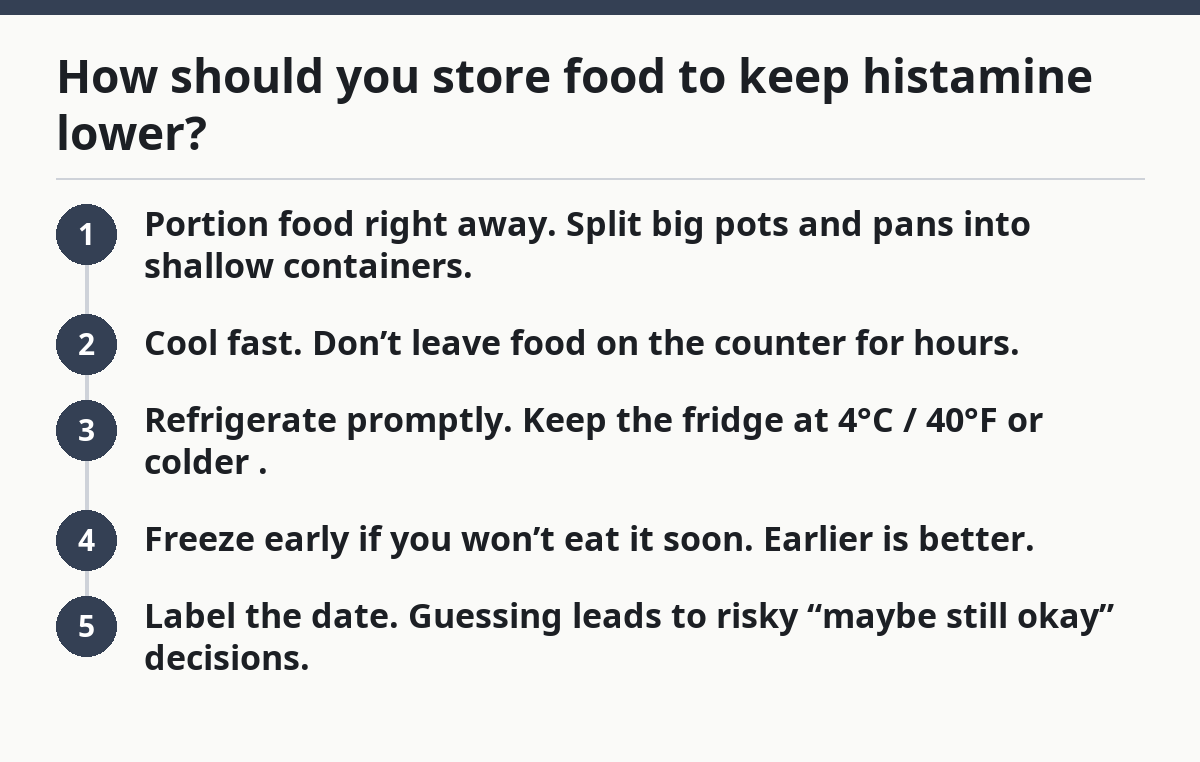
Use this routine instead:
- Portion food right away. Split big pots and pans into shallow containers.
- Cool fast. Don’t leave food on the counter for hours.
- Refrigerate promptly. Keep the fridge at 4°C / 40°F or colder.
- Freeze early if you won’t eat it soon. Earlier is better.
- Label the date. Guessing leads to risky “maybe still okay” decisions.
A few storage details make a real difference:
- Shallow containers cool faster than deep bowls.
- Single-meal portions reduce repeat warming.
- Glass or food-safe plastic both work if they seal well.
- Don’t pack the fridge too tightly. Cold air needs room to move.
- Keep raw and cooked foods separate.
A common mistake is to let a pot cool “until it stops steaming” and then forget it for an hour or two. That may sound harmless, but the time adds up fast. For histamine-sensitive eaters, the goal is not perfect freshness; it’s minimal wait time.
If you want one simple rule, make it this: cook less, cool faster, freeze sooner.
Leftover rules that work in a real kitchen
The best leftover rule is to decide the next meal before the current meal ends. If you know you will not eat it within a day or two, freeze it right away instead of hoping you’ll get to it.
Picture this: it’s Tuesday night, and there’s half a tray of roasted chicken, some rice, and cooked carrots left over. You’re tempted to keep all of it in one big dish and “figure it out later.” That’s how leftovers linger past the point of comfort.
Use these practical rules:
- Only save food you’d be willing to eat soon.
- Cool in small portions, not one giant mass.
- Aim for one reheat, not repeated reheating.
- Freeze what you can’t eat quickly.
- Throw out the “I’m not sure” container.
A note on time: standard food safety advice often uses a short refrigerated window for leftovers, but histamine-sensitive people may need a tighter limit for some foods. There is no universal clock that fits every person. The right window depends on the food, the fridge temperature, and your reaction pattern.
What usually helps most:
- Soups and stews: portion and freeze the extra right away
- Cooked meat: keep only what you’ll use soon
- Grains and rice: cool quickly and store cleanly
- Sauces: move them into shallow containers
What often causes trouble:
- Repeated spooning in and out of the same container
- Leaving leftovers on the counter while deciding what to do
- Keeping several days’ worth of mixed meals in the fridge
- Trusting smell alone
You do not need a perfect pantry system. You need a repeatable habit. Histamine control rewards boring routines.
Can you freeze leftovers if you react to histamine?
Yes, freezing is one of the most useful tools for histamine control because it slows further buildup and gives you a way to “pause” food while it’s still at its best. Freezing does not remove histamine already present, but it can help stop the clock much earlier than refrigeration alone.
Picture this: you’ve cooked extra turkey and want it for lunch later in the week. If you leave it in the fridge until Friday, you’re gambling with both freshness and tolerance. If you freeze it the same day, you’ve given yourself a much better chance.
Freezing works best when you follow these habits:
- Freeze food as soon as it has cooled enough to be safe
- Use flat, shallow packages for faster freezing
- Freeze in meal-sized portions
- Label the date and food name
- Thaw in the fridge, not on the counter
A few limits matter:
- Freezing does not make old food histamine-safe again.
- Food that sat warm too long before freezing may already be a poor choice.
- Very watery dishes can change texture after thawing.
- Some people still react to food that was frozen quickly, so personal tolerance still matters.
This is where generic advice falls short. People often hear “freeze leftovers” and think that solves everything. It doesn’t. The timing before freezing matters just as much as the freezer itself.
If your freezer is crowded, use that as a clue to cook smaller batches. The cleanest histamine strategy is often not “store more,” but “make less and freeze earlier.”
What about reheating, cooling, and food safety?
Reheating helps with bacteria risk, but it does not erase histamine that has already formed. That means a steaming bowl can still be a bad match for a histamine-sensitive person if it sat too long before reheating.
Picture this: yesterday’s pasta is cold in the fridge. You microwave it until it’s hot all the way through, and it still triggers symptoms. That can happen because heat kills some microbes, but it does not reverse the chemical changes histamine-sensitive eaters care about.
Use this simple framework:
- Cool quickly after cooking
- Store cold
- Reheat once
- Eat soon after reheating
- Do not cool and reheat the same food over and over
The temperature goal for safety is to heat leftovers thoroughly. That helps with germs, but for histamine control the more important question is how long the food sat before it was reheated.
One useful habit is to divide leftovers before refrigeration, not after. That way you only reheat what you plan to eat. Less handling means less waiting and fewer chances to leave a dish on the counter.
A few foods deserve extra caution:
- Fish and seafood
- Ground meat
- Creamy sauces
- Cooked rice
- Mixed dishes with many ingredients
The general rule is simple: reheating is not a reset button. It is a safety step, not a histamine fix.
What should you cook if leftovers are a problem?
The safest leftovers are often the ones you never create in oversized batches. Small, fresh meals are easier to tolerate than big mixed dishes that sit for days.
Picture this: instead of making a giant pot of chili, you cook enough for tonight plus one lunch. That feels less efficient, but for histamine control it often works better than batch cooking for three or four days.
Better choices for many histamine-sensitive eaters:
- Fresh-cooked rice made in small amounts
- Simple roasted vegetables
- Small portions of plain meat or fish eaten soon after cooking
- Meals with fewer ingredients
- Foods you can freeze immediately
Foods that are harder to manage:
- Long-simmered soups
- Tomato sauces stored for days
- Slow-cooked meats
- Fermented side dishes
- Marinades with vinegar or soy sauce
If batch cooking is the only way you eat well, keep the batch small and freeze part of it the same day. That gives you the convenience of planned meals without forcing the food to linger in the fridge.
This is where people often need to change the cooking style, not just the storage style. For some households, the right answer is not a better container. It’s a smaller pot.
A few practical swaps:
- Make two servings instead of six
- Cook sauces fresh and freeze extra portions quickly
- Store ingredients separately instead of as one mixed dish
- Build meals from fresh components rather than one big casserole
The best meal plan is the one you can repeat on tired nights. If your system only works on a calm Sunday, it will fail on Wednesday.
When does a leftover need to be tossed?
A leftover needs to be tossed when you can’t confirm its storage history, when it has sat too long for your tolerance, or when it smells, looks, or feels off. For histamine-sensitive people, “probably okay” is not a strong enough standard.
Picture this: a container appears in the back of the fridge with no label. You don’t know if it’s from two days ago or six. That is not a mystery worth solving by taste-testing.
Throw it out if:
- You can’t date it
- It sat out longer than you meant to
- It’s been reheated multiple times
- You already know it tends to trigger you
- The texture or smell has changed
Keep in mind that some foods can be unsafe or poorly tolerated before they look spoiled. That’s why relying on appearance alone is a bad habit.
The hard truth is that waste is sometimes the price of symptom control. If a food is a frequent trigger, trying to “save it” is usually more expensive than tossing it. That doesn’t mean you should be careless. It means you should plan smaller.
A good pantry habit is to keep a quick “use first” shelf in the fridge. Put fresh leftovers there, and if they’re still there when your chosen window closes, move them out without a second round of debate.
What are the exceptions where the usual advice flips?
The usual advice flips when your body tolerates a food well, your fridge stays very cold, or freezing changes the food too much to be useful. In those cases, a standard leftover rule may be either too strict or not strict enough.
Picture this: a person does fine with cold cooked rice the next day but reacts badly to fish after a few hours. Those two foods do not need the same storage rule, and treating them the same can create unnecessary stress.
Common exception cases:
- You tolerate some leftovers well. Then use your own pattern, not someone else’s worst-case rule.
- Your freezer is the problem. If frozen texture ruins the meal, batch cook less instead of freezing everything.
- You have a very cold, reliable fridge. That helps, but it still doesn’t make long storage a free pass.
- You react more to certain categories. Fish, tomatoes, and fermented foods may need stricter handling than plain grains or vegetables.
There’s also a practical exception: if a food is very fresh, plain, and eaten quickly after cooking, the leftover issue may barely matter. The whole problem starts when food sits, cools slowly, and gets reheated again.
Use the strictest rule for the foods that bother you most. Use a lighter rule only where you have clear evidence from your own reactions.
Which system is best for most people?
The best system for most people is small-batch cooking plus fast freezing, because it cuts down both storage time and guesswork. That approach beats big batch cooking for anyone who reacts to day-old leftovers, especially with fish, meat, tomato dishes, and mixed meals.
Picture this: you want dinner to be easy, but you also want fewer symptom surprises. Small-batch cooking gives you that balance better than trying to keep a week’s worth of food alive in the fridge.
Here’s the practical version:
- Cook what you’ll eat soon
- Freeze what you won’t eat soon
- Keep the fridge cold
- Label everything
- Reheat once, then eat
This is not the cheapest-looking system at first glance, because it can feel less “efficient” than one giant pot. But it often saves money in a different way: less wasted food, fewer symptom flares, and fewer meals you have to throw out because you forgot how long they sat there.
The biggest mistake is trying to force a standard meal-prep routine onto a body that doesn’t like long-stored food. That usually ends in waste and frustration.
If you want one plain-language verdict: cook smaller, chill faster, freeze sooner. That is the cleanest leftover control strategy for histamine-friendly eating.
What should I ask a dietitian or clinician?
You should ask for help if your reactions are frequent, severe, or hard to link to specific foods, because histamine issues can overlap with other problems and need a careful plan. A registered dietitian can help you build a safer pattern without turning meals into a constant experiment.
Picture this: you’ve tried every leftover rule you found online, but some days are still unpredictable. That’s the point where personalized guidance starts to matter.
Good questions to bring up:
- Which foods are most likely to be a problem for me?
- How short should my leftover window be?
- Should I avoid batch cooking entirely?
- What does a safer freezer routine look like in my kitchen?
- How do I keep meals practical without constant waste?
If symptoms are intense, prolonged, or confusing, professional guidance matters more than any generic food list. That is especially true if you’re also dealing with digestive symptoms, allergy-like symptoms, or a very limited diet.
The point of this guide is not to make you fear your fridge. It’s to help you control the part that actually changes symptoms: time, temperature, and portion size.
FAQ
How long can I keep leftovers if I’m histamine-sensitive?
There is no single safe time that fits everyone, but shorter is better for most histamine-sensitive eaters. Many people do better when they use leftovers the same day or the next day, and freeze the rest early. The food type matters too — fish, tomato dishes, and slow-cooked meats usually need the tightest control.
Does freezing remove histamine from food?
No, freezing does not remove histamine that is already there. It mainly slows further change by stopping the food from sitting warm in time. That’s why freezing is most useful when you do it soon after cooking, not after the food has already lingered in the fridge.
Is reheated food worse for histamine?
Reheated food is not automatically worse, but reheating does not fix histamine that has built up during storage. A dish can be piping hot and still trigger symptoms if it was stored too long. One reheat is usually better than repeated cooling and reheating cycles.
Which leftovers are safest?
Plain, freshly cooked foods that are cooled quickly and frozen early are usually the easiest to manage. Simple grains, some vegetables, and small portions of plain meat often work better than mixed dishes, sauces, or fermented foods. Your own tolerance still matters, so keep notes on what works.
What is the biggest leftover mistake?
The biggest mistake is leaving food in the fridge too long because it still looks fine. Histamine changes are not easy to see, and smell is not a reliable test. If you know a food bothers you, short storage and early freezing are safer than trying to stretch it.
Drafted with AI; not yet reviewed by a person.