Last updated: November 20, 2026
Quick answer: choose a 1-ingredient oil or a 1–2 ingredient spread, then use it up in 4 to 8 weeks if the label and your cooking pace make that realistic. For How to Pick Low Histamine Cooking Oils, Fats, and Spreads, the practical rule is still simple: pick a plain oil or spread with 1–2 ingredients, no flavored add-ins, and a storage plan that matches the bottle or tub. For a broader buying framework, see the low histamine grocery shopping guide.
Key takeaways
- A safer buying pattern is usually simple: plain ingredient list, familiar fat, and a package you can finish before it sits around for months.
- Olive oil, avocado oil, coconut oil, butter, ghee, and plain margarine are the main names to compare.
- Neutral taste matters when you need one fat for many meals, but ingredient simplicity matters more than flavor.
- Smoke point matters for cooking method, but it does not override freshness or storage.
- Refrigerated spreads need the same label check as oils, especially for extra flavors, seed blends, or added herbs.
What should I buy first?
Start with one plain fat you can use in 2 or 3 different meals, then add a second option only if you need a different flavor or cooking style. For many shoppers, the first choice is olive oil, avocado oil, coconut oil, butter, ghee, or a plain margarine with a short ingredient list.
The goal is not to build a full shelf of specialty products. It is to keep a small set of fats that are easy to recognize, easy to store, and easy to finish before they lose quality. A bottle you use every week is usually a better low histamine buy than a “perfect” oil that sits unopened for months. For more meal-planning context, the low histamine food list can help you match the fat to the rest of the plate.
Here is the simple order I would use at the shelf:
- Read the ingredient list first, not the front label.
- Pick the version with the fewest ingredients, usually 1 to 2.
- Check whether the product is meant for the pantry or the refrigerator.
- Match the fat to the cooking job: raw use, low heat, or higher heat.
- Avoid products with garlic, chili, truffle, herbs, or “butter-style” flavoring if the goal is to keep the food predictable.
A neutral-tasting oil is useful when you want one bottle to cover eggs, rice, vegetables, and quick pans. Olive oil has a stronger taste than avocado oil, while coconut oil and butter each bring their own flavor. That flavor is not a problem by itself, but it can make a product less flexible if you need a bland base. For example, if you cook vegetables often, a milder oil may fit more meals; if you want more flavor, olive oil may be the better match.
This is where many generic lists go wrong: they treat “low histamine” like a single yes-or-no label. A safer approach is to check whether the product is plain, stable enough for your use, and simple enough that you can buy the same item again without guessing; if you have a diagnosed condition or ongoing symptoms, consult a qualified professional and follow your clinician’s advice. That is the standard that fits the wider low histamine grocery shopping guide and the label-reading advice from the FDA.
Which fats are simplest to keep around for low histamine cooking?
The simplest fats to keep around are the ones with 1 clear job, 1 short ingredient list, and 1 storage method you can follow without thinking. Olive oil, avocado oil, coconut oil, butter, ghee, and plain margarine fit that pattern better than flavored blends or mixed cooking sprays.
A useful way to compare them is by taste, ingredient complexity, and how easy they are to keep in rotation.
| Fat or spread | Typical buying advantage | Common drawback | Best use case |
|---|---|---|---|
| Olive oil | Commonly available and easy to use | Stronger flavor than neutral oils | Dressings, sautéing, everyday cooking |
| Avocado oil | More neutral tasting | Can cost more than basic oils | Pan cooking when you want little flavor |
| Coconut oil | Simple and stable in the pantry | Distinct coconut taste | Baking, sautéing, recipes where coconut fits |
| Butter | Familiar flavor | Needs more care than shelf-stable oils | Cooking when dairy suits you |
| Ghee | Clarified butter with fewer milk solids | Still a dairy fat for some readers | Higher-heat cooking and rich flavor |
| Margarine | Often sold in spread form | Ingredient lists vary a lot | Toast, spreading, and some cooking uses |
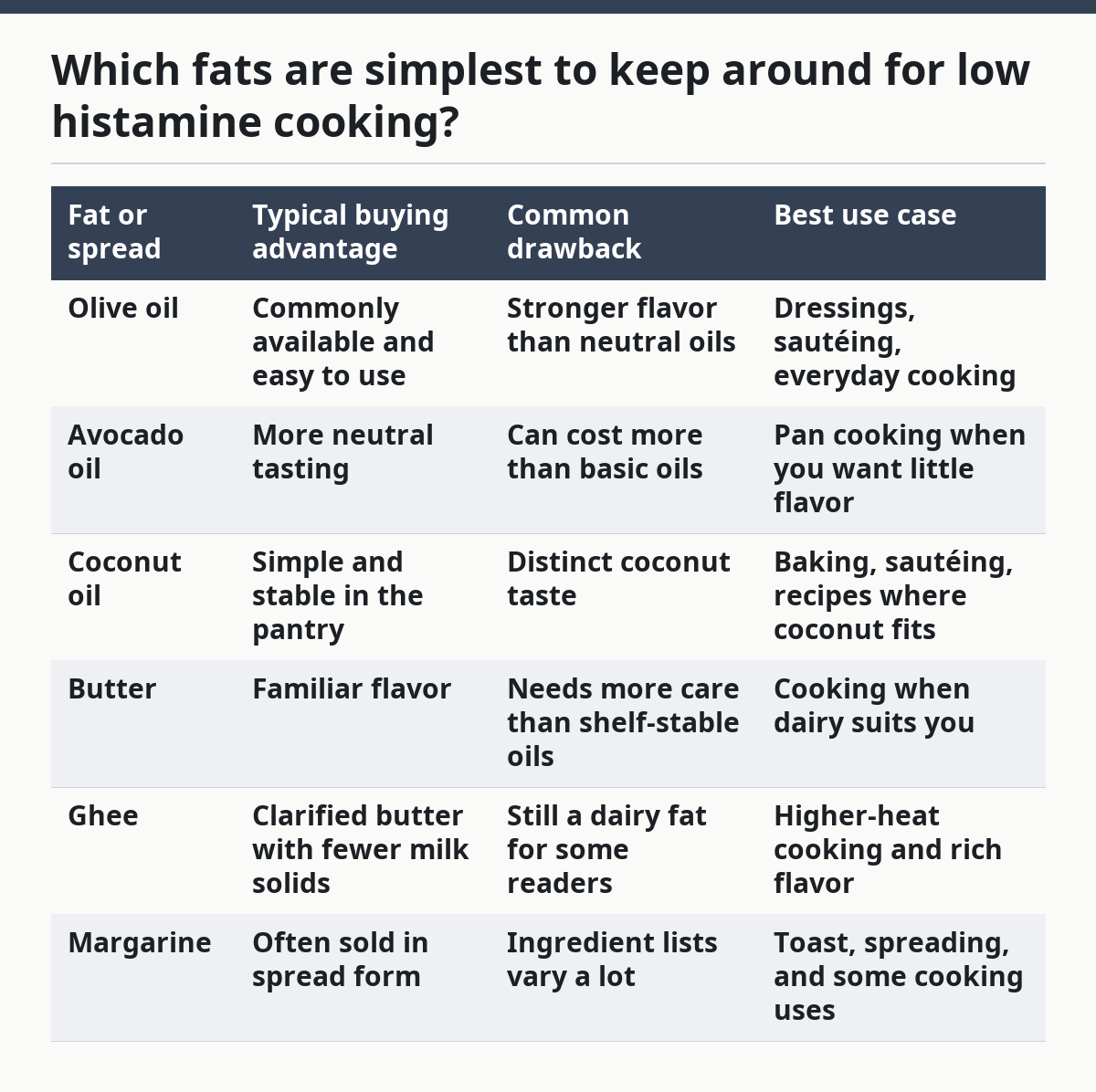
The best pick is not the fanciest one. It is the one you can buy in the same form every time. If you switch between products every trip, you add more label reading, more chance of hidden flavorings, and more room for error. In practice, that can mean saving 1 or 2 products you know well instead of trying a new bottle every week.
One honest limitation: “simple” does not mean “identical for everyone.” Butter and ghee are not the same thing, and margarine is not automatically a safe stand-in for butter. A plain margarine can be fine for one person and a poor choice for another because the ingredient list is where the real answer lives. For ingredient-specific comparisons, see the low histamine spreads guide.
How do packaging and storage change the choice?
Packaging and storage change the choice because a low histamine fat can still become a bad buy if it is hard to keep fresh. A 1-liter bottle that will linger for months is a weaker choice than a smaller bottle you can finish in normal use.
Look at the package as part of the product, not as an afterthought. Dark glass, opaque bottles, and tight lids help protect oils from light and air. A clear bottle is not automatically a bad buy, but it gives you less protection once the package is opened and sitting on the counter.
For spreads, the container matters in a different way. A tub you open and close every day gets crumbs, warm air, and spoon contact. That is one reason refrigerated spreads deserve a closer look than a sealed pantry oil. If the spread needs cold storage, treat that instruction as part of the label, not a suggestion; if you are unsure how to handle it, consult a qualified professional and check the package directions. The USDA FoodKeeper is a useful source for storage timing and handling.
Here is the core buying and storage procedure:
- Choose the smallest package you can reasonably finish, such as a bottle or tub that fits your weekly cooking pattern. A smaller size reduces the time the product sits open.
- Check the storage line on the label before paying. If the package says refrigerate after opening, plan for fridge space at home.
- Buy the version with the fewest add-ins. A plain oil or plain spread is easier to keep stable than a flavored one.
- Bring it home and seal it tightly after each use. Air and light are the main enemies of oils once the seal is broken.
- Use the product in the same way each time. A steady rotation beats leaving several half-used fats on the shelf.
The mistake to avoid is buying based on price alone. A large bottle can look cheaper, but if it sits around too long, the real cost is waste and uncertainty. A smaller container with a clear storage plan is often the smarter low histamine choice, especially when the package only lasts 4 to 8 weeks in normal use.
Which label details matter most?
The label details that matter most are the ingredient list, the storage instruction, and any extra flavoring terms that turn a plain fat into something more complicated. If a product has 2 ingredients instead of 8, that is usually easier to manage.
Read the back panel, not the front claim. “Light,” “pure,” “premium,” or “natural” tells you very little. The ingredient list tells you whether you are buying olive oil, avocado oil, coconut oil, butter, ghee, or a spread with extra ingredients that may not suit a sensitive plan. For a simple shopping companion, the low histamine condiments page can help you compare labels beyond oils.
Watch for these label signals:
- Added herbs, garlic, onion, chili, or spice blends
- “Butter flavor” or “olive oil blend” without a clear short list
- Seed oils mixed into a spread when you wanted one named fat
- Preservatives or emulsifiers you do not want to guess about
- Refrigerate-after-opening instructions on spreads and some oils
The reason this matters is simple: low histamine shopping rewards clarity. If the label needs a long second read, that product may be harder to live with than it first looked. A plain product also makes it easier to spot a bad batch or a changed formula later.
One common failure is assuming every spread works like butter. It does not. Some spreads are made for convenience and softness, not for a simple ingredient profile. If your goal is a low histamine kitchen, “spreadable” is not enough. You still need to know what is inside.
How does smoke point fit in?
Smoke point fits in as a cooking guide, not as the only rule. A higher smoke point can make a fat easier to use for hotter pans, but it does not cancel out ingredient complexity or poor storage.
For this topic, smoke point basics are enough. Use a more neutral and heat-tolerant fat when you are sautéing or pan cooking. Use a more flavorful fat when flavor matters more than heat. Coconut oil, butter, and ghee will behave differently from olive oil and avocado oil in a hot pan, and that difference affects both taste and kitchen use. If you want a broader cooking reference, see the Harvard T.H. Chan School of Public Health on dietary fats.
Do not turn smoke point into a ranking system that ignores the rest of the label. A high smoke point does not help if the product is loaded with extra flavoring or if you cannot keep it fresh. The better question is: does this fat match the way I cook most nights?
A practical rule is to keep one lower-flavor option and one richer-flavor option. That gives you a simple pair without filling the cupboard with 5 almost-identical bottles. For many people, that means one neutral oil and one spread or solid fat.
The trade-off is usually this: the most neutral option is not always the one with the most flavor, and the most stable pantry option is not always the one you reach for first. A low histamine kitchen works better when those two needs are balanced instead of chased separately.
What should I avoid on the shelf?
Avoid anything that looks like a low-histamine shortcut but hides a crowded ingredient list or an awkward storage rule. That usually means flavored oils, “buttery” blends, and spreads that need extra attention but do not offer much in return.
The biggest mistake is buying a product because it sounds gentle, then discovering it contains several ingredients you did not want to manage. Another mistake is choosing a spread that must be refrigerated and then leaving it out like a pantry oil. A third is buying a large container because it is convenient, then using it so slowly that freshness becomes a question mark.
A good rule is to skip products that fail two tests at once. If a fat has both a long ingredient list and a storage rule you are unlikely to follow, it is probably not the right pick for this task. You do not need a perfect oil for every meal; you need a dependable one.
This is also where margarine deserves caution. Plain margarine may fit some kitchens, but the label varies a lot from one brand to another. If the package reads like a chemistry set, keep moving.
Who this approach is not for: anyone trying to maximize variety, gourmet flavor, or a pantry full of specialty oils. This method favors repeatable choices over novelty. That is the point.
How do I make the final pick in the store?
Make the final pick by choosing the plainest product that fits your cooking style, your storage space, and your tolerance for flavor. If you can explain the choice in one sentence, it is probably a good candidate.
Use this quick filter:
- Can I name the fat in one word?
- Does the ingredient list stay short, usually 1 to 2 items?
- Do I know where it will live after opening?
- Will I use it often enough to finish it in a normal rotation?
- Does it fit the heat level of the meals I actually cook?
If the answer is yes to most of those questions, the product is worth considering. If the answer depends on guessing, skip it and choose a plainer option. That is usually the safer move for low histamine shopping, and it keeps the whole kitchen simpler.
The low histamine cooking fat decision is not about chasing a perfect brand. It is about making a clean, repeatable choice that holds up after the first purchase. That is the same logic that helps the rest of the low histamine grocery shopping and product selection process stay manageable.
Which fats are simplest to keep around for low histamine cooking?
The simplest fats are the ones with the shortest ingredient list and the clearest storage rule. Olive oil, avocado oil, coconut oil, butter, ghee, and plain margarine are the main names to compare, but the best one is the one you will use up at a steady pace. If you need another reference point, the low histamine food list can help you keep the whole meal plan consistent.
Do spreads need extra ingredient checks?
Yes, spreads need extra ingredient checks because many of them include more than just the named fat. A butter-style or margarine-style spread can hide extra oils, flavors, or additives, so the ingredient panel matters more than the front label.
How should i store opened oils?
Store opened oils the way the label says, then keep the lid tight and the package out of heat and light. If the product is meant for the refrigerator after opening, treat that as part of the purchase decision, not a later fix. The USDA FoodKeeper is a practical check for storage timing.
Drafted with AI; not yet reviewed by a person.