Last updated: November 19, 2026
Choose plain, short-ingredient shelf-stable breakfast items with low-risk packaging and a fast use plan. For low histamine breakfast ingredients, that usually means simple oats, rice cakes, plain cereal, seed-based spreads, and mild dried fruit with no long additive list, no flavored coatings, and no “mystery blend” on the label.
Key takeaways
- The safest shelf-stable breakfast picks are usually the plainest ones.
- Oats, rice cakes, simple cereal, nut or seed butter, syrup, and dried fruit can all fit if the label stays short.
- Packaging matters as much as the food itself; once opened, many dry items need tight sealing and a short rotation plan.
- A mix of one base, one spread, and one sweet add-on is easier to control than a premade breakfast mix.
- If a product lists a long flavor system, mixed oils, or extra inclusions, it is often a poor fit for a low histamine pantry.
What should I look for first?
Look for a plain ingredient list of about 3 to 5 items, then check whether the food can sit unopened on the shelf and still stay useful after opening. For a low histamine shelf-stable breakfast ingredient, the label should read like food, not like a lab report.
Start with the base item. Oats, rice cakes, and plain cereal are the easiest place to begin because they can be stored dry and used in more than one way. Then look at the spread or topping. Nut butter and syrup can work, but only if the product stays simple and does not hide extra oils, flavorings, or add-ins.
A beginner usually does best by buying the ingredient, not the breakfast. A box of plain oats gives more control than a flavored instant packet. A jar of plain nut butter gives more control than a sweetened spread. That matters because low histamine eating often depends on reducing surprises, not chasing a perfect list.
Two useful reference pages for reading labels are the FDA’s food allergy guidance and the USDA FoodKeeper resource:
- FDA food allergies guidance: https://www.fda.gov/food/food-labeling-nutrition/food-allergies
- USDA FoodKeeper app page: https://www.foodsafety.gov/keep-food-safe/foodkeeper-app
The trade-off is simple: the plainer the item, the more control you keep, but the less “ready-made” it feels. That is why this approach suits someone stocking a breakfast base, not someone who wants a sweet, fully assembled morning meal.
Which shelf-stable breakfast ingredients fit best?
The best shelf-stable breakfast ingredients are the ones that stay plain, store dry, and pair easily with one other food. Oats, rice cakes, cereal, nut butter, syrup, and dried fruit are the main names to know.
| Ingredient | Why it fits | Watch for | Common substitution |
|---|---|---|---|
| Oats | Dry, flexible, easy to portion | Flavored packets, long ingredient lists | If oats are not tolerated, use plain rice-based cereal or rice cakes |
| Rice cakes | Light, dry, simple base | Seasoning, chocolate coating, seed mix | Plain crackers or unsalted crispbread if tolerated |
| Cereal | Quick breakfast base | Sugar coatings, fruit bits, cocoa, additives | Plain oat-based or rice-based cereal |
| Nut butter | Adds fat and staying power | Added sugar, stabilizers, mixed oils | Seed butter if nuts are a problem |
| Syrup | Simple sweetener in a squeeze bottle or jar | Pancake syrups with flavors or blends | A plain sweetener that fits the person’s diet |
| Dried fruit | Easy add-on in small amounts | Sulfites, added sugar, mixed fruit blends | Single-fruit dried pieces with a short label |
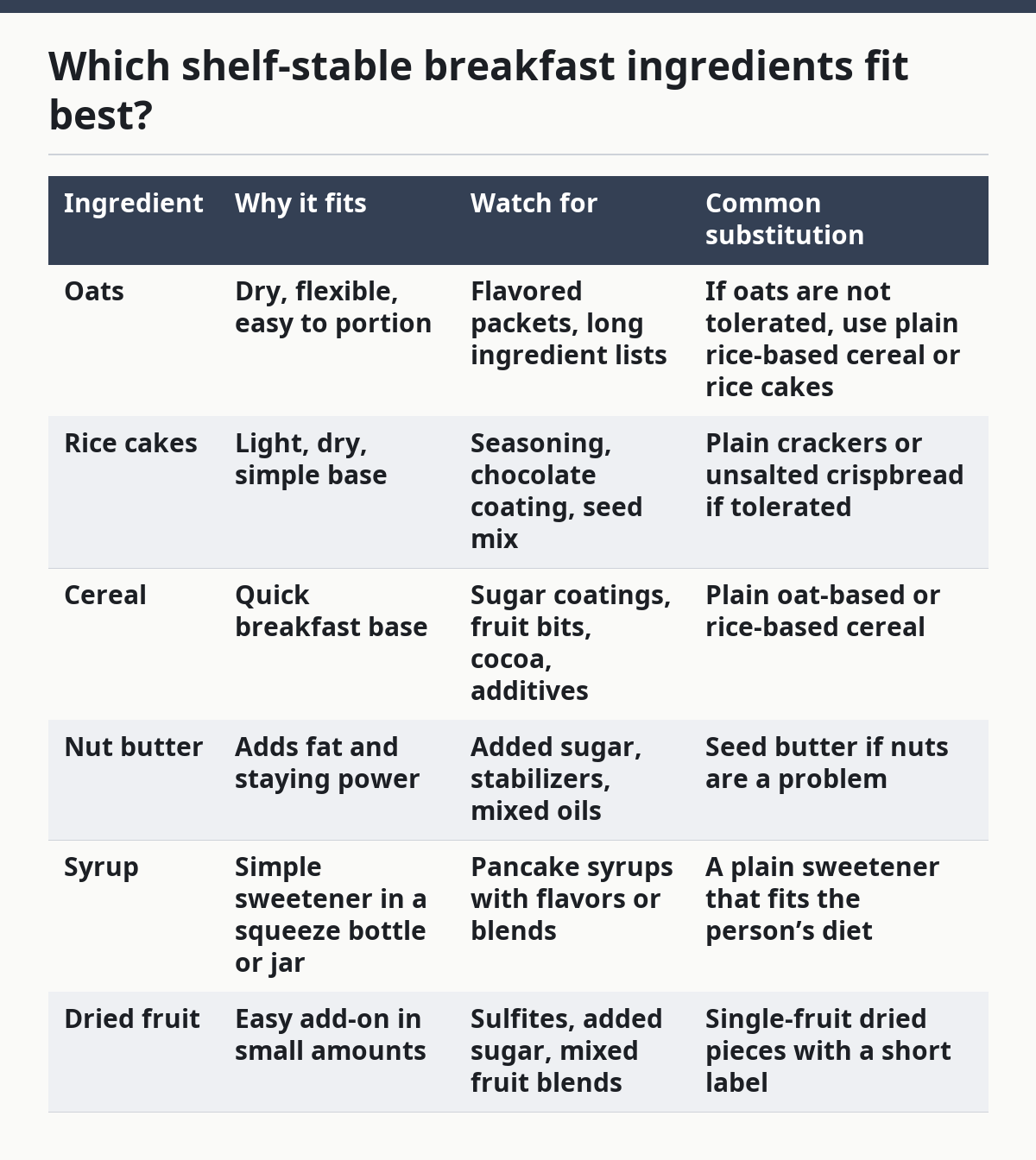
Oats deserve special attention because they are often the most useful pantry base. Plain rolled oats or similar plain oat products are easier to screen than instant flavored cups. Rice cakes are helpful when a person wants something dry and quick with no cooking. Plain cereal can work too, but the label needs a closer read because many boxes hide sugar, flavoring, and fruit pieces.
Nut butter is useful, but this is where the label matters most. A short ingredient list is better than one that mixes nuts with sugar, oil, cocoa, or flavor extracts. If nuts are a problem, seed butter is the obvious swap. That substitution is not perfect, but it gives a similar texture for spreading on rice cakes or cereal-style bowls.
Syrup and dried fruit are support ingredients, not the base. Syrup gives sweetness with little effort. Dried fruit adds texture and a little variety, but it is the kind of ingredient that can drift into trouble if the bag contains mixed fruit, oils, or preservatives a reader does not want.
How do I screen the label without overthinking it?
Screen the label in 3 quick passes: ingredients, extras, and storage instructions. That takes less than 1 minute per package once you know what to skip.
- Read the ingredient list first. Pick the plainest product on the shelf, ideally one with a short list you can read in a single glance. A box with 20 words on the front and 4 ingredients on the back is usually a better choice than the reverse.
- Check for add-ons that change the food. Skip flavored coatings, chocolate bits, fruit chunks, spice blends, and “natural flavors” if your threshold is strict. These extras are where a simple breakfast item becomes a guess.
- Look for oils, sweeteners, and stabilizers. Many people can handle them, but they often turn a basic pantry item into a more complicated choice. If a nut butter has more than nuts and salt, or if cereal reads like dessert, move on.
- Check the package type. Boxes, sealed bags, and jars are easy to store; loose bins are not. Once opened, reseal tightly or move the food to an airtight container if the package no longer closes well.
- Plan the first 7 to 14 days after opening. Dry foods hold up best when they are used quickly and kept dry. That is where shelf-stable breakfast ingredient choices succeed or fail in real kitchens.
The biggest mistake here is trying to make every item “low histamine” by guesswork alone. A plain-looking package can still hide a long additive list. On the other hand, a product with a short, boring label is often the better pick even if it is not marketed for special diets.
This is also where the category split matters. Some foods are ingredients, and some are breakfast products pretending to be ingredients. A plain oat box is easier to judge than a flavored breakfast biscuit. That difference saves time and reduces second-guessing.
How should I store them after I buy them?
Store shelf-stable breakfast ingredients in a cool, dry cabinet, then keep opened items sealed tightly so they do not pick up moisture or odors. Dry storage is the main job here, and it matters more than fancy containers.
Use a simple routine:
- Keep unopened boxes and bags in one cabinet section so older items are easy to see.
- Open one item at a time when possible, instead of opening five packages and forgetting which one came first.
- Move oats, cereal, or dried fruit into airtight containers only if the original package does not reseal well.
- Keep nut butter sealed and upright, with the lid tightened after every use.
- Put a date on the package when you open it, using a pen and masking tape if needed.
A shelf-stable food is not the same as a forever food. Once opened, it is vulnerable to air, heat, and contamination from crumbs or damp spoons. That is why the best low histamine pantry setup is simple: short ingredient list, dry cabinet, and quick use.
The FoodKeeper resource from USDA is useful here because it helps frame storage time as a practical kitchen issue, not a guessing game. If a package has a “best by” date, treat that as a quality guide, then rely on your own storage habits after opening. Dry foods that get clumpy, smell off, or show moisture are not worth pushing.
Who this is not for: someone who wants to buy one giant breakfast bin and forget it for months. That approach tends to fail because dry foods still age, and opened packages do not stay unchanged just because they are shelf-stable.
What mix-and-match combinations work best?
The best low histamine breakfast combinations use one base, one spread, and one small sweet add-on. That gives structure without forcing a recipe.
Here are practical combinations built from the named ingredients on this page:
| Base | Spread | Add-on | Result |
|---|---|---|---|
| Oats | Nut butter | Dried fruit | A simple bowl with more body and sweetness |
| Rice cakes | Nut butter or seed butter | Syrup | A fast hand-held option |
| Plain cereal | Nut butter | A few dried fruit pieces | A dry bowl with extra richness |
| Oats | Syrup | Dried fruit | A softer, sweeter bowl |
| Rice cakes | Syrup | None | The simplest grab-and-go option |
The point is not to make breakfast fancy. The point is to make it dependable. One base keeps the meal from becoming random. One spread adds staying power. One small sweet ingredient keeps the meal from feeling like plain cardboard.
This is also where the right grain matters. Oats are better when you want something more filling. Rice cakes are better when you need speed or a lighter option. Plain cereal sits in the middle, which makes it useful for mornings when you want no cooking and no long prep.
If nuts are a problem, the swap is seed butter. If syrup feels too sweet, leave it out. If dried fruit is not tolerated, skip it and keep the base plain. Low histamine breakfast planning works better when the formula stays flexible instead of fixed.
What mistakes make these foods a bad fit?
The biggest mistakes are buying flavored products, storing opened food too loosely, and treating all shelf-stable items as equally safe. Each mistake costs time, money, and trust in the pantry.
Flavored oats, frosted cereal, and sweetened nut butter look convenient but often carry extra ingredients that make label screening harder. That can lead to buying something that seems simple and then discovering it is not a fit. The fix is to choose the plain version first and add sweetness later with a separate ingredient like syrup or dried fruit.
Another mistake is ignoring the package seal. A zip-top bag that does not close properly can let in moisture and crumbs. That can change texture fast, especially for oats, cereal, and dried fruit. An airtight container solves that problem better than folding the top over once and hoping for the best.
A third mistake is buying too many versions of the same item. Three different cereals and two nut butters sound flexible, but they make it harder to learn what actually works. One plain option in each category is usually enough for a first pass.
The last mistake is assuming “shelf-stable” means “safe forever.” Dry food lasts longer than fresh food, but it still needs a dry cabinet, a closed lid, and a plan for use. If the package has been opened and forgotten, it should not stay on the breakfast shelf just because it looks untouched.
Can I build a breakfast base from just these foods?
Yes, you can build a workable breakfast base from oats, rice cakes, cereal, nut butter, syrup, and dried fruit alone. The easiest structure is one dry base plus one topping, with an optional sweetener if the base is plain.
That matters because many low histamine shoppers do not want a full meal kit. They want ingredients that can sit on a shelf and still turn into breakfast in 2 or 3 minutes. A single box of oats or cereal, a jar of nut butter, and one bag of plain dried fruit can cover several mornings without much decision fatigue.
The limit is variety. These foods can carry a morning, but they do not create endless options by themselves. If a person wants savory breakfast choices, chilled foods, or cooked protein, this page is not the right answer. It is for stock-up shopping and simple assembly, not for a full breakfast menu.
That is also why the hub page matters. This article belongs inside a bigger pantry system, where shelf-stable items are only one part of the larger low histamine shopping picture.
What shelf-stable breakfast foods are easiest to keep on hand?
The easiest shelf-stable breakfast foods to keep on hand are plain oats, rice cakes, plain cereal, nut butter, syrup, and dried fruit. They store in a dry cabinet, pair in simple ways, and do not require a refrigerator until after opening if the package stays sealed.
Plain oats and rice cakes are the least fussy because they stay useful across many breakfasts. Nut butter and syrup are easy add-ons because they turn plain bases into something more filling or more pleasant. Dried fruit works best in small amounts because it changes the texture and sweetness without much effort.
Which breakfast ingredients are less likely to spoil quickly?
Dry, unopened ingredients are less likely to spoil quickly than moist or highly perishable foods. Oats, rice cakes, boxed cereal, sealed nut butter, syrup, and dried fruit all fit that pattern better than fresh fruit, milk, or cooked leftovers.
The key is what happens after opening. If a package stays dry and closed, it holds up better. If it takes in moisture, gets crumbly, or picks up an off smell, it is no longer doing the job you bought it for.
What can I combine for a simple low histamine morning meal?
A simple low histamine morning meal can be one base plus one topping, such as oats with nut butter, rice cakes with syrup, or cereal with a few pieces of dried fruit. That keeps the meal short, repeatable, and easier to screen for label issues.
If nuts are a problem, use seed butter instead. If sweetness is not needed, skip syrup and keep the base plain. The safest pattern is the one you can repeat without a long ingredient search every morning.
Drafted with AI; not yet reviewed by a person.