Last updated: November 19, 2026
Quick Answer: Histamine intolerance symptoms and food triggers often show a repeatable pattern in 2 to 4 weeks, especially when several symptoms follow the same meal. If the reaction is severe or constant, consult a professional.
Key Takeaways
- Histamine intolerance symptoms often affect more than one body system, which is why they can be hard to spot.
- The main suspects are high-histamine foods, histamine releasers, and foods that slow breakdown.
- Symptoms can start within minutes to a few hours, but timing alone does not prove the cause.
- Tracking food and symptoms for 2 to 4 weeks can reveal repeat patterns.
Histamine intolerance symptoms often show up as a pattern, not a single dramatic reaction: flushing, headaches, nasal congestion, itching, hives, stomach upset, or a mix of skin symptoms and gastrointestinal symptoms after certain meals. If that sounds familiar, speak with a qualified professional about your own situation, because food patterns can overlap with allergies, mast cell disorders, and other conditions. This guide on Histamine Intolerance Symptoms and Food Triggers: How to Tell If Food Is the Problem focuses on how to tell whether food is the problem.
Who this is for — and who should do something else
This guide is for someone who notices that food seems to affect symptoms within minutes to a few hours, especially when the same meals keep causing trouble. It assumes you already know the basics of tracking what you eat, and that you are trying to decide whether histamine intolerance, a food allergy, or something else is more likely. It also assumes you can keep a simple food-and-symptom log for at least 7 days.
This is not the right starting point if you have swelling of the lips or tongue, trouble breathing, fainting, or a rapidly spreading rash after eating. Those are emergency red flags, not a food journal problem. It is also not the right tool if your symptoms are constant and unrelated to meals, or if you already have a diagnosed condition that needs a clinician’s plan, such as inflammatory bowel disease or a known food allergy. If that sounds like your situation, consult a professional for evaluation rather than relying on self-tracking alone.
The term histamine intolerance is used for a pattern where histamine seems to build up faster than the body can break it down, but it is not a single, universally standardized diagnosis. A generic article often implies there is one neat test or one perfect elimination diet. There usually is not. Many clinicians first look for a pattern across histamine intolerance symptoms, then rule out other causes before labeling the problem. For background, see the NHS overview of histamine intolerance and related diet guidance from the Cleveland Clinic.
Use this guide as a way to organize the question: “Is food the trigger, and if so, which kind of food pattern fits best?” A short tracker, a careful look at timing, and an honest review of alternatives are more useful than guessing from one bad meal. If you need a broader food framework later, the hub on histamine friendly foods can help with planning, but this page is about recognizing the problem first.
What histamine intolerance symptoms usually look like
Histamine intolerance symptoms usually involve more than one body system, and that mix is part of what makes them confusing. A person may notice flushing, itching, hives, nasal stuffiness, headache, reflux, nausea, diarrhea, abdominal cramping, or a racing heartbeat after eating. Skin symptoms and gastrointestinal symptoms often show up together, though not every person gets both. Mayo Clinic notes that histamine-related reactions can vary widely, which is part of the diagnostic challenge.
The pattern often looks inconsistent at first. A meal may be fine one day and cause symptoms another day, especially if the meal was higher in histamine, the portion was larger, alcohol was involved, or sleep and stress were poor. That inconsistency is one reason people miss the connection. They blame one ingredient, when the real issue may be the total load from several foods in a 24-hour period.
A useful clue is symptom variety. Food allergies often produce a more immediate, narrower set of signs, such as hives, swelling, wheezing, or vomiting soon after exposure to a specific food. Histamine intolerance is commonly discussed as broader and more variable. That does not make it harmless or definite; it just means the pattern is different. Mast cells, the immune cells that release histamine and other mediators, can also be involved in related disorders, which is one reason symptoms can look similar across conditions.
If the only symptom is one isolated complaint, such as a headache every few weeks, histamine intolerance is less convincing than a repeated pattern across several meals or days. The pattern becomes more plausible when the same clusters of symptoms keep returning.
Which foods most often raise suspicion?
The foods that raise suspicion are usually the ones that are already high in histamine, promote histamine release, or interfere with breakdown. A simple food log often points to leftovers, fermented foods, aged cheeses, cured meats, vinegar-heavy meals, alcohol, and fish that is not very fresh. That list is not a diagnosis; it is a map of common triggers to examine. For more detail, the Cleveland Clinic and NHS both list similar categories.
A generic article will often list “bad foods” as if the issue were fixed. It is not. The same food can be tolerated in one context and poorly tolerated in another. Freshness matters. Storage matters. Portion size matters. A meal with several moderate triggers can behave like one large trigger.
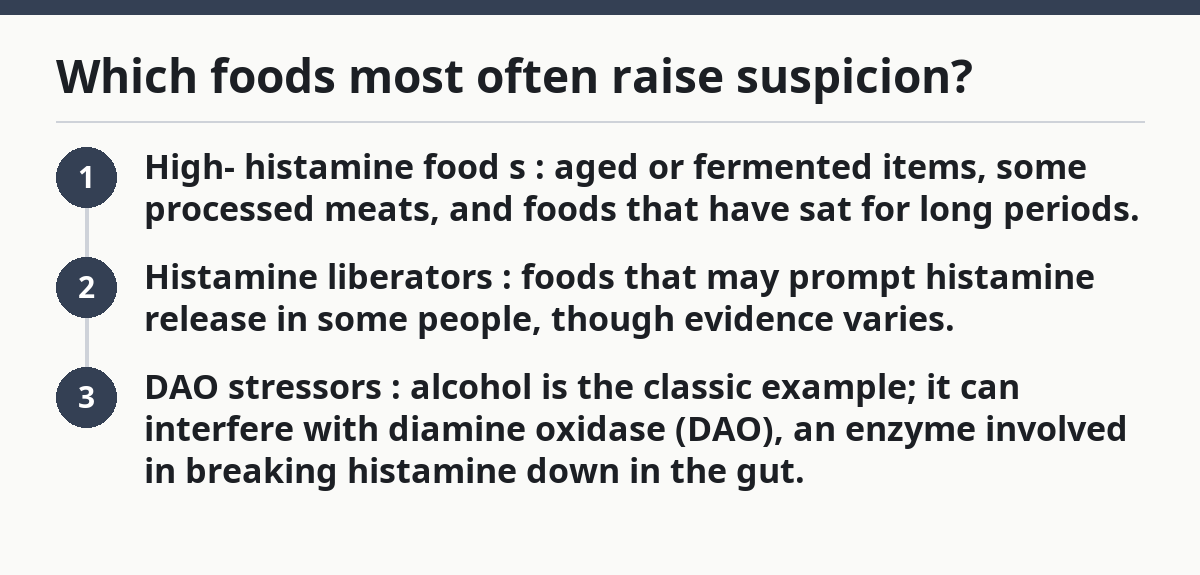
Three categories matter most:
- High-histamine foods: aged or fermented items, some processed meats, and foods that have sat for long periods.
- Histamine liberators: foods that may prompt histamine release in some people, though evidence varies.
- DAO stressors: alcohol is the classic example; it can interfere with diamine oxidase (DAO), an enzyme involved in breaking histamine down in the gut.
This is where people go wrong: they build a list from the internet, remove half the pantry, and still feel bad because the real pattern is elsewhere. For example, a meal of leftovers, wine, and cheese may matter more than any single ingredient. A plain chicken dinner eaten fresh may be fine, while the same chicken reheated two days later may not be.
A measured approach is better than a complete purge. The goal is not to live on a tiny menu forever. The goal is to see which foods, storage patterns, and combinations repeatedly precede symptoms.
How quickly do histamine symptoms appear after eating?
Histamine-related symptoms often appear within minutes to a few hours after eating, but timing varies enough that the interval alone cannot prove the cause. Some people notice flushing or itching quickly. Others notice headache, congestion, or stomach upset later, sometimes after a meal plus a trigger such as alcohol or exercise. Cleveland Clinic and Mayo Clinic both note that timing can vary.
The key is to look for a repeatable time window. If symptoms appear within the same 15-minute to 4-hour range after similar meals on multiple occasions, that pattern becomes more meaningful. If symptoms show up the next morning without any consistent food link, food may be only one piece of a larger picture.
A practical way to study timing is to record:
- the meal time,
- the exact foods,
- portion size,
- any alcohol,
- when symptoms started,
- which symptom came first.
That five-part record is more useful than “I felt bad after dinner.” A symptom that starts 20 minutes after a meal and follows the same sequence each time is more suggestive than one that appears 18 hours later with no pattern.
Do not over-read a single fast reaction. A true food allergy can also appear quickly, and some non-food issues can mimic the same timeline. Likewise, not all histamine-type reactions are immediate. The timing tells you where to look, not what to conclude. If the reaction is severe, urgent, or includes breathing trouble, stop the experiment and get medical care right away.
How to sort food triggers without guessing
You can sort food triggers by tracking, trimming variables, and watching for repeatable patterns over 2 to 4 weeks. That is usually enough time to see whether food is involved without turning every meal into a science project.
Start with a simple notebook or phone note. Write down each meal, snack, and drink for at least 7 days before changing anything. Include leftovers, sauces, condiments, and alcohol. Then compare symptom days with non-symptom days. The point is not to identify one “villain” food from memory. The point is to see whether the same categories keep lining up with the same symptoms.
Use this stepwise approach:
- Record every meal for 7 days. Write the full menu, not just the main dish, and include leftovers, drinks, sauces, and supplements. Verify that each entry has a time stamp to the nearest hour. A problem is any missing meal or vague note like “snack.”
- Mark symptom onset in minutes or hours. Note exactly when flushing, itching, headache, stomach pain, reflux, diarrhea, or congestion began. Verify whether the first symptom appeared within a 15-minute to 4-hour window after eating. A problem is a vague entry like “later that day.”
- Circle repeated trigger categories. Look for patterns involving fermented foods, aged foods, alcohol, leftovers, or mixed meals. Verify that the same category appears at least 3 times before treating it as meaningful. A problem is reacting to one isolated meal and assuming it proves the trigger.
- Change one variable at a time for 1 to 2 weeks. Keep the rest of the menu as stable as possible while testing one category, such as leftovers or alcohol. Verify that the change is narrow enough to interpret. A problem is removing 10 foods at once and then not knowing what mattered.
- Check freshness and storage. Note whether meat, fish, or prepared foods were eaten immediately, refrigerated, or kept for several days. Verify that storage times are written down. A problem is forgetting that a food was cooked on Monday and eaten again on Thursday.
- Compare meal load, not just ingredients. Record whether several moderate triggers came together in one meal. Verify if symptoms follow stacked exposures, such as wine plus cheese plus leftovers. A problem is blaming only the cheese when the full meal was the issue.
- Review the pattern with a clinician if it repeats. Bring the log to an allergist or other qualified professional, especially if symptoms involve skin symptoms and gastrointestinal symptoms together. Verify that the pattern is clear enough to discuss. A problem is continuing a strict self-imposed diet for months without confirming the cause.
A good result is not “I never eat anything fun again.” A good result is a clearer, smaller list of foods or situations that repeatedly line up with symptoms. That may point toward histamine intolerance, but it may also point toward a food allergy, reflux, irritable bowel syndrome, medication effects, or mast cell-related issues.
Histamine intolerance symptoms are not the same as a food allergy
Histamine intolerance symptoms are not the same as a food allergy, even though the two can look similar on the surface. A food allergy involves an immune response to a specific food protein, while histamine intolerance is usually discussed as a mismatch between histamine load and breakdown. That distinction matters because the next step is different.
Allergies often have a clearer culprit and a faster, more repeatable pattern after one particular food. Histamine intolerance more often shows up as a threshold problem: enough histamine from one meal, or from several foods across a day, seems to tip the body over. That is why a person might tolerate one serving but not a larger portion, or do fine with fresh food but not leftovers.
Mast cells can blur the picture. These cells release histamine and other chemicals, so mast cell disorders can create symptoms that resemble either allergies or histamine intolerance. A person with repeated flushing, hives, abdominal pain, or lightheadedness after meals needs a real evaluation, not a self-made label.
The wrong move is to assume all post-meal symptoms are histamine intolerance and start eliminating major food groups indefinitely. That can hide a true allergy or another condition that deserves a different plan. It can also make eating harder than it needs to be. If a symptom pattern is strong enough to change your diet for more than 2 to 3 weeks, it is strong enough to discuss with a professional.
When to stop self-tracking and get evaluated
Self-tracking should stop when the pattern is severe, unclear, or medically risky. Food logs are useful, but they are not a substitute for evaluation when the clues point beyond a simple intolerance.
Breathing trouble, throat tightness, or facial swelling: This can signal an allergic reaction — seek urgent medical care immediately rather than continuing food experiments.
Symptoms start within minutes of a specific food every time: That pattern fits a possible allergy more than a vague intolerance — see an allergist for proper evaluation.
Symptoms happen with little or no relation to meals: Food may not be the main driver — ask a qualified professional to look for other causes.
Repeated hives, flushing, or diarrhea affect daily life: The pattern may involve mast cells, allergy, or another disorder — bring the log to a clinician instead of tightening the diet further.
You are cutting more and more foods to stay comfortable: Restrictive eating can become unsafe and nutritionally thin — stop expanding the list and get guidance.
Symptoms are getting worse over 2 to 4 weeks: Worsening patterns deserve medical review, not more guesswork — seek evaluation promptly.
A good rule is simple: if the pattern is stable and mild, tracking may help clarify it. If the pattern is intense, escalating, or tied to alarming symptoms, the problem is no longer just “finding a trigger.” It is getting the right diagnosis.
For general background on food patterns, the hub on histamine friendly foods can help later, but the diagnosis question belongs with an allergist or other qualified clinician.
Common mistakes that make the pattern harder to see
The most common mistake is changing too many variables at once. Removing fermented foods, leftovers, alcohol, and dairy in the same week can make symptoms improve, but it leaves you with no clue which factor mattered. The correct move is to test one change for 1 to 2 weeks at a time.
Another mistake is judging by one meal. Histamine-related patterns often depend on the day’s total load, not one ingredient eaten in isolation. The consequence is false certainty. The better alternative is to compare several similar meals and look for repeats.
A third mistake is ignoring freshness and storage. A fish dish eaten the day it was cooked is not the same as the same dish eaten after several days in the fridge. The consequence is blaming the wrong food. The fix is to log preparation day and leftovers every time.
A fourth mistake is treating skin symptoms and gastrointestinal symptoms as separate problems. In histamine-related patterns, they may belong to the same episode. The consequence is fragmented notes and missed patterns. The better approach is to record all symptoms together, even if one seems minor.
A fifth mistake is self-diagnosing from social media lists. Those lists often mix allergies, intolerance, and mast cell issues into one bucket.
Drafted with AI; not yet reviewed by a person.