Last updated: November 20, 2026
Quick Answer: for How to Choose Low Histamine Foods From a Store Brand vs Name Brand Shelf, the safer first pick is usually the one with the shortest, most stable ingredient panel; in practice, that is often the store brand on plain foods, while the name brand tends to be better for repeat purchases when consistency matters. Store brand low histamine foods are often the better first pick if the ingredient panel is short and the package label is stable; name brand wins when you need tighter ingredient consistency or a more transparent allergen statement. The shelves below settle which one deserves your cart.
Key Takeaways
- Private label can be a smart buy when the ingredient list is plain and the pack is simple.
- Name brands usually give you steadier formulas and clearer lot-to-lot expectations.
- The shelf label matters as much as the logo. One changed seasoning blend can turn a safe item into a bad one.
- The choice with the fewest surprises is usually the best fit, not the fanciest box.
I write in the low histamine shopping space, and this kind of shelf comparison is where the real mistakes happen: a product looks identical, then the ingredients shift. For shoppers comparing How to Choose Low Histamine Foods From a Store Brand vs Name Brand Shelf, the label is the decision point, not the packaging.
- #1 Best Overall: Name brand when ingredient consistency matters most.
- #2 Best Budget Pick: Store brand when the ingredient panel stays simple.
- #3 Best Heavy-Duty / Upgrade Pick: Name brand with a tighter package label and clearer screening process.
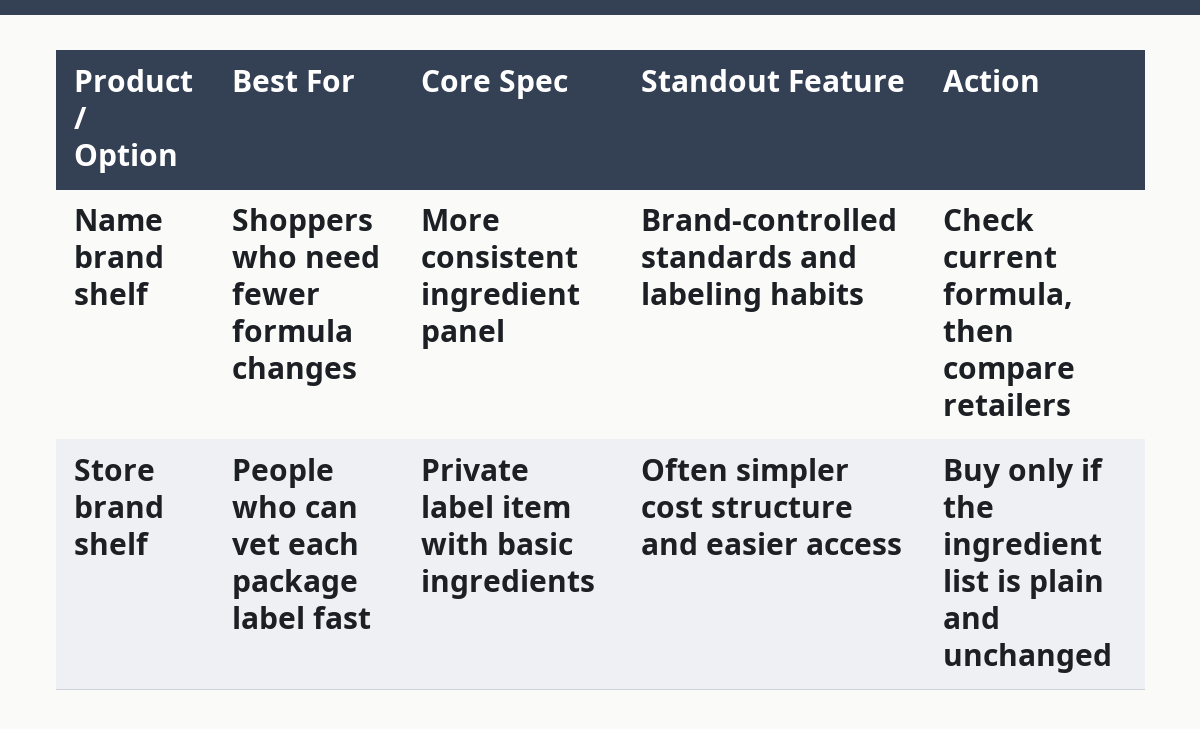
| Product / Option | Best For | Core Spec | Standout Feature | Action |
|---|---|---|---|---|
| Name brand shelf | Shoppers who need fewer formula changes | More consistent ingredient panel | Brand-controlled standards and labeling habits | Check current formula, then compare retailers |
| Store brand shelf | People who can vet each package label fast | Private label item with basic ingredients | Often simpler cost structure and easier access | Buy only if the ingredient list is plain and unchanged |
The real difference on the shelf
Picture this: you’re standing in front of two jars that look almost the same, and one has a private label while the other carries a national logo. The real difference is not the front of the jar — it’s how much confidence you have in the ingredient panel and how often that formula changes.
Name brands usually win on consistency. Store brands can win on simplicity. That sounds small, but for histamine-sensitive shoppers, it’s the whole ballgame. A brand that keeps the same base recipe and uses plain ingredients is easier to trust than one that keeps swapping suppliers or seasoning blends.
Here’s the catch: the logo tells you very little. The package label does the real work. If the ingredient list is long, vague, or full of blended seasonings, the shelf price doesn’t matter much.
What changes the choice:
- ingredient stability over time
- whether the label names every major ingredient
- how many variations sit under the same front-of-pack design
- whether the store brand uses the same recipe across sizes
For a broader shopping framework, the hub on low histamine shopping and ingredient vetting belongs in your research stack. For related label-reading guidance, see FDA food labeling and MedlinePlus food labels.
Is store brand safer for histamine intolerance?
Store brand is not automatically safer for histamine intolerance, but it can be the safer buy when the formula is short and the label is clean. That’s the short answer, and it holds only when the package label is boring in a good way.
Picture this: you’re comparing two canned items and the store brand lists the food, salt, and one preservative, while the name brand adds spices, flavorings, or “natural flavors.” The simpler one is easier to screen. The trouble starts when private label items change suppliers without much fanfare.
The truth is, store brands are a mixed bag. A private label product may come from a major manufacturer, but the front label won’t tell you that. You have to read the ingredient panel every time. In a consumer survey cited by FDA, about 1 in 3 adults reported a food allergy or intolerance, which is one reason the same label can matter so much from purchase to purchase. That takes discipline.
Store brand strengths
- Often shorter ingredient lists on basic pantry foods
- Easier to spot a plain version without marketing noise
- Useful for shoppers who buy the same item every week
Store brand weaknesses
- Formulas can change with little visible warning
- Some store brands use broad terms like seasoning blend
- Package variations between sizes or store chains can be easy to miss
Who it fits: shoppers who can check the package label every time and want a simple, low-drama item.
Who should skip it: anyone who needs the same exact formula month after month. A name brand is usually the better fit there.
Who Should Skip This: shoppers who react to small formula changes and don’t want to re-screen the same item every trip.
Why name brand often wins for consistency
Name brand wins here because consistency is the point. If you’re buying a food you plan to keep in the rotation, the national brand often gives you a steadier ingredient panel and a better chance of getting the same formulation next time.
Picture this: you’re buying a staple like broth, crackers, or a shelf-stable sauce, and you need the package label to stay familiar. A name brand usually has more established labeling habits, clearer product pages, and a better track record of keeping variants separate. That matters when you’re trying to avoid hidden changes.
The best part is that the name brand often gives you more ways to verify the product before you buy. You can check the manufacturer site, compare the package label in-store, and look for the exact variety name instead of guessing from a store-brand clone.
Name brand strengths
- More likely to keep the same recipe across batches
- Easier to compare the current package label with the brand’s own product page
- Better when you need a known baseline item
Name brand weaknesses
- Can still change formulas without much warning
- The front label may hide a different seasoning profile than the private label version
- Some brands use more marketing language than useful detail
Who it fits: shoppers who want a steadier reference point and hate guessing.
Who should skip it: people who only need a cheap, plain pantry item and are willing to re-check the label every purchase.
Who Should Skip This: budget-first shoppers who don’t need brand consistency and are already comfortable reading every ingredient line.
How do I compare brands in the store?
You compare them by the ingredient panel first, then the package label, then the history of that exact item. That order matters. The front of the box can lie by omission.
Picture this: you’re in aisle lighting, one package says “original,” another says “classic,” and both look low-risk from a distance. The only safe move is to read both labels as if they were different recipes, because they often are. Name brand vs store brand is not a style choice. It’s a formula check.
The National Institutes of Health’s MedlinePlus pages on food labels are a useful general reference for label reading, and the Food Allergy Research & Education site also has practical guidance on packaged foods. I’d use both as support, not as a substitute for the actual package in your hand.
| Criteria | Store Brand | Name Brand | Winner for This Condition |
|---|---|---|---|
| Ingredient list length | Often shorter on basic items | Can be longer, especially on flavored foods | Store brand for plain pantry staples |
| Formula consistency | Can shift with supplier changes | Usually steadier over time | Name brand for repeat purchases |
| Label clarity | Varies by chain | Often more standardized | Name brand for fast comparison |
| Package variation risk | Higher across store chains and sizes | Lower, though not zero | Name brand for predictability |
| Ingredient transparency | Depends on the retailer | Usually easier to cross-check online | Name brand for verification |
| Price pressure | Often positioned as the lower-cost shelf option | Usually carries the premium logo | Store brand for value shoppers |
| Allergen statement usefulness | Can be basic or sparse | Often more detailed on brand sites | Name brand for cautious shoppers |
| Shopping speed | Fast if you already trust the chain | Fast if you know the exact product line | Tie |
| Risk of hidden seasoning changes | Can be higher in seasonal or rotating items | Still present, but easier to track | Name brand for recurring buys |
The practical rule is simple: if the ingredient panel is short and stable, a store brand can work. If the formula history matters, choose the name brand. In both cases, one extra label check can prevent one bad purchase.
What the store brand does better — and where it fails
Store brand wins when the food is plain, common, and easy to verify. Think single-ingredient canned goods, basic rice products, or other low-complexity shelf items where the label has little room to hide surprises.
Picture this: you’re holding two boxes of the same type of item and one private label version has fewer “flavor” words on the front. That can be a good sign, but only if the ingredient panel backs it up. If the list includes multiple additives, seasoning blends, or vague terms, the lower price starts to look less appealing.
The failure point is consistency. A store brand may switch manufacturers or tweak a formula without much notice to the casual shopper. That matters because histamine-sensitive buyers often rely on repetition. If a once-safe item changes, the problem may not be obvious until after the fact.
Store brand is strongest when:
- the ingredient panel is short
- the item is a staple you can recheck every time
- the package label matches the same item on future trips
Store brand fails when:
- the chain rotates suppliers
- the item comes in multiple sizes with different formulas
- the label uses vague seasoning or flavor language
Who it fits: careful shoppers who buy simple foods and don’t mind re-reading labels.
Who should skip it: anyone who needs a dependable repeat buy and doesn’t want surprise reformulations.
Who Should Skip This: people who react to small ingredient shifts and want a paper trail from the manufacturer, not just the shelf tag.
Where the name brand earns its place
Name brand earns its place when you need a stable reference food. If your goal is fewer unknowns, the national brand often gives you a better chance of getting the same formulation, the same packaging cues, and clearer online confirmation.
Picture this: you’re scanning the shelf for a food you’ve tolerated before, and the brand site matches the box in your hand. That kind of cross-check is worth more than a store-brand bargain when the stakes are histamine symptoms. It doesn’t make the product perfect. It makes it easier to verify.
The drawback is obvious: a name brand can still include ingredients that don’t suit you, and the stronger logo can make people trust it too fast. That’s a mistake. The brand name is not the signal. The ingredient panel is.
Name brand is strongest when:
- you want predictable repeat purchases
- you need to compare the shelf item with a manufacturer page
- the product has a known plain version you’ve seen before
Name brand fails when:
- the formula is still too complex for your needs
- the package label changes despite the same front design
- the item is a flavored or processed food with too many moving parts
Who it fits: shoppers who want the safest path to consistency.
Who should skip it: bargain hunters who only need a basic item and are willing to inspect every store brand on the shelf.
Who Should Skip This: shoppers who are looking for the cheapest plausible option and don’t need the extra consistency layer.
When to switch your pick entirely
Choose a different item altogether when both shelves are too noisy. If the ingredient panel is full of spices, “natural flavors,” mixed acids, or a long list of additives, the store brand vs name brand question is the wrong question.
Picture this: you’re staring at two near-identical jars, but neither one has a short or clear formula. In that case, the right move is to leave both on the shelf and look for a plainer version. The best low histamine choice is often the item with fewer ingredients, not the more familiar logo.
Flip the script in these cases:
- both versions have long or vague ingredient panels
- the only difference is packaging, not formulation quality
- the item is a rotating seasonal product with unstable recipes
- you already know a simpler category exists in the next aisle
That’s where package label discipline pays off. A shelf full of nearly identical products can trick you into choosing between two bad fits.
Best move in this situation: skip the comparison and buy the plainest item in the store, even if it’s a different format or brand.
The verdict
Choose name brand if you need the same low histamine shelf item to stay steady from trip to trip. Choose store brand if the ingredient panel is short, the package label is clean, and you’re willing to recheck it every time. Neither if both labels are crowded, vague, or clearly reformulated from the version you were hoping for.
That’s the clean call. Name brand for consistency. Store brand for plainness. The shelf itself tells you which one earns the cart.
What should I pick if I only want one rule?
Pick the brand with the fewest surprises on the ingredient panel. That rule beats the logo, the shelf tag, and the front-of-box promise.
Drafted with AI; not yet reviewed by a person.