Last updated: November 20, 2026
Quick answer: use a 3-part check for low histamine bread, wraps, and tortillas at the store—plain ingredients, the freshest usable date, and a freezer plan for anything you will not eat within 1 to 3 days. The biggest traps are long storage time, long ingredient lists, and add-ins like seeds, vinegars, or “natural flavors” that can make an otherwise plain product a poor fit.
Key takeaways
- Freshness matters as much as ingredients, because older bread can be a worse fit even when the label looks simple.
- Plain sandwich bread is easier to judge than flavored wraps, stuffed flatbread, or seasoned pita.
- Tortillas can work well when they are plain and short-ingredient, but the right choice depends on the base flour and the additives.
- Freezing after purchase helps you control timing, which is useful when the store date is too far away.
- Seed-heavy, grain-heavy, or sourdough-style products are often the ones to skip first.
What should I check first on the shelf?
Start with the ingredient list, the date code, and the style of bread in that order. For low histamine bread, wraps, and tortillas at the store, that gives you the quickest filter before you compare six nearly identical packages of sandwich bread, wraps, tortillas, or pita.
Use this simple 5-step check in the aisle:
- Pick the plainest style first. Choose sandwich bread, basic tortillas, plain wraps, or plain flatbread before anything with herbs, cheese, fruit, onion, garlic, seeds, or spices. A plain package is easier to fit into a low histamine plan than a “specialty” loaf.
- Read the ingredient list from top to bottom. Shorter is better here. If the first few items already include several add-ins, skip it and move on.
- Check the freshness date or best-by date. Pick the package with the nearest reasonable date if you plan to eat it soon, since stale bread is harder to manage for this use. If the date is far away, plan to freeze it the same day.
- Look for storage clues. Shelf-stable bread and tortillas are common, but a long shelf life can mean more preservatives or a product that sits longer before you use it. That is not automatically bad, but it is a trade-off.
- Choose one package only after you know how you will store it. If you will not finish it in a few days, make sure your freezer space is ready.
Because of that, the simplest product you will actually use within 1 to 3 days is usually the easiest low histamine bread, wraps, and tortillas at the store to manage, or the one you can freeze right away in slices. The worst fit is the loaf that looks “healthy” because it has seeds, grains, and extras piled on top of a long ingredient list.
Which ingredients make bread less suitable?
Ingredients that make bread less suitable are usually the ones that add fermentation, acidity, flavoring, or extra plant parts that can be harder to tolerate. That includes vinegar, sourdough-style starters, yeast-heavy specialty breads with long proofing claims, seed mixes, and breads packed with nuts, dried fruit, or spices.
A plain sandwich bread often has a cleaner profile than a “rustic” loaf or bakery wrap. A simple tortilla can also be easier than a flavored wrap, but many tortillas still carry emulsifiers, gums, or preservatives that you may want to judge case by case. Low histamine shopping is not about one perfect ingredient; it is about avoiding stacked triggers in the same package.
However, the label still matters even when the product sounds plain. Here is a practical comparison of common store options:
| Product type | Usually easier to fit? | Common trade-off | Good sign on the label | What to skip first |
|---|---|---|---|---|
| Sandwich bread | Often yes | Can be highly processed | Short ingredient list, plain style | Seeds, vinegar, sourdough, “multigrain” blends |
| Tortillas | Often yes | May use additives for softness | Plain flour or simple base with few extras | Flavored wraps, herb blends, long additive lists |
| Wraps | Sometimes | Often contain more conditioners | Short list and neutral flavor | Spinach, tomato, herb, or specialty wraps |
| Flatbread | Sometimes | Can hide extra oils or seasonings | Plain, simple dough | Garlic, onion, cheese, seed toppings |
| Pita | Sometimes | Bakery-style versions vary a lot | Plain, unsweetened, no fill-ins | Stuffed or seasoned pita |
| Gluten-free bread | Sometimes, but not always | Often has more gums and starch blends | Simple formula and short shelf life you can manage | Long additive lists, seed-heavy blends, sweeteners |
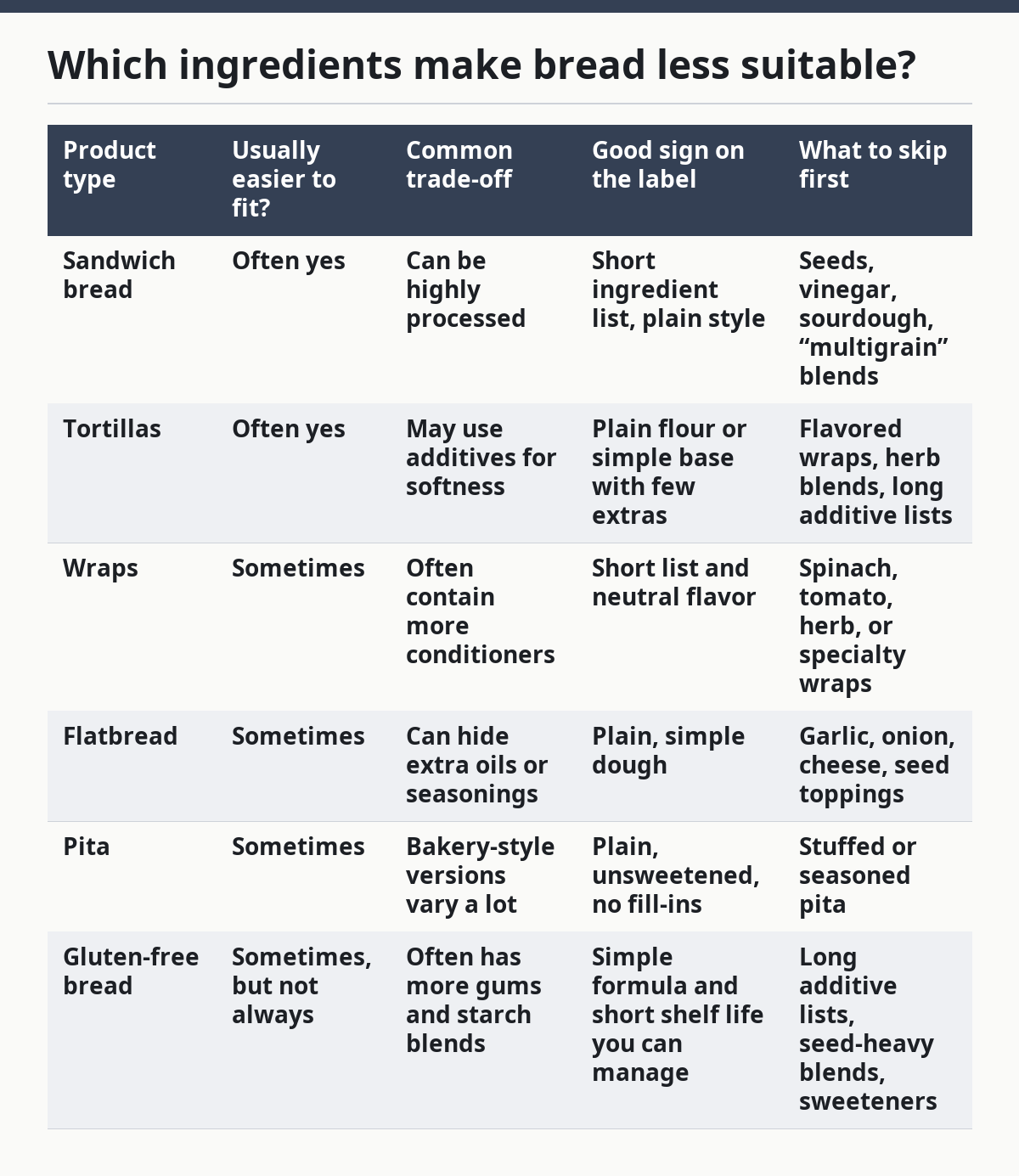
The trade-off is clear: the simplest bread is not always the most “natural,” and the most attractive artisan loaf is often the least useful choice for this purpose. If your stomach seems happiest with very plain foods, the fancy loaf is usually the wrong spend.
How do I choose tortillas and wraps without guessing?
Choose tortillas and wraps by looking for the shortest plain formula you can find, then checking how long they need to sit on the shelf before you eat them. A tortilla is not automatically safer than sliced bread, but it can be easier to portion, freeze, and use the same day.
For low histamine bread, wraps, and tortillas at the store, a good check takes under 2 minutes:
- Choose plain first. Plain flour tortillas, plain wraps, or plain flatbread give you fewer possible trouble spots than seasoned versions.
- Avoid strong flavors. Herb, tomato, spinach, chili, and garlic wraps sound harmless, but they add ingredients that can complicate a low histamine plan.
- Watch the softness aids. Some wraps rely on gums, conditioners, or emulsifiers to stay pliable. That does not make them unsuitable by itself, but it does make them less “clean” as a starting point.
- Check pack size against your use. A 6-pack makes sense only if you will finish or freeze it quickly. A large family pack can turn into stale food before you get through it.
- Look at the best-by date and your next 48 hours. If you will not use them soon, freeze them in small stacks so you can thaw only what you need.
For pita, the same rules apply, but the shape changes the risk. Stuffed pita, seasoned pita, and bakery pita with a lot of extras are much less predictable than a plain pocket pita. Gluten-free bread is also worth a closer look because the ingredient list is often longer than the front label suggests.
So if you want one rule to remember, make it this: plain shape, plain flavor, short use window. That rule keeps you out of the products that are trying too hard.
Should I care more about freshness or ingredients?
You should care about both, but freshness often decides whether a bread actually works for you that week. A very short ingredient list can still be a poor choice if the bread has sat too long, while a slightly more processed loaf may be easier to manage if it is fresh and you freeze it promptly.
This is where date labels matter. The FDA explains that date labels on packaged foods are usually about quality, not safety, so a “best by” date does not tell you whether a bread is ideal for a low histamine plan. The USDA FoodKeeper is useful for storage timing if you need a reference for how long food holds up after purchase.
What to do in the store:
- If you will eat it fast, pick the freshest acceptable loaf. The idea is to keep the window short.
- If you will not eat it fast, buy with freezing in mind. That changes the decision from “what looks best today?” to “what can I portion and freeze cleanly?”
- Avoid bread that already looks close to stale. Dry edges, crushed slices, and a bag with lots of air exposure are not helpful.
- Do not let the date alone overrule the ingredient list. A product can be fresh and still be a poor fit because it is packed with seeds, spices, or extras.
The trade-off is real: the freshest bread in the aisle is not always the most simply made bread, and the simplest bread is not always the freshest. For low histamine bread, wraps, and tortillas at the store, the right answer is the one you can use quickly without sitting on the counter for a week.
What is the smartest freezer plan?
The smartest freezer plan is to freeze bread the same day you buy it, in portions you can use without thawing the whole package. That matters because bread, wraps, and tortillas are easy to overbuy, and the extra days on the counter are often the problem.
A practical freezer routine looks like this:
- Bring the bread home as soon as possible. The less time it spends warm in a bag, the better your odds of preserving quality.
- Split it into use-sized portions. For sliced bread, that may mean 2 to 4 slices per stack. For tortillas or wraps, that may mean 1 to 2 per bundle.
- Wrap tightly or keep the original package well sealed. Air exposure dries the surface and makes thawing less pleasant.
- Label the bundle with the buy date. Even a simple marker helps you avoid guessing later.
- Freeze it flat. Flat storage keeps slices from warping and makes it easier to pull out only what you need.
This is especially useful for sandwich bread, tortillas, and wraps because they thaw quickly. Pita and flatbread also freeze well in small stacks. Gluten-free bread can be more fragile after thawing, so smaller portions usually work better than one large frozen block.
The main drawback is texture. Frozen bread is rarely identical to fresh bread, and very soft wraps can crack if handled roughly. That is still better than letting a questionable package sit open for several days.
What should I skip, even if the front of the package looks healthy?
Skip anything that dresses itself up as healthy while hiding a long list of add-ins. The front of the package can say whole grain, artisan, high fiber, ancient grain, or plant-based, but the back can still be packed with the exact things that make the product a worse fit.
The most common traps are:
- Seed-heavy loaves. Seeds add texture and flavor, but they also add another layer of variables.
- Sourdough-style breads. They are popular, but that style is not the first place to start for a low histamine shopper.
- Bakery breads with many inclusions. Cheese, onion, garlic, olives, dried fruit, and herbs turn a simple bread into a mixed bag.
- “Healthy” wraps with long additive lists. A wrap can look plain from the outside and still contain a long list of conditioners, gums, or flavorings.
- Anything you cannot identify in one quick read. If the ingredient list takes a full minute to untangle, the product is probably too complicated for your starting point.
This is not a rule against all whole grain products or all fiber. It is a warning against turning bread shopping into a nutrition contest. For low histamine purposes, simpler often beats trendier, and that is a useful loss of glamour.
What is the best first choice for most shoppers?
The best first choice for most shoppers is a plain sandwich bread or plain tortilla with a short ingredient list and a plan to freeze what will not be eaten in the next few days. That choice gives you the most control with the least guesswork.
If you are deciding between bread types, start here:
- Plain sandwich bread if you want the easiest everyday option.
- Plain tortillas if you want something that portions well and freezes cleanly.
- Plain wraps or flatbread if you need a foldable option and can keep the flavor neutral.
- Plain pita if you want a pocket style and can find one without extra seasoning.
- Gluten-free bread only if you already know it works for you, because the ingredient list can be more complex than it looks.
Who this is not for: anyone who needs a very broad diet with no ingredient screening at all. This approach is for the person who is trying to make a careful store choice, not for the person who wants a “free pass” food. If your symptoms are severe or unclear, a registered dietitian or clinician familiar with histamine issues can help you sort out which triggers matter most.
Overall, the core job is simple: keep the bread plain, keep the list short, keep the date close to when you’ll eat it, and freeze the rest fast. That is the shortest path to a useful store pickup, and it is the same logic that fits the broader Low Histamine Shopping and Ingredient Vetting — The Complete Guide without turning every grocery trip into a research project.
FAQ
What makes packaged bread more or less suitable for a low histamine diet?
Packaged bread is more suitable when it has a short ingredient list, a plain flavor, and a freshness date that matches how soon you will eat it. It becomes less suitable when it includes seeds, sourdough, vinegar, spices, or long shelf-life tricks that push it away from a simple staple.
Are tortillas easier to fit than sliced bread?
Tortillas can be easier to fit when you want a plain, flexible option that freezes well in small stacks. They are not automatically better than sliced bread, because some tortillas contain just as many additives, but the format makes them easy to portion and keep fresh.
Should I freeze bread right away?
Yes, if you will not finish it within a few days. Freezing right away helps you control freshness and avoid the slow decline that happens on the counter, especially with sliced bread, wraps, and tortillas.
Drafted with AI; not yet reviewed by a person.