Last updated: November 20, 2026
Key Takeaways
- Assign each day one role, one backup, and one fallback meal.
- Low-energy meals should take 5 to 10 minutes of active work with minimal cleanup.
- Use one high-energy day to prep a component that helps with two later meals.
- The real goal is to avoid making every day equally demanding.
Planning How to Plan Low Histamine Meals for a Week of Different Energy Levels means building easy, moderate, and backup meals before you get hungry. The answer is to map each day by energy first, then assign a low histamine meal to each slot. That approach helps you keep dinner realistic, lunch manageable, and breakfast simple without turning the week into a second job.
Plan the week around energy, not ambition
Picture this: you’re staring at an empty fridge on a Monday night, already tired, and the meal plan on your phone asks for a 45-minute dinner. That’s the wrong plan. A flexible weekly meal plan works because it matches the meal to the day you actually have, which is especially useful when you are planning low histamine meals for different energy levels.
Start by labeling the week with three energy tiers: low, medium, and high. Low-energy days get the simplest meals. Medium days can handle a little chopping or reheating. High-energy days are the best time for extra prep, like roasting vegetables or cooking plain grains, because that work can pay off later in the week.
Use this simple split:
- Low energy: heat-and-eat dinner, quick lunch, one assembled breakfast
- Medium energy: 15- to 25-minute meals
- High energy: cook-ahead component for later in the week
A generic meal plan often fails because it treats every day like the same day. The better choice is to accept that Tuesday may not look like Saturday, then plan low histamine meals around that reality.
How do I plan low histamine meals for a week of different energy levels?
You plan them by giving each day one job, one backup, and one exit ramp. That means a low-energy dinner, a quick lunch, and a freezer backup sitting in the wings. If a day goes sideways, you swap to the easier slot instead of abandoning the whole week.
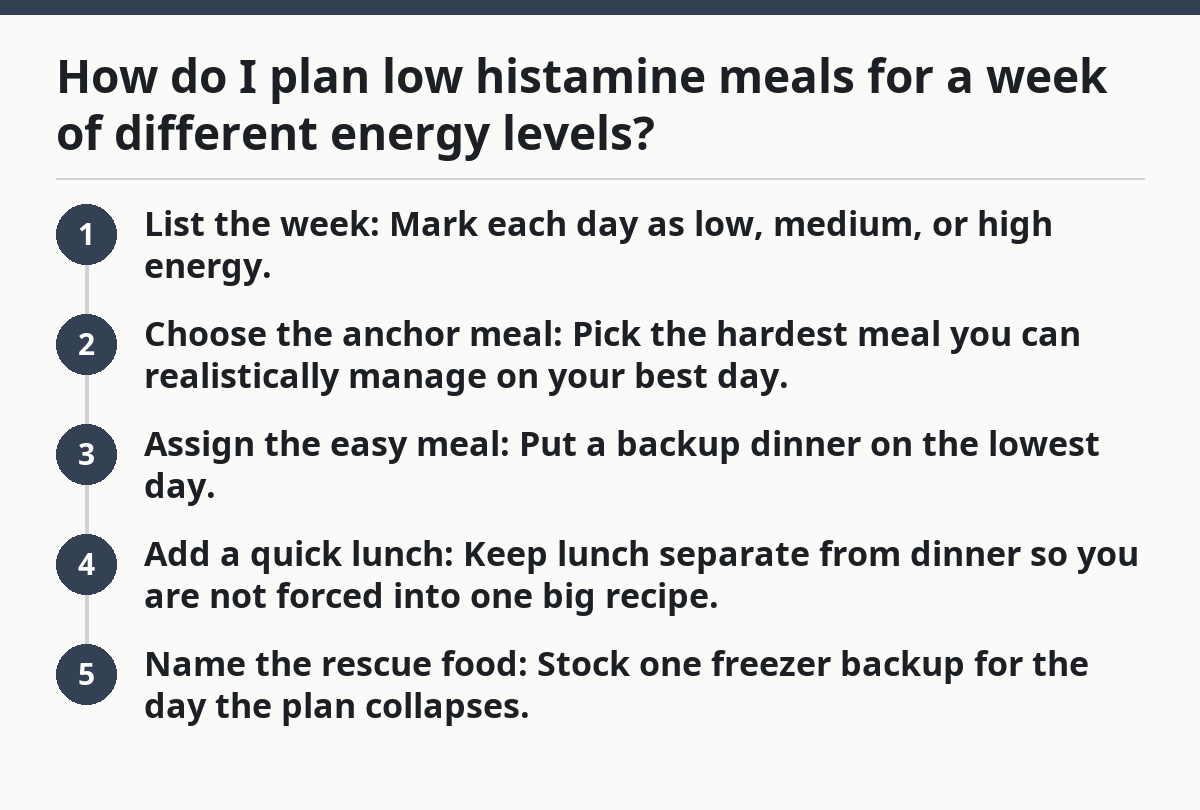
Use this order:
- List the week: Mark each day as low, medium, or high energy.
- Choose the anchor meal: Pick the hardest meal you can realistically manage on your best day.
- Assign the easy meal: Put a backup dinner on the lowest day.
- Add a quick lunch: Keep lunch separate from dinner so you are not forced into one big recipe.
- Name the rescue food: Stock one freezer backup for the day the plan collapses.
The trick is not variety for its own sake. It is repeatable structure. A low-energy day might be rice, a cooked protein you tolerate, and a simple vegetable. A medium day might be the same food in a different form, like a bowl instead of a plate. On a high-energy day, you can cook the component that makes the next two meals easier.
For a broader system, the hub on meal planning for histamine sensitivity can support this week setup, while this page keeps the focus on daily energy. For food safety details on leftovers and storage, the USDA Food Safety and Inspection Service has clear guidance on refrigeration and reheating, and the Cleveland Clinic offers a practical overview of low histamine eating.
Build a 3-level meal template you can repeat
Picture this: you already know Wednesday is a low-energy day, so dinner does not need creativity, only a clean path from fridge to plate. That is where a 3-level meal template saves you from decision fatigue.
Build each meal with the same structure: protein, starch, and vegetable. Keep the ingredients plain and the method simple. The point is not to make every meal identical. The point is to stop re-planning from scratch every night.
A workable set of templates looks like this:
- Low energy: one-pan reheat meal, no knife work
- Medium energy: fresh assembly with 1 cooked item and 2 cold items
- High energy: cook-ahead component plus a full dinner
For example, a cook-ahead component might be plain rice, roasted squash, or a simple protein you know you handle well. A quick lunch might be a bowl built from leftovers and a fresh side. A backup dinner might use the same format each time, so the only question is which tolerated foods go in it.
Templates reduce decisions without reducing flexibility. If one ingredient is off-limits, you swap the part, not the whole meal.
What should a low-energy day meal look like?
A low-energy day meal should need 5 to 10 minutes of active work and no complicated cleanup. If a meal needs a sauce, a marinade, or multiple pans, it belongs on a better day. Not today.
Think in rescue mode. Keep these in the rotation:
- A reheated starch with a plain protein
- A simple soup or bowl built from tolerated ingredients
- A freezer backup that can move straight into the oven or pan
- A quick lunch that uses leftovers, not a new recipe
Your low-energy day is not the day for experiments. New foods and long ingredient lists make it harder to spot what worked and what didn’t. That matters with histamine sensitivity, where consistency helps you read your own body.
The cost of overplanning a low day is simple: you skip the meal, eat something random, or feel boxed in by a recipe you cannot face. The fix is to keep one meal in reserve and let the rest of the day stay plain.
What should a high-energy day do for the rest of the week?
A high-energy day should create one cook-ahead component that reduces work on two later days. That could be plain grains, cooked protein, or a vegetable side that reheats well. You are not batch cooking the whole week here; you are buying time.
Use high-energy time for the tasks that feel heavy when you are tired:
- Cooking one main component
- Chopping a vegetable that holds well
- Portioning a meal into 2 or 3 containers
- Freezing one backup dinner before the week gets away from you
This is where people overdo it. They turn a good day into a marathon and then hate the plan by Thursday. One solid component is enough. A single extra batch of plain food can carry a lunch and a dinner, which is usually all a flexible week needs.
A good rule: if the prep takes longer than 30 minutes and does not create a clear second meal, save it for another week. That keeps the plan sustainable.
The mistakes that break a flexible low histamine week
The biggest mistake is making every day equally hard. That turns a flexible plan into a rigid one, and rigid plans crack fast. The second mistake is forgetting a freezer backup, which leaves you with no answer when your energy drops suddenly.
Watch for these problems:
- Too many new recipes: you cannot tell what triggered what
- No quick lunch: lunch turns into vending-machine thinking
- No backup dinner: one tired night derails the whole plan
- Too much prep on one day: you burn out before the week starts
The fix is boring, and that is the point. Keep one meal slot simple enough to repeat, and keep one meal in the freezer. That gives you a margin of error.
For low histamine meal planning, the plan that survives a bad day is better than the plan that looks impressive on paper. A tidy spreadsheet is useless if you can’t use it at 7 p.m.
What does a finished week actually look like?
A finished week has a low-energy dinner, a quick lunch, and a cook-ahead component already assigned before the week starts. That setup lets you swap meals instead of improvising. You are not aiming for perfection; you are aiming for repeatable choices.
Here is a simple example of how the week can sit on paper:
- Monday: medium energy, make one cook-ahead component
- Tuesday: low energy, use backup dinner
- Wednesday: medium energy, quick lunch from leftovers
- Thursday: low energy, freezer backup
- Friday: high energy, prep a component for the weekend
- Weekend: flexible meals built from what is left
Notice what is missing: there is no pressure for every dinner to be new. That is the whole point. A flexible weekly meal plan works when it gives you choices, not chores.
If you want the shortest possible summary, use this: plan the week by energy, protect the low days, and let the high days do the lifting.
How do I plan meals for good days and bad days?
Plan the good days to support the bad days. Put the more active prep work on the days when you have energy, then assign plain reheated meals to the days when you do not. That way, the hard days already have a path, and you are not forced to cook from scratch when you are drained.
What is an energy-based meal plan?
An energy-based meal plan is a meal plan that matches food prep to how much energy you have that day. Low-energy days get simple meals, medium days get moderate prep, and high-energy days do the cooking that helps later in the week. It keeps the plan realistic instead of equal.
How do I stop meal planning from becoming too rigid?
Leave room for swaps. Build 2 or 3 meal slots that can trade places, and keep one freezer backup ready so a bad day does not wreck the whole week. If the plan only works when everything goes right, it is too tight.
For more structure, the meal planning for histamine sensitivity hub can sit alongside this week-by-week approach and fill in the broader system.
Drafted with AI; not yet reviewed by a person.