
Last updated: November 19, 2026
Quick answer: this guide gives you 3 practical meal patterns, and the best one is the one you can repeat with fresh ingredients, safe storage, and fewer symptom flares. Histamine-Friendly Meals for Specific Lifestyles — The Complete Guide is about matching low-histamine meals to real life: vegan, athlete, busy parent, shift worker, budget-conscious cook, or someone eating on the road. The right meal plan is less about a perfect list of “safe” foods and more about timing, storage, and a short list of repeatable meals that fit your life. For a clinical overview of histamine intolerance, see the Cleveland Clinic, the NHS food symptom-tracking guidance, and the AAAAI background on histamine and allergy-related reactions.
Histamine intolerance is a medical topic with real variation from person to person, so if symptoms are severe, persistent, or tied to multiple foods, a clinician or dietitian should be involved.
Key takeaways
- Histamine-friendly eating is mostly about freshness, storage, and predictable ingredients, not special products.
- The same meal pattern does not suit every lifestyle; a night-shift worker and a vegan need different defaults.
- Freshly cooked meat, eggs, rice, oats, most pears, apples, zucchini, carrots, and cucumber are common low-histamine building blocks, but tolerance varies.
- Leftovers are often the trap, because histamine can rise in stored foods even when the food still looks fine.
- The most repeatable plan is the one you can follow without guesswork, food waste, or constant symptom chasing.
What actually makes a meal histamine-friendly?

A histamine-friendly meal is one that avoids the main food patterns that tend to trigger symptoms: aged, fermented, slow-stored, or heavily processed ingredients. That usually means cooking from fresh ingredients, keeping sauces simple, and eating or freezing food soon after cooking, not letting it sit for days in the refrigerator.
Because histamine is not one single ingredient, the biggest mistake is treating this like a standard allergy diet without professional guidance. Different people react to different thresholds, and severe symptoms deserve medical input. The Cleveland Clinic notes that histamine intolerance is individualized, and the NHS advises tracking foods and symptoms rather than guessing. A meal with grilled chicken, rice, and steamed zucchini may work well for one person and still cause symptoms in another if the chicken was marinated overnight or the leftovers were reheated on day three.
The practical rule is simple: choose ingredients that are usually tolerated, then remove the common histamine amplifiers. That includes vinegar, soy sauce, aged cheese, cured meats, fermented condiments, canned fish, long-simmered broths, and slow-cooked leftovers that have been stored for too long, but this should be adjusted with a clinician or dietitian if symptoms are severe or mixed with other food issues. Freshness matters more than culinary complexity. For food-storage basics, the USDA recommends refrigerating perishables within 2 hours.
A useful starting framework is the Cleveland Clinic’s overview of histamine intolerance and the NHS’s general guidance on food symptom tracking, because both emphasize individualized tolerance rather than a one-size-fits-all blacklist. For background, the AAAAI also has plain-language material on histamine and allergy-related reactions.
Which lifestyle makes histamine-friendly eating hardest?
The hardest lifestyle is the one with the least control over timing, refrigeration, and food prep. That usually means shift workers, frequent travelers, and parents cooking for more than one person at once. A meal can be “safe” on paper and still fail if it sits in a lunch box for 6 hours, waits under heat lamps, or gets assembled from condiments of unknown age.
People with a vegan or vegetarian lifestyle face a different problem: many of the easiest low-histamine proteins are off the table, so the diet can become too repetitive too quickly. Athletes and high-output workers have the opposite issue; they need enough calories and protein without leaning on fermented protein snacks, aged dairy, or packaged bars that often contain cocoa, nuts, or syrups that some people do not tolerate well.
The right approach depends on two things:
- How much control you have over freshness.
- How much variety your body can actually tolerate without triggering symptoms.
A meal plan that ignores those two factors usually fails by the second week. That is why Histamine-Friendly Meals for Specific Lifestyles — The Complete Guide keeps the focus on practical fit, not just ingredient lists.
Histamine-friendly meals for busy parents and full schedules

Busy parents win with meals that are fast, mild, and safe to repeat two or three times a week. The best choices are dinners that can be cooked in under 30 minutes, use 5 to 7 ingredients, and turn into the next day’s lunch only if they are cooled quickly and frozen or eaten promptly. This is the lifestyle where simplicity beats creativity.
Good defaults include:
- Turkey rice bowls with steamed carrots and zucchini
- Egg scramble with spinach only if tolerated, plus toast or rice cakes
- Baked chicken with olive oil, salt, and herbs, served with rice and cucumber
- Oatmeal with pear slices for breakfast
- Potato soup made without stock cubes, tomatoes, or onion-heavy seasoning if those are triggers
The strength of this pattern is predictability. A child can often eat the same base meal with different sides, and the adult meal does not need separate cooking. The weakness is boredom, which is not trivial. When the same three dinners repeat all week, people start “improving” them with ketchup, spice mixes, cheese, or sauces that may be the very reason symptoms come back. In practice, the safer habit is to keep one meal plain and add variety through tolerated sides rather than through sauces.
Parents should also watch the storage problem. A batch-cooked rice dish that tastes fine on day one may be a poor choice on day four, especially if it was cooked in bulk and kept in the refrigerator. Food safety rules still matter here. The U.S. Department of Agriculture recommends refrigerating perishables within 2 hours, and that basic rule becomes even more important when histamine is a concern.
Who this section is for: adults who need a weekday system, not a recipe hobby. Who should skip this style: anyone who wants highly flavored meals every night or who has already found that leftovers are a reliable trigger.
Histamine-friendly meals for athletes and active people
Athletes need the most deliberate version of histamine-friendly eating because training increases the pressure to eat often, recover quickly, and pack in protein. The winning strategy is not to find “superfoods.” It is to use fresh, plain fuel that can be repeated around workouts without creating a second problem.
The best base meals are:
- White rice with fresh chicken or turkey and steamed carrots
- Potatoes with eggs and a tolerated green vegetable
- Oats with a tolerated fruit such as pear or apple
- Freshly cooked beef or fish only if it is truly fresh and immediately handled well; fish is tricky because histamine can rise fast after harvest if the chain is poor
This lifestyle is where timing matters more than recipe novelty. A pre-workout meal that is too high in fiber or fat may feel heavy, but a convenient packaged bar may contain ingredients that are more likely to trigger symptoms. That trade-off matters. A plain bowl of rice and turkey is not glamorous, but it is easy to digest, easy to scale up, and easy to prep in a safe way.
The downside is that performance nutrition often relies on convenience foods, and many convenience foods are histamine traps: flavored yogurts, cured deli meats, protein powders with lots of additives, vinegar-based dressings, and snack products with long ingredient lists. An athlete may need to accept less variety for a period of time to get symptoms under control, and a sports dietitian can help decide where that trade-off is worth it.
If the goal is muscle gain, the plan should be reviewed with a dietitian so calories and protein do not drop too low. Histamine-friendly eating can become under-fueling very fast if the meal list is too narrow.
Histamine-friendly meals for vegans and vegetarians
Vegan histamine-friendly meals are possible, but they are the least forgiving version because many plant proteins are either fermented, preserved, or commonly paired with trigger ingredients. This is the lifestyle where ingredient quality matters more than the title of the dish.
Safer vegan building blocks often include:
- Rice, quinoa, millet, or oats
- Zucchini, carrots, cucumber, lettuce, and some squashes
- Pears, apples, blueberries if tolerated, and melons for some people
- Olive oil and salt
- Pumpkin seeds or other seeds only if personally tolerated
A workable vegan dinner might be a warm rice bowl with roasted zucchini and carrots, olive oil, and fresh herbs, or oatmeal with pear and cinnamon if cinnamon is tolerated. The challenge is protein density. Beans, lentils, tofu, tempeh, and fermented soy products are common vegetarian staples, but they are not universally safe in histamine-sensitive diets. Tempeh is especially problematic for many people because it is fermented.
That creates a real weakness: vegan histamine-friendly eating can become carbohydrate-heavy unless the person carefully tests tolerated seed butters, legumes, or protein supplements under guidance. Even then, the result is often more limited than a conventional vegan diet. This is the one lifestyle where the “healthy” version of the diet can become too restrictive too quickly.
The recommendation here is blunt: if someone is vegan and already symptomatic, they should not wing it with internet lists. A dietitian should help build a short, nutrient-complete rotation and watch for gaps in protein, iron, B12, iodine, calcium, and total energy intake. Histamine-Friendly Meals for Specific Lifestyles — The Complete Guide only works well here when it is supervised and realistic.
The honest side-by-side
A fresh-food, low-leftover approach wins for most people because it is the only method that directly reduces the biggest histamine risks at the same time: aged ingredients, long storage, and hidden additives. A highly structured meal prep system wins only when the person can cook, cool, freeze, and reheat with discipline. So the better choice depends on the week, not just the menu.
| Criteria | Fresh-cook everyday meals | Batch-prep and freeze | Winner for this condition |
|---|---|---|---|
| Symptom control | Usually better because food is eaten soon after cooking | Can work if frozen quickly, but storage adds risk | Fresh-cook if symptoms are sensitive |
| Time on weekdays | Requires daily cooking, often 20–30 minutes | Lower daily effort once prep is done | Batch-prep for packed schedules |
| Leftover risk | Low if portions are small | Higher unless freezing is immediate | Fresh-cook for leftover-triggered users |
| Budget control | Can be moderate, but waste rises if plans change | Often better for planned shopping | Batch-prep for tight grocery budgets |
| Meal variety | Easier to change proteins and vegetables | Can feel repetitive after 2–3 days | Fresh-cook for boredom-prone eaters |
| Travel or work lunch | Harder to manage without a refrigerator | Works well with frozen portions and an insulated bag | Batch-prep for commuters |
| Cooking skill needed | Lower; simple stovetop and oven meals are enough | Moderate; cooling and storage technique matter | Fresh-cook for beginners |
| Best for vegan diets | Needs careful planning, but keeps ingredients simple | Can help with grain-and-vegetable bases | Fresh-cook if legumes are not tolerated |
| Best for athletes | Excellent for precise pre- and post-workout meals | Good for large calorie needs if frozen promptly | Fresh-cook for tight timing |
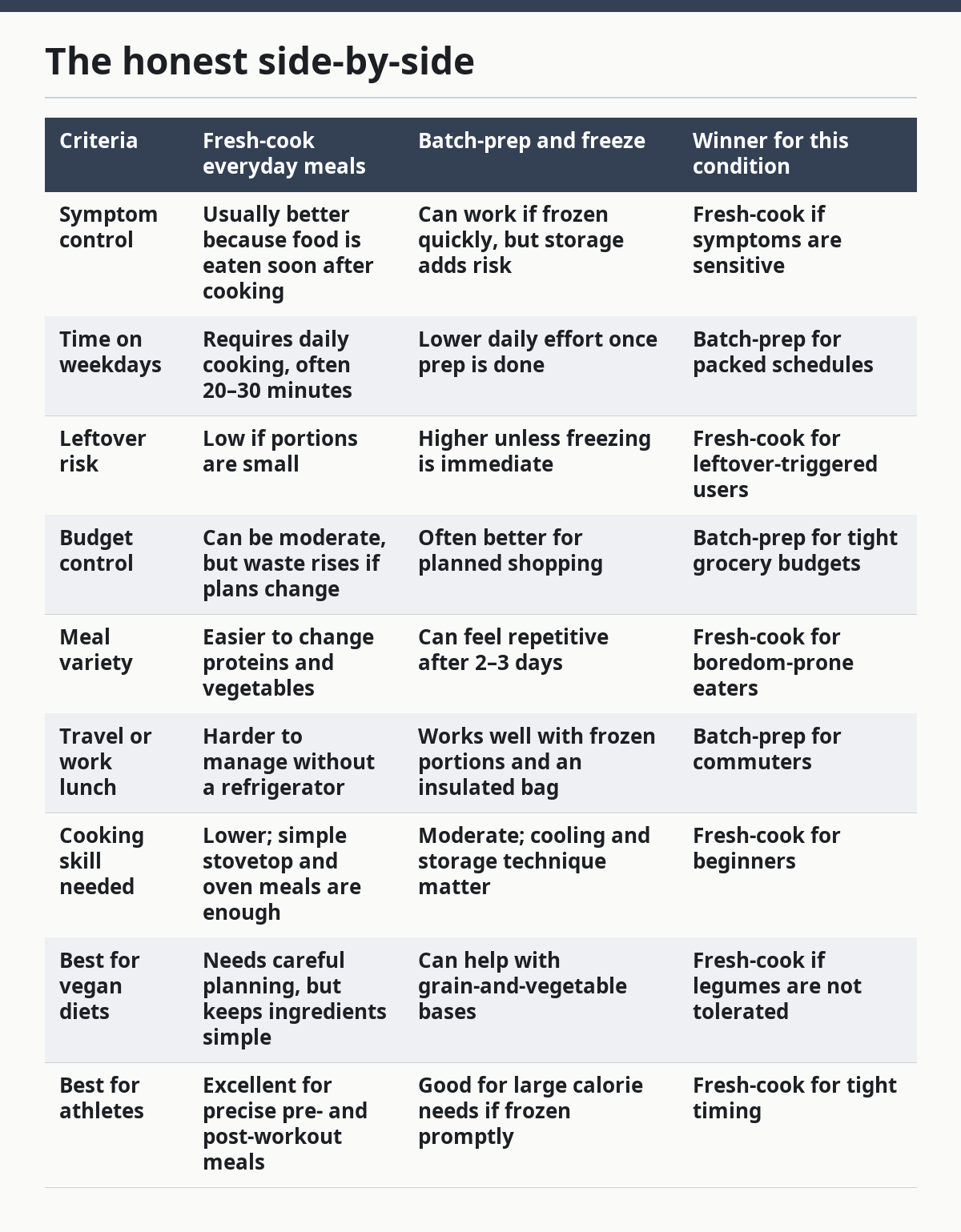
The pattern is clear: fresh-cook wins on symptom control, while batch-prep wins on logistics. A person with mild symptoms and a strict schedule may need batch-prep to eat consistently. A person whose symptoms flare with leftovers should treat fresh cooking as the default and accept the extra time. If you want a simpler framework, start with the section on Histamine-Friendly Meals for Specific Lifestyles — The Complete Guide and then adjust the storage method to match your routine.
One more honest drawback deserves mention. Batch-prep only helps if the food is cooled and frozen correctly. The USDA’s “2-hour rule” for perishables matters here, and the reason is not just food poisoning. Delayed cooling can make histamine management harder even when the food still seems safe to eat.
What to do when your lifestyle does not fit the ideal plan
The right meal plan changes when your situation has one of four exceptions.
First, if you work nights or rotating shifts, choose freezer-friendly meals and eat them soon after thawing. A night shift often destroys regular mealtimes, so the goal is not culinary perfection; it is avoiding food that has sat warm for hours in a break room. In practice, that usually means packing one main meal and one backup snack.
Second, if you travel often, shrink the meal list to portable foods with clear ingredients: plain oats, rice cakes, fresh fruit you know you tolerate, and simple protein you can buy the same day. Airport food courts are a bad place to improvise a histamine plan. The fewer decisions you make on the road, the fewer chances there are to buy something aged or heavily seasoned.
Third, if you react to many “safe” foods, stop tightening the list on your own. That is the point at which a supervised elimination plan matters more than another online chart. The diet can become so narrow that it raises other risks, especially for calories and micronutrients, so this is where Histamine-Friendly Meals for Specific Lifestyles — The Complete Guide becomes a medical-style process rather than a casual food list.
Fourth, if you are managing histamine issues alongside IBS, reflux, or a true food allergy, the overlap changes everything. A meal that is low histamine may still be too acidic, too fibrous, or unsafe because of a separate allergy. That is a medical review situation, not a DIY puzzle.
The best adjustment strategy is to keep 5 to 8 “anchor meals” and rotate them rather than chase dozens of recipes. That is boring, but it works. It also gives you a clearer way to test what changes symptoms by keeping the rest of the meal stable.
The verdict: which meal style to choose
Choose fresh-cook everyday meals if your symptoms are reactive, leftovers bother you, and you can cook for 20 to 30 minutes most days. Choose batch-prep and freeze if your schedule is tight, your meals need to travel, and you can freeze portions within the same day. Neither if you are reacting to so many foods that the list has become smaller than a supervised diet should be.
That verdict is especially true for people trying to support both histamine control and another demanding lifestyle, such as athletics or parenting. In those cases, the wrong choice is usually the one that looks efficient on paper but breaks down in real life by day four. The better choice is the one you can repeat, store correctly, and actually eat.
How do I build a histamine-friendly meal with real food?
Start with one protein, one starch, and one vegetable, then keep the seasoning plain. A practical plate might be chicken, rice, and zucchini; eggs, potatoes, and cucumber; or oats, pear, and a tolerated seed. The fewer moving parts, the easier it is to see which ingredient causes trouble. If the meal is for a specific lifestyle, make the portions match the schedule: larger for athletes, simpler for parents, and more portable for shift workers.
Are leftovers always bad for histamine intolerance?
Not always, but they are a common problem. Histamine can rise as foods sit, especially protein-rich foods, so cooling fast and freezing portions early is safer than keeping meals in the refrigerator for several days. If leftovers reliably trigger symptoms, make them a rare exception, not the backbone of the diet. That rule matters even more when you are comparing histamine-friendly meals for specific lifestyles and trying to keep the system practical.
Can I eat out and still stay histamine-friendly?
Yes, but restaurant meals are harder to control because of marinades, sauces, stocks, and storage. The safest order is usually the simplest one: grilled fresh protein, plain rice or potatoes, and a plainly cooked vegetable. Ask about vinegar, soy sauce, tomato-based sauces, and whether the fish or meat was pre-marinated. When in doubt, order fewer ingredients and fewer extras.
Is a vegan histamine-friendly diet realistic?
It is realistic, but it is harder to do well than a mixed diet. A vegan version often depends on a short list of grains, vegetables, and carefully chosen proteins, and it can become too restrictive without professional help. If symptoms are active, I would not build it alone. For this lifestyle, Histamine-Friendly Meals for Specific Lifestyles — The Complete Guide is most useful when you use it to narrow choices, not to eliminate whole food groups without review.
What should I do first if I suspect histamine is the problem?
Pick one simple 7-day pattern and track symptoms, timing, and leftovers. Then review the pattern with a clinician or dietitian if symptoms continue, because histamine issues can overlap with allergies, IBS, reflux, or mast-cell disorders. A short, structured trial tells you more than a long list of internet “safe foods.” If you need a starting point, keep the plan plain, keep portions consistent, and change only one variable at a time.
Drafted with AI; not yet reviewed by a person.
