Last updated: November 19, 2026
Key Takeaways
- Low histamine cooking aims to limit histamine buildup by controlling time, temperature, and ingredient simplicity.
- These methods help keep ingredient lists short and move food from heat to plate with minimal delay.
- A low histamine kitchen uses the fridge, counter, tools, and containers to support speed, not clutter.
- Proteins work best when they are cooked soon after purchase, handled lightly, and served or cooled quickly.
Low histamine cooking works when food stays cold, clean, and simple from the moment it is bought until the moment it is eaten. In this Low Histamine Cooking Methods and Kitchen Setup — The Complete Guide, the kitchen setup matters as much as the recipe, because histamine rises as food ages, and poor handling can turn a safe ingredient into a bad meal fast. If the goal is fewer reactions, the answer is not fancy low-histamine cuisine; it is shorter storage time, gentler cooking, and a workflow that keeps leftovers under tight control.
What low histamine cooking is trying to prevent
Low histamine cooking is designed to limit histamine buildup in foods by controlling time, temperature, and ingredient complexity. The main problem is not the cooking method alone; it is how long food sits before and after cooking, especially protein foods like fish, meat, and leftovers.
The key here is the clock, and the best setup generally treats time as one of the first ingredients. This is what separates a practical kitchen from one that quietly builds risk on the counter. A fresh chicken breast cooked promptly is a different situation from the same breast left in the fridge for several days, even if the recipe is identical.
A simple way to think about it is this:
- Freshness matters more than culinary flair.
- Cooling speed matters more than covered bowls on the counter.
- Ingredient lists matter more than sauce quality.
The wrong assumption is that low histamine means “just avoid tomatoes and vinegar.” That is incomplete. A meal can be low in obvious triggers and still be a problem if the food is old, reheated repeatedly, or stored in a deep container that cools slowly.
What this usually means in practice
- Buy smaller amounts more often, rather than bulk-cooking for the whole week.
- Cook proteins soon after purchase or freeze them promptly.
- Use short ingredient lists and plain seasonings.
- Treat leftovers as a same-day or next-day item, not a casual 4-day plan; for personal tolerance questions, consult a clinician or dietitian, and follow food safety guidance from the FDA and USDA Food Safety and Inspection Service.
A useful standard to keep in mind is basic food safety guidance from the U.S. Food and Drug Administration and the USDA Food Safety and Inspection Service: cold food should stay cold, hot food should not linger at room temperature, and cooked food should be cooled quickly. Those food safety rules are not histamine rules, but they point in the same direction.
Which cooking methods are usually the safest starting point?
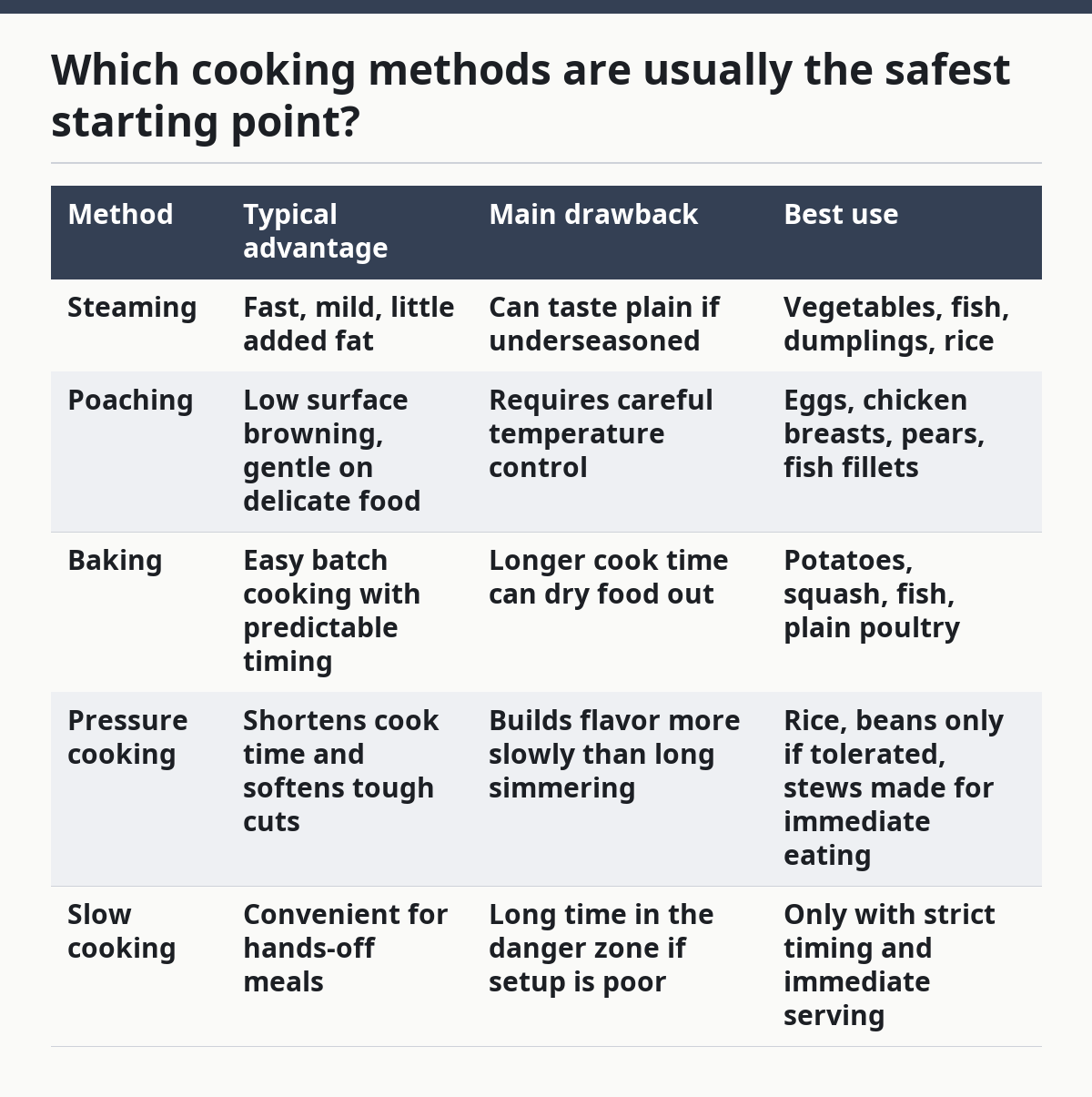
The safest starting point is usually gentle, dry heat or moist heat with quick service: steaming, poaching, baking, and pressure cooking are easier to manage than long braising, slow cooking, or heavily fermented techniques. The reason is simple — these methods let a cook keep ingredient lists short and move food from heat to plate without much waiting.
Here is a practical comparison:
| Method | Typical advantage | Main drawback | Best use |
|---|---|---|---|
| Steaming | Fast, mild, little added fat | Can taste plain if underseasoned | Vegetables, fish, dumplings, rice |
| Poaching | Low surface browning, gentle on delicate food | Requires careful temperature control | Eggs, chicken breasts, pears, fish fillets |
| Baking | Easy batch cooking with predictable timing | Longer cook time can dry food out | Potatoes, squash, fish, plain poultry |
| Pressure cooking | Shortens cook time and softens tough cuts | Builds flavor more slowly than long simmering | Rice, beans only if tolerated, stews made for immediate eating |
| Slow cooking | Convenient for hands-off meals | Long time in the danger zone if setup is poor | Only with strict timing and immediate serving |
The wrong picture is a pot kept warm for hours while the rest of dinner gets finished. That is exactly the sort of setup that makes low histamine cooking harder, not easier. The correct picture is a tray of fish going into a hot oven for 10 to 15 minutes, plated right away, with vegetables already washed and ready.
What this means for technique:
-
Choose a method that finishes within a predictable window.
- Check: you can name the cook time before you start.
- Do not: start a recipe that depends on “checking later” and improvising.
-
Keep the sauce simple.
- Check: broth, oil, salt, and a tolerated herb may be enough.
- Do not: build a sauce from aged vinegar, soy sauce, or fermented ingredients if those are known triggers.
-
Serve immediately when possible.
- Check: food goes from heat to plate with no long pause.
- Do not: leave the pot on a turned-off stove for 30 minutes.
-
Use small pans and shallow containers.
- Check: food heats and cools evenly.
- Do not: pack hot food into a deep stockpot and expect it to cool quickly.
-
Keep proteins the focus.
- Check: meat and fish are the most time-sensitive items in the meal.
- Do not: let them sit while side dishes finish slowly.
-
Build the meal around tolerable staples.
- Check: rice, potatoes, oats, zucchini, carrots, pears, or other tolerated foods anchor the plate.
- Do not: assume a “clean” spice blend is automatically safe.
This is also where a person should be honest about limits. Low histamine cooking is not a guarantee for everyone, and it is not a substitute for medical advice when symptoms are severe or complex. Food tolerance varies, and a clinician or dietitian familiar with histamine-related issues can help if the pattern is unclear.
How do you set up a kitchen for low histamine cooking?
You set up a low histamine kitchen by making the fridge, counter, tools, and storage containers support speed, not clutter. The best setup shortens the time between purchase, prep, cooking, and cooling, while keeping cross-contamination and long storage under control.
The most useful tool is not a special appliance. It is a clear workflow.
-
Create one cold-zone shelf in the refrigerator.
Check: raw proteins sit on a lower shelf in covered, leakproof containers.
Do not: store raw meat above ready-to-eat food, where drips can fall. -
Reserve one cutting board for proteins and one for produce if possible.
Check: boards are easy to wash and dry, and you know which one touched raw food.
Do not: use a cracked board that traps moisture and residue. -
Keep shallow storage containers ready.
Check: cooked food can be spread into a thin layer for faster cooling.
Do not: put a full pot directly into the fridge and hope it chills quickly. -
Clear a counter for immediate prep.
Check: the space is empty enough that washing, trimming, and plating happen in sequence.
Do not: prep around mail, lunch bags, or open spice jars. -
Stock plain staples within arm’s reach.
Check: salt, olive oil or another tolerated oil, rice, potatoes, oats, and safe herbs are easy to grab.
Do not: keep “special” ingredients so scattered that you start substituting at the last minute. -
Use a thermometer for doneness and cooling discipline.
Check: food reaches a safe internal temperature for the ingredient, and hot leftovers are handled quickly.
Do not: rely on color alone, especially with poultry. -
Designate a leftovers policy before cooking starts.
Check: you know whether food will be eaten now, chilled for tomorrow, or frozen in portions.
Do not: make a large batch and decide later.
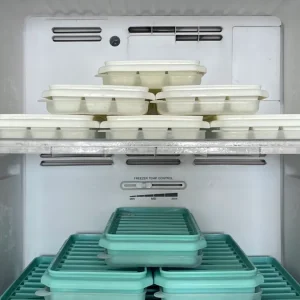
A compact setup often works better than a beautiful one. A fridge with a visible “use first” bin, a stack of 1-cup or 2-cup containers, and one clean cooling shelf can do more for symptoms than an expensive appliance lineup.
| Kitchen item | What to look for | Why it helps |
|---|---|---|
| Shallow glass or BPA-free containers | Low sides, tight lids | Faster cooling and less forgotten food |
| Instant-read thermometer | Readout in seconds, easy to sanitize | Removes guesswork for poultry, fish, and reheating |
| Sheet pans | Flat metal surface, easy to line if needed | Great for cooling, roasting, and portioning |
| Dedicated produce basket | Open, washable, visible | Keeps washed produce separate from raw proteins |
| Label tape or marker | Date and contents readable at a glance | Reduces mystery leftovers |
The setup is wrong when it forces delay. If the knife block, spices, pans, and containers are spread across the kitchen, the cook spends more time walking and less time handling food. In low histamine cooking, that extra 10 minutes matters.
The correct way to cook proteins without creating problems
Proteins are safest when they are cooked soon after purchase, cooked through without overhandling, and served or cooled quickly. Fish, chicken, turkey, eggs, and fresh meat need tighter timing than vegetables because they are more perishable and less forgiving of storage mistakes.
A practical protein workflow looks like this:
-
Unpack and refrigerate or freeze the protein immediately.
Check: the food is put away before anything else on the grocery list.
Do not: let raw meat sit out while other errands get finished. -
Plan the cook for the same day when possible.
Check: the meal slot is on the calendar, not “sometime tonight.”
Do not: buy fish and wait several days to decide on dinner. -
Trim, portion, and season simply.
Check: pieces are uniform so they cook at the same rate.
Do not: overload the pan with too many pieces or too much marinade. -
Cook with a predictable heat source.
Check: oven, skillet, steamer, or pressure cooker is already preheated or set.
Do not: start cold and keep guessing at timing. -
Confirm doneness with a thermometer when needed.
Check: poultry and thicker cuts reach a safe internal temperature for your food safety standard.
Do not: slice repeatedly to “see if it looks done,” because that loses juices and slows service. -
Plate or chill right away.
Check: cooked protein leaves the cooking vessel as soon as it is finished.
Do not: let it rest on a warm burner for a long stretch. -
Cool leftovers in thin layers.
Check: food is spread into shallow containers before refrigeration.
Do not: stack hot meat into a deep bowl and close the lid tightly.
The visual clue for good protein cooking is straightforward: the outside is cooked, the center is done, and the food is moved off heat without lingering. The visual clue for a bad result is steam trapped in a deep container, especially with soup, stews, or shredded meat.
A few practical differences matter here:
- Chicken breast on a sheet pan cools faster than chicken kept in a covered roasting pan.
- Pan-seared fish served immediately is easier to manage than fish held under a warmer.
- Hard-boiled eggs are simpler than egg salad left in the fridge for several days.
The trade-off is obvious: this style favors short planning cycles. It is not ideal for someone who depends on cooking one large batch on Sunday and eating it all week. That is exactly the wrong rhythm for many low histamine eaters.
For food safety specifics, the USDA Food Safety and Inspection Service and the FDA both publish plain-language guidance on cold holding, reheating, and cross-contamination. Those are useful references for the kitchen side of the problem.
Why leftovers are the hardest part of low histamine cooking
Leftovers are the hardest part of low histamine cooking because storage time can undo an otherwise careful meal. A fresh dish eaten right away is not the same as the same dish held for days in the refrigerator, especially if it contains meat, fish, stock, or mixed ingredients.
The honest answer is that leftovers need a stricter rule than most people expect. Some cooks do better with no leftovers at all. Others can tolerate same-day cooling and next-day eating if the food was handled well and stored cold. The safest broad approach is usually to keep leftovers small, cool them fast, and eat or freeze them promptly.
Here is what correct leftover handling looks like:
- The food is portioned into shallow containers within about an hour of cooking, or sooner if the kitchen is warm.
- Containers go into the fridge with space around them, not stacked tightly while still hot.
- Reheating happens once, not again and again.
- A portion is discarded if it smells off, tastes odd, or sat too long.
And here is what usually goes wrong:
- A pot of soup stays on the stove for a long time before refrigeration.
- A whole casserole gets put in the fridge in one deep dish.
- The same container is reheated for lunch, then cooled again for dinner.
- Leftovers are treated like a convenience stockpile instead of a time-sensitive food.
A simple comparison helps:
| Leftover habit | Better choice | Why it matters |
|---|---|---|
| Large pot in the fridge | Shallow, portioned containers | Faster cooling, less time in the danger zone |
| Repeated reheating | Single reheat of a single portion | Less quality loss and fewer handling steps |
| Mixed leftovers in one bin | Labelled portions by date | Easier to rotate food before it becomes a risk |
| Several days of fridge storage by default | Freeze extra portions promptly | Stops time from doing the damage |
This section is where low histamine eating often becomes less convenient than a standard meal plan. That inconvenience is real. It is also the reason a freezer, labels, and small portions matter so much. A person who wants low histamine habits without constant food waste usually needs a freezer strategy, not just a recipe list.
What should the pantry and spice shelf look like?
The pantry and spice shelf should be short, plain, and easy to scan in under 30 seconds. A low histamine kitchen is less about having many “safe” products and more about keeping a small set of ingredients that are consistently tolerated, then rotating them carefully.
The practical shelves usually contain:
- rice, oats, or another simple starch
- potatoes, squash, or other fresh produce kept properly
- salt and a small set of tolerated herbs
- a neutral oil if tolerated
- basic baking staples if the person bakes at home
What belongs nowhere near the center of the shelf, if it is a known trigger for the person:
- vinegar-heavy condiments
- fermented sauces
- aged cheeses
- packaged spice blends with long ingredient lists
- broths or bouillon with many additives
The visual test is simple: can the cook reach for three ingredients and know exactly what each one does? If not, the shelf is too busy.
A useful pantry audit
-
Remove products with long ingredient labels.
Check: each item has a clear job in the kitchen.
Do not: keep three nearly identical sauces “just in case.” -
Separate everyday items from experimental items.
Check: the foods you rely on are in front and visible.
Do not: bury staples behind specialty jars. -
Check opened products for age and smell before using them.
Check: you know when each jar was opened.
Do not: trust a condiment just because it still looks fine. -
Keep seasonings plain at first.
Check: salt, parsley, basil, rosemary, or other tolerated herbs are enough to start.
Do not: build flavor by default with chili blends, acids, or fermented ingredients. -
Store dry goods away from heat and moisture.
Check: the pantry is cool and the containers close well.
Do not: keep flour or oats above the stove where steam collects. -
Label anything decanted from the original package.
Check: the name and date are visible without opening the container.
Do not: leave unlabeled powders in generic jars.
The main mistake is to treat the pantry as a flavor library. For a low histamine kitchen, it works better as a controlled tool kit. If a person is still figuring out triggers, a food diary and a clinician’s guidance can help identify what actually belongs on the shelf.
Which tools and appliances help most, and which are not worth it?
The most useful tools are the ones that reduce waiting, confusion, and deep storage; the least useful are the ones that promise convenience but create more leftovers or more complexity. A thermometer, shallow containers, a sheet pan, and a reliable fridge matter more than a specialty appliance with a big marketing claim.
Here is a practical judgment call:
| Item | Worth it for many kitchens? | Why |
|---|---|---|
| Instant-read thermometer | Yes | Helps with doneness and safe reheating |
| Shallow freezer-safe containers | Yes | Supports fast cooling and portion control |
| Sheet pans | Yes | Good for roasting, cooling, and lining up food in a single layer |
| Food processor | Sometimes | Useful if tolerated ingredients are chopped often, but not essential |
| Slow cooker | Usually no, unless used carefully | Long cook times can make timing and storage harder |
| Vacuum sealer | Sometimes | Helpful for freezing portions, but not necessary for most homes |
| Fermentation crock | No for most low histamine kitchens | Fermentation is usually the wrong direction for histamine control |
The best appliance is often the boring one: a fridge that stays cold and has space. If the refrigerator is packed too tightly, cooled food warms slowly and smells can transfer. If the freezer is small, portions pile up and get forgotten. A kitchen that can hold 2 or 3 days of carefully portioned food is often better than one that tempts a person into batch cooking for a week.
The honest limitation here is that no gadget solves histamine tolerance by itself. A person can own the right pans and still have trouble if food sits out too long or if the same leftovers are reheated repeatedly. The method is doing the heavy lifting.
What does a practical low histamine meal day look like?
A practical low histamine meal day is built around fresh cooking, short storage, and simple repetition without boredom. The day should look calm, not frantic: one or two fresh prep windows, a small number of ingredients, and a clear plan for what gets eaten now and what gets frozen.
A workable day might look like this:
- Breakfast: oatmeal or eggs cooked fresh, with a tolerated fruit or a plain starch.
- Lunch: rice or potatoes with freshly cooked chicken or fish and a simple vegetable.
- Dinner: a second fresh meal, or a thawed portion made from a previously frozen same-day batch.
The point is not to make the menu exciting. The point is to make it predictable enough that no one is improvising with questionable ingredients at 7 p.m.
A simple 6-step day plan
-
Decide the protein first.
Check: you know whether dinner is fish, chicken, or eggs before shopping.
Do not: buy a random protein and hope it works later. -
Buy only what will be used soon.
Check: the quantity fits the next 1 to 2 days.
Do not: stock up on perishable food for a whole week. -
Prep vegetables early.
Check: washing and trimming happen before the pan is hot.
Do not: leave food chopped and wet on the counter. -
Cook one meal at a time.
Check: the protein leaves heat as soon as it is done.
Do not: juggle two long recipes at once unless the kitchen is organized for it. -
Use the freezer for surplus, not the fridge.
Check: extra portions are frozen in single servings if they will not be eaten very soon.
Do not: assume “I’ll get to it tomorrow” is a storage plan. -
Review the day before bed.
Check: leftovers are labelled, cooled, and accounted for.
Do not: leave mystery containers for the next morning.
This approach is not for a cook who wants elaborate sauces, marathon meal prep, or one giant Sunday session. It is for someone who wants fewer variables and more control. That restraint is the whole point.
For a reader who needs absolute precision because symptoms are severe, the safest next step is personal medical guidance, especially if low histamine eating is being used alongside other dietary restrictions.
The Verdict: what matters most, and what to ignore
What matters most is speed, shallow storage, and simple ingredients; what should be ignored is the idea that a single “low histamine” recipe can fix poor kitchen habits. The safest kitchen is the one that keeps food fresh, cools it quickly, and avoids long storage by default.
If I had to rank the priorities, I would put them in this order:
- Freshness of ingredients.
- Fast cooling after cooking.
- Small portions.
- Simple methods like steaming, poaching, baking, and quick pressure cooking.
- A fridge and freezer setup that makes the right choice easy.
The biggest mistake is trying to solve histamine sensitivity with ingredient swaps alone. That leaves out the part that often matters most: elapsed time. The second-biggest mistake is building a kitchen that encourages leftovers as a convenience habit. That works for some diets. It often works against this one.
This guide is not for someone looking for “best recipes for the week.” It is for someone who wants to stop making food worse after it is cooked. That distinction changes the whole kitchen.
What if the kitchen still feels too complicated?
The kitchen still feels complicated when the cook is trying to manage too many foods, too many containers, or too many days at once. The fastest fix is to reduce the number of meals planned per shopping trip and use the freezer as a buffer, not a warehouse.
A simple reset can look like this:
- Keep only 5 to 10 staple items visible.
- Cook one protein fresh and freeze any extra in one meal-sized portion.
- Use the same shallow container style for all leftovers.
- Label everything with the date, even if it seems obvious.
- Repeat the same few cooking methods until the workflow becomes automatic.
The visual clue that the system is working is a quiet fridge: clean shelves, small containers, and no forgotten pot in the back. The clue that it is not working is the opposite — stacked dishes, unlabeled food, and a constant sense that something needs to be used “soon.”
Low histamine cooking becomes manageable when the kitchen stops behaving like a storage problem and starts behaving like a timing problem. That is the real shift.
Drafted with AI; not yet reviewed by a person.