Last updated: August 10, 2026
Histamine can turn a normal dinner into a guessing game. So the best starting point is usually blunt: keep a short list of low-histamine staple foods, then change out the biggest trigger ingredients first. I’m writing this as a food writer who has spent years turning nutrition topics into usable kitchen decisions, and the goal here is not theory — it’s helping you build meals that are easier to tolerate without making cooking feel impossible.
- Start with a small baseline: 5 to 10 plain foods is usually easier to manage than a large “safe” list.
- Histamine tolerance is highly individual; one food can be fine for one person and a trigger for another.
- Freshly cooked and quickly cooled food is usually easier to manage than leftovers that sit for days.
- Common trigger categories include fermented foods, aged cheeses, cured meats, vinegar, and long-stored leftovers.
- For strong, persistent symptoms or if you are losing weight, consult a clinician or dietitian.
The Real Difference Between a Low-Histamine Food List and Safe Ingredient Swaps
The food list is the map. The swaps are the route. I think a lot of people get stuck because they treat those as identical, then wonder why a “safe” meal still causes trouble. Sound familiar? A clinician or registered dietitian can help you separate symptoms from food patterns, because histamine tolerance is personal and often needs professional guidance. A low-histamine list tells you which foods are generally easier to start with; safe ingredient swaps tell you what to use when a recipe calls for something more likely to trigger symptoms.
This split matters because histamine tolerance is not a neat yes-or-no line. One person may handle plain yogurt but react to leftovers; another may do fine with oats but not with avocado. A rigid “approved foods” chart often flops in real kitchens. It leaves out timing, storage, ripeness, and the way a dish is assembled. Cleveland Clinic notes that symptoms can vary widely, which is why a personalized approach is often more useful than a universal list.
My take is simple: use the list as a filter, not a promise. Pick foods that are usually simpler — fresh meat or fish cooked and eaten right away, eggs if you tolerate them, many fresh vegetables, and certain grains like rice. Then rebuild the meals you already know how to cook with swaps. Vinegar-heavy dressings become olive oil and herbs. Tomato sauce turns into a mild pumpkin or herb-based sauce. Aged cheese becomes a fresh, simpler topping only if you already know you handle it. Johns Hopkins Medicine recommends using elimination-style approaches carefully and, when needed, with professional support.
The trade-off is obvious. Safer usually means narrower, and narrow can get repetitive fast. It can also become too restrictive if you start cutting foods before you know which ones actually bother you. Better to think: “controlled baseline first, then one item at a time.” With severe symptoms or confusion, speak with a clinician or dietitian before making major changes, especially if you have weight loss, anemia, or trouble eating enough.
Low-Histamine Food List: What Are the Best Starting Staples?

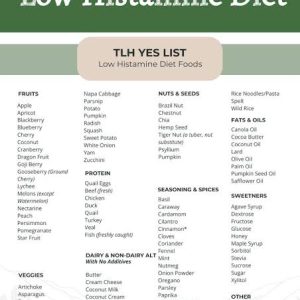
Skip the fantasy of a perfect master list. Low-histamine eating usually works better when you shop from categories that are easier to manage: fresh, plain, minimally processed. That means fewer chances for fermentation, aging, or long storage to muddy the waters.
Here is the kind of starting list I’d use for a practical kitchen reset:
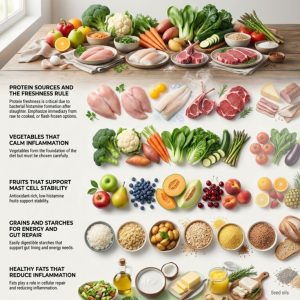
- Freshly cooked meats such as chicken, turkey, and some cuts of beef or lamb, if you tolerate them
- Fresh fish only if you cook and eat it promptly after purchase
- Eggs, if they are part of your personal tolerance pattern
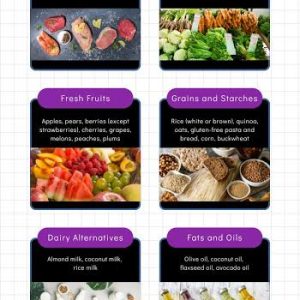
- Rice, quinoa, oats, and similar plain grains
- Fresh vegetables such as carrots, zucchini, cucumber, lettuce, broccoli, cauliflower, and green beans
- Fresh fruits that are often better tolerated, such as apples, pears, blueberries, grapes, and melon, depending on your own response
- Olive oil, coconut oil, and simple salts
- Herbs like basil, parsley, dill, and oregano in modest amounts
- Non-dairy milks without a long additive list, if they sit well with you
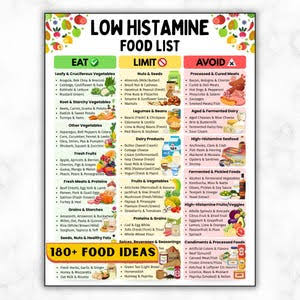
I’m being careful here because “low histamine” is not the same as “safe for everyone.” Some foods that show up on one list may still bother you. Spinach, tomatoes, eggplant, citrus, bananas, and avocado often cause problems for many people, so I would not treat them as starter foods. Fermented foods — vinegar, soy sauce, kombucha, sauerkraut, kefir, yogurt, aged cheese — are common troublemakers and should usually be the first things to cut while you figure things out. Cleveland Clinic and the British Dietetic Association both note that trigger foods vary, which is why personal testing matters.
Storage can change everything. Fresh chicken eaten the same day is one thing; cooked chicken sitting in the fridge for days is another. That’s why leftovers matter so much in histamine management. Want a safer baseline? Cook smaller portions, chill food quickly, and freeze extra servings instead of letting them linger. FDA food-safety guidance also supports rapid cooling and proper refrigeration for cooked food.
Use the list like a grocery filter, not a diagnosis. If a food is on the “safer” side but makes you itch, flush, bloat, or get headaches, it does not belong in your personal rotation right now. Your body gets the final vote.
Safe Ingredient Swaps That Actually Make Cooking Easier
Here’s where the plan becomes practical. Replacing the ingredients that show up everywhere — acidic condiments, fermented seasonings, aged dairy, long-marinated proteins — can make dinner stop feeling like a trap. And for significant symptoms, it’s worth checking them with a clinician or dietitian instead of assuming any substitute is automatically safe.
- Vinegar or pickle brine → olive oil, salt, herbs, and a little water or cucumber for brightness
- Soy sauce or tamari → coconut aminos, if you tolerate it, or a simple salt-and-herb seasoning
- Tomato sauce → roasted pumpkin, carrot, or zucchini-based sauce
- Sour cream or yogurt → coconut-based alternatives or plain fresh dairy only if you know it works for you
- Aged cheese → fresh cheese only if tolerated, or skip dairy and use olive oil for richness
- Lemon-heavy dressings → herb oil dressings or a touch of apple if you need acidity and tolerate it
- Cured meats → freshly cooked poultry, beef, or turkey
- Pre-made spice blends with additives → single herbs and spices you already know are safe
- Leftover protein salads → freshly cooked protein served the same day
The real strength of swaps is not culinary purity. It is symptom control with less panic. A person who can’t tolerate a classic vinaigrette may still enjoy a salad with olive oil, dill, cucumber, and a pinch of salt. A pasta eater who reacts to tomato sauce may do better with olive oil, garlic if tolerated, and soft vegetables.
But swaps can become a trap. You may replace one ingredient and keep all the others that still bother you. Or you may pile on “low histamine” substitutes that are highly processed and then wonder why you feel off. I’d rather see a simple meal built from a few fresh ingredients than a long ingredient list full of substitutes. Clean enough. Not fancy.
One more caution: “safe” is personal. Coconut aminos, for example, work well for many people, but not all. The same is true for fresh dairy, oats, or eggs. A swap only helps if it reduces your symptom load. If it doesn’t, cross it off your own list and move on.
The Honest Side-by-Side
If I had to choose the better tool for a new low-histamine eater, I would pick the ingredient swap approach — because it gets you from “I can’t eat this recipe” to “I can still make dinner” faster. The food list matters, but the swaps are what make the plan livable.
| Criteria | Low-Histamine Food List | Safe Ingredient Swaps | Winner for [condition] |
|---|---|---|---|
| Ease of starting | Simple to understand, but can feel restrictive fast | Requires a little recipe thinking, but preserves familiar meals | Swaps for people who hate dietary whiplash |
| Kitchen flexibility | Limits you to a narrower set of foods | Lets you rebuild soups, salads, sauces, and mains | Swaps |
| Risk of accidental triggers | Lower if you stick to plain, fresh foods | Depends on the substitute ingredients you choose | Food list for severe sensitivity |
| Meal variety | Can get repetitive quickly | Higher variety if you keep the swaps simple | Swaps |
| Grocery shopping | Easy to sort items into keep/avoid | Harder at first because you compare ingredients | Food list for overwhelmed beginners |
| Eating with a family | Harder unless everyone eats the same baseline meal | Easier to modify shared recipes at the end | Swaps |
| Best for symptom reset | Strong first step when you need a clean baseline | Useful after you identify your own trigger pattern | Food list for elimination phase |
| Long-term sustainability | Can be too narrow if you never reintroduce foods | More sustainable for day-to-day cooking | Swaps |
| Recipe rescue | Not very helpful on its own | Directly solves the “what do I cook instead?” problem | Swaps |
My honest view: the list is the foundation, but the swaps save your week. The list gives you safety. The swaps give you normal life.
The Real Difference Between Fresh, Leftover, and Processed Foods
Generic articles tend to gloss over this, but it matters a lot: histamine risk is not just about the food category. Age, storage, and processing all change the picture. Fresh, plain food usually wins because it has had less time and fewer conditions to build up problems. Leftovers are often where people get blindsided. Sneaky little culprit.
I’d treat fresh-cooked meals as the safest default. Cook a protein, eat it soon, and keep the seasoning simple. For leftovers, cool them quickly and freeze extra portions rather than assuming “fridge safe” means histamine safe. That is not a perfect rule for every person, but it is a practical one.
Processed foods are trickier. They can hide vinegar, citric acid, yeast extracts, fermented flavorings, soy, preservatives, and other ingredients that may bother sensitive eaters. Sometimes a packaged food looks simple on the front and becomes a full trigger list on the back. That is why I prefer readers learn label scanning early. You do not need to memorize every additive. You do need to spot the usual suspects quickly.
The upside of this approach is clarity. If symptoms improve with fresher food, you learn something useful fast. The downside is inconvenience. Cooking more often takes time, and freezing portions takes planning. No way around that.
My recommendation is to build a small “safe meal system”: one or two proteins, two or three vegetables, one grain, one fat, and two or three seasonings that you already trust. That gives you enough structure to shop and enough flexibility to repeat meals without getting bored. If you start with that, you will have a better read on which problem is the ingredient and which problem is the age of the food. The FDA’s food-storage guidance is useful here because it reinforces the basic 2-hour cooling rule for cooked food.
Our Verdict: Which One to Choose and Why
Choose the low-histamine food list if you are at the beginning of your reset, your symptoms are unpredictable, or you need the cleanest possible starting point. Choose safe ingredient swaps if you already know a few trigger ingredients and want to keep cooking normal meals with fewer flare-ups. Neither works well if you are cutting entire food groups blindly and losing weight, energy, or confidence — that is the point to bring in a clinician or dietitian.
My actual verdict is this: start with the food list, then move quickly into swaps. The list tells you what to buy. The swaps tell you how to eat like a human while you figure out your trigger pattern. If you stop at the list, the diet can become too narrow to live with. If you jump straight to swaps without a baseline, you may keep accidentally using ingredients that keep you symptomatic.
Here is the cleanest way to think about it:
- If your symptoms are strong or confusing, use the food list first.
- If your meals are already built around tomato sauce, vinegar, cheese, soy, or leftovers, focus on swaps first.
- If you need to feed a household, swaps are usually the better long-term strategy.
- If you are in a symptom flare and want to simplify fast, the list wins.
What I would not do is start with a giant “safe foods” spreadsheet and try to obey it perfectly. That tends to create fear, not meals. Pick a small baseline, swap the obvious trigger ingredients, and keep notes on what actually happens. That is the shortest path to a useful personal plan.
When to Reconsider This Choice Entirely
Sometimes the right move is neither a smarter list nor a cleaner swap. It is to step back and ask whether histamine is the only issue. I would reconsider the whole approach when any of these apply:
- Symptoms keep worsening despite a very simple diet. That can mean the problem is broader than histamine alone.
- You are avoiding so many foods that meals are no longer adequate. A restrictive plan that leaves you underfed is not a success.
- You react to many fresh foods, not just fermented or aged ones. That pattern deserves professional evaluation.
- You have red-flag symptoms like trouble swallowing, rapid weight loss, severe swelling, or repeated vomiting. Those are not DIY nutrition issues.
There is another reason to pause: some people become so focused on “safe” eating that they never reintroduce foods. That can shrink your diet more than the condition itself requires. When you are using a low-histamine plan for more than a short reset, I think it is worth checking whether you are still responding to the original trigger or just living in fear of one.
The most useful version of this guide is not endless avoidance. It is a temporary structure that helps you find your own threshold. If your plan is making life smaller rather than steadier, it has stopped serving you.
Exception Scenarios: When the Verdict Flips
The answer changes in a few specific situations, and it helps to say that plainly.
First, for highly sensitive people who react to tiny changes, the food list matters more than swaps. In that case, ingredient replacement can still backfire because the substitute itself may be a problem. Start with the simplest foods and only add one variable at a time.
Second, for family cooking where one meal needs to work for everyone, swaps win. It is easier to make a neutral base meal and let others add vinegar, cheese, hot sauce, or other extras at the table than to make separate dinners.
Third, when symptoms mainly come from leftovers, storage strategy matters more than ingredient choice. Freshly cooked food may solve more than any swap list ever will. In that case, batch size and freezing habits become the real tools.
Fourth, if you are already eating a limited diet and feel worse, not better, the answer may be that you need reintroduction guidance rather than tighter avoidance. A stricter list will not help if the core problem is under-eating, stress, or misidentified triggers.
That is the honest version of the decision: the “best” tool changes with the problem. If the problem is broad and chaotic, the food list is your anchor. If the problem is one or two recurring trigger ingredients, swaps are the practical win.
A Practical Starter Plan You Can Use Tonight
If you want a simple way to begin, I would not overcomplicate it. Build one meal from each of these pieces:
- A plain protein you tolerate
- A low-risk starch
- Two vegetables
- A simple fat
- One or two herbs
For example, think in patterns rather than recipes: rice with chicken and zucchini; oats with pear if that works for you; turkey with carrots and olive oil; lettuce bowls with cucumber and fresh-cooked protein. If you need flavor, add the least complicated seasoning you know you handle.
Then make one swap at a time. Replace vinegar with herbs. Replace tomato sauce with