Last updated: November 20, 2026
Quick answer: a low histamine leftover is worth saving only if the smell, texture, and storage history all still look normal. If any one of those looks off, toss it. This guide on How to Decide Whether a Low Histamine Leftover Is Still Worth Saving shows how to judge cooked rice, cooked meat, vegetables, and the storage container without guessing.
Key Takeaways
- A leftover can look fine and still be the wrong choice if the smell, feel, or container tells a different story.
- Cooked rice and cooked meat need the strictest check because small changes show up fast.
- Softness, sliminess, dryness, and sour notes matter more than wishful thinking.
- A clean container with a tight lid helps, but it does not rescue food that already smells stale or odd.
- If you are unsure after the check, it can be safer to discard it.
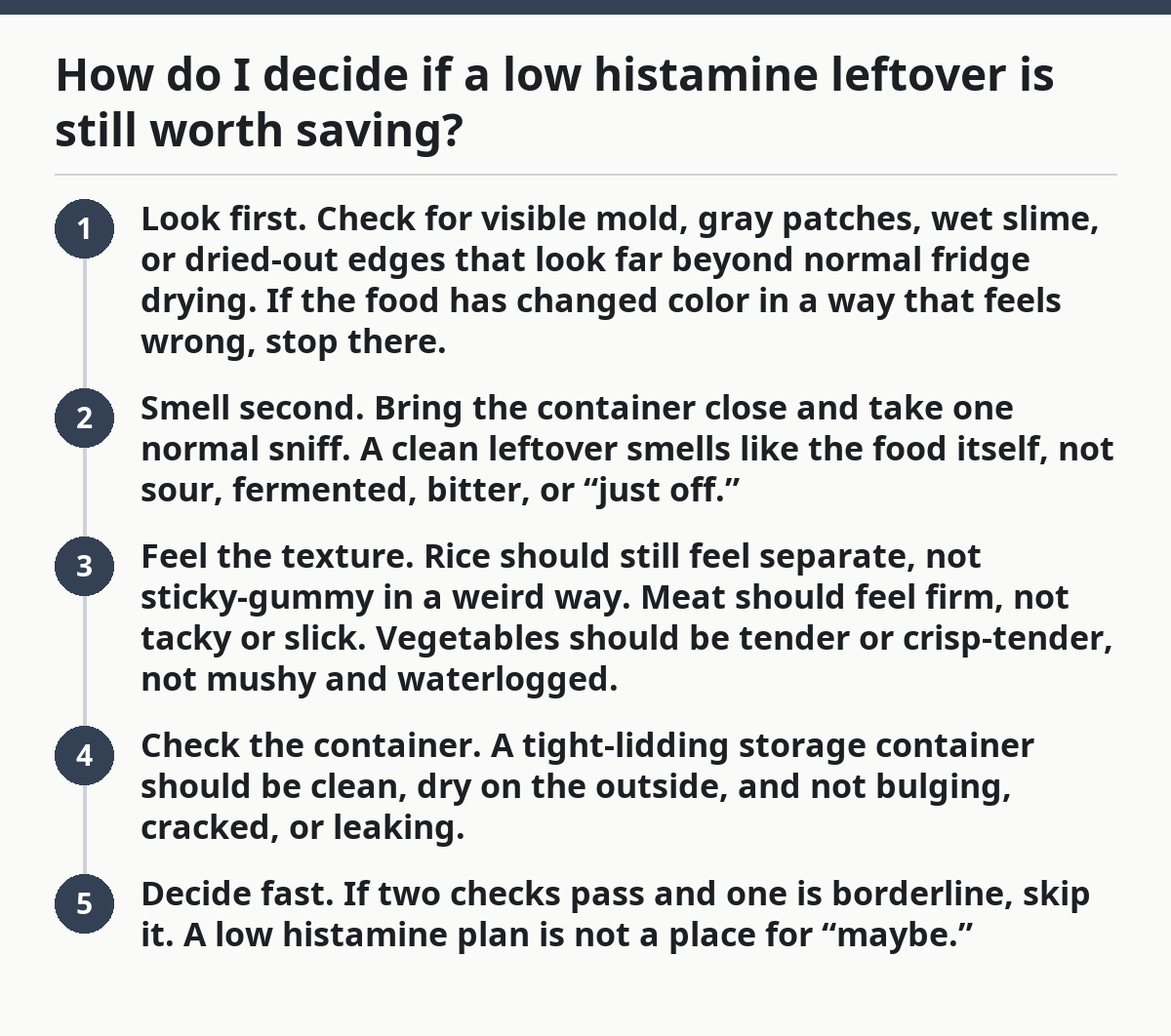
How do I decide if a low histamine leftover is still worth saving?
A low histamine leftover is worth saving when it still smells clean, feels like the food you cooked, and has stayed cold in a sealed container. That is the basic decision rule, and it works better than trying to judge by the clock alone.
Picture this: you open the fridge, spot last night’s meal, and want to know if it belongs in lunch or the bin. You need a fast call, not a kitchen lecture. The truth is, three checks settle most cases before you reheat anything.
- Look first. Check for visible mold, gray patches, wet slime, or dried-out edges that look far beyond normal fridge drying. If the food has changed color in a way that feels wrong, stop there.
- Smell second. Bring the container close and take one normal sniff. A clean leftover smells like the food itself, not sour, fermented, bitter, or “just off.”
- Feel the texture. Rice should still feel separate, not sticky-gummy in a weird way. Meat should feel firm, not tacky or slick. Vegetables should be tender or crisp-tender, not mushy and waterlogged.
- Check the container. A tight-lidding storage container should be clean, dry on the outside, and not bulging, cracked, or leaking.
- Decide fast. If two checks pass and one is borderline, skip it. A low histamine plan is not a place for “maybe.”
Here’s the catch: a leftover can pass the smell test and still be a bad fit if the texture has gone soft in a way that signals age. That matters most with mixed dishes, where one ingredient can spoil the whole container.
For broader storage habits, the hub page on low histamine food storage and leftovers belongs next. This page is only about the keep-or-discard call. For general food safety guidance, see the USDA Food Safety and Inspection Service and the FDA on refrigeration and leftovers.
What should I check on cooked rice, cooked meat, and vegetables?
Therefore, you should check cooked rice, cooked meat, and vegetables by looking for the fastest visible change in each one. Each food fails in a different way, so one rule does not fit all.
Picture this: you’ve got plain rice, roasted chicken, and green beans in separate containers. Each one needs a different eye. Rice goes wrong by feel, meat goes wrong by smell and tackiness, and vegetables go wrong by limp texture and pooling liquid.
- Cooked rice: Separate grains are a good sign. Clumped rice is not automatically bad, but rice that smells sour, feels sticky in a gluey way, or has any slick sheen should go.
- Cooked meat: Chicken, turkey, beef, or fish should smell like cooked protein, not sharp or funky. If the surface feels slimy or tacky, or the color has shifted to dull gray-brown with an odd wet look, discard it.
- Vegetables: Most cooked vegetables should hold some shape. If they have collapsed into mush, released a lot of liquid, or smell fermented, they are past the point of saving.
- Mixed dishes: Casseroles, grain bowls, and stir-fries are harder to judge because one bad ingredient can hide inside the rest. If the sauce smells sour or the bottom layer looks wet and separated, toss the whole container.
You do not need a perfect memory of what the food looked like on day one. You only need to know whether it still resembles cooked food or has crossed into a tired, damp, stale state. That shift is easiest to see in rice.
A practical note for low histamine eating: if a food is already borderline, it is rarely a smart trade to “save” a few bites. A fresh batch of rice or vegetables usually costs less than a bad meal.
What does smell tell me that sight misses?
Smell tells you when a leftover has started to change in ways your eyes can miss. Sour, fermented, ammonia-like, or sharp bitter odors are a bad sign even when the food still looks normal.
Picture this: the container looks fine from the outside, but the second you lift the lid, the air changes. That moment matters. A leftover with a clean smell usually smells bland or like the original dish; a risky one has a note that sticks in the nose after one sniff.
Use this simple filter:
- Clean smell: mild, familiar, and close to the original dish.
- Borderline smell: dull, stale, or slightly metallic. That is a warning, especially for meat.
- Bad smell: sour, fermented, rancid, or pungent. Do not taste it to “check.”
A common mistake is trusting spices. Garlic, curry, chili, and herbs can cover a lot, which is why smell is not a free pass. A well-seasoned leftover can still be off if the underlying food has changed.
On the flip side, not every strong smell means spoilage. Onion, fish sauce, kimchi, and some sauces already smell loud. The question is whether the container smells like the food you cooked or like something has shifted since then. If you have to pause and think about it, that pause is the answer.
For a low histamine eater, smell is especially useful because it gives you a quick yes-or-no before you commit to reheating. A safe-looking container is not enough when the scent has changed. The USDA says refrigerated leftovers should be used within 3 to 4 days, but smell still matters because the food itself is the final check.
Does the storage container tell me anything?
Yes, the storage container tells you a lot because it protects the food from air, leaks, and fridge odors. A good container is clean, sealed, and unwarped; a bad one can turn a decent leftover into a questionable one.
Picture this: you pull out a container with a loose lid, stained corners, or a crack along the rim. That is not just a mess issue. It can let in fridge air, hold odors, and make the food harder to judge.
Check these points before you decide to keep the food:
- Lid fit: It should close snugly without wobbling.
- Surface condition: No cracks, deep scratches, or warped plastic.
- Odor: The container itself should not smell sour or musty after washing.
- Leak evidence: Liquid pooling around the rim or in the fridge shelf is a warning.
- Clean edges: Dried sauce on the lip or under the seal means the storage was sloppy, and sloppy storage raises doubt.
Glass containers usually make inspection easier because you can see condensation, liquid separation, and color changes. Plastic containers can stain and hold odors longer, so they need a closer sniff. Neither one saves food that already smells wrong.
A container also helps you remember whether the leftover was treated well in the first place, but if you are unsure, it is wise to check food-safety guidance or a dietitian rather than relying on the container alone. If the lid was left open, the food sat in a shallow layer, or the container was packed too full to cool evenly, the odds of keeping it drop. You do not need exact lab conditions to see a poor setup.
That said, the container is a clue, not a verdict by itself. A spotless box does not make old rice safe. It only makes the judgment easier.
When should I throw it out instead of taking a chance?
Therefore, you should throw it out when the food is borderline in more than one way, or when the dish no longer looks or smells like food you would serve yourself. One warning sign can be enough if it is strong; two smaller signs are enough if they stack up.
Picture this: you are holding a container and trying to talk yourself into keeping it because it was expensive or took time to cook. That is the wrong moment for thrift. The decision is about whether the leftover is still worth the risk, not whether it hurts to waste it.
Discard it if you see any of these:
- A sour, bitter, or fermented smell
- Slimy, tacky, or gluey texture
- Gray, dull, or unusually wet meat
- Mushy vegetables with separated liquid
- Mold, fuzz, or spotting
- A cracked, dirty, or leaky container
- Any leftover that makes you hesitate after all three checks
Do not do the “small bite” test. That can muddy the judgment and does nothing to rescue a questionable dish. Also skip the “I’ll just eat the safe-looking part” approach when the food is mixed. In a mixed dish, the part you can see is not the whole story.
The best habit is blunt: if the leftover seems only barely acceptable, it is not a good candidate for a low histamine meal. There is enough daily uncertainty in eating patterns without adding one more shaky container.
What mistakes make people save the wrong leftover?
The biggest mistake is treating “looks fine” as the whole decision. A leftover can look normal under kitchen light and still have the wrong smell, the wrong feel, or the wrong history. Another mistake is saving food because it is convenient, not because it is still a good choice.
Picture this: you are standing at the fridge at 7 p.m., tired, hungry, and tempted to keep the container because dinner is already there. That is exactly when bad calls happen. A tired brain wants a yes, even when the food is saying no.
Common mistakes and what they cost:
- Ignoring smell: You keep a leftover that should have been tossed. That can lead to a meal you won’t want to finish.
- Trusting the container alone: A sealed box can still hold food that has gone stale or odd.
- Saving mixed dishes too long: One questionable ingredient can make the whole thing a loss.
- Confusing dryness with safety: Dried edges are not the same as okay food. Dry can still mean old.
- Trying to rescue a bad dish with seasoning: Spices hide odor; they do not fix the problem.
Here’s a simple rule that cuts through all of that: if you would not plate it for someone else without thinking twice, do not keep it for yourself. That is especially true for cooked meat and cooked rice, where texture changes are easy to spot.
The goal is not to be perfect. It is to be consistent. A clear discard rule saves more time than a half-dozen second guesses.
How do you know if leftovers are still safe?
Ultimately, you know leftovers are still safe when they still smell normal, look like the food you made, and feel right for that food. A clean container helps, but it is not enough on its own. If the smell is sour, the texture is slimy, or the dish makes you pause, throw it out. For more on storage timing, the FDA and USDA both give plain-language fridge guidance.
When should you throw out leftover food?
Therefore, you should throw out leftover food as soon as it shows a clear bad smell, slimy texture, mold, or a visible change that does not fit the dish. You should also throw it out when there are two smaller warning signs together. A borderline container, odd smell, and soft texture is not worth gambling on. The CDC’s food-safety guidance and USDA leftovers advice both support that cautious approach.
How long can cooked food stay in the fridge?
Specifically, cooked food can stay in the fridge only as long as it still passes the smell, sight, and texture check. Time helps you judge, but it does not replace the food itself. If you want the storage side, the hub on low histamine food storage and leftovers covers the fridge and cooling side in more detail.
Drafted with AI; not yet reviewed by a person.