Last updated: November 19, 2026
Quick answer: A low histamine rotation menu usually works best as a 2-week cycle with 3 to 5 repeatable meals, plus one fallback meal, so you can keep variety without rebuilding your plan every week. In How to Build a Low Histamine Rotation Menu Without Getting Bored, the goal is not novelty every day; it is enough variety to keep eating simple, calm, and sustainable.
Key takeaways
- A rotation menu is a short cycle of meals you can repeat without rebuilding your plan every week.
- Safe core foods do the heavy lifting; theme meals add variety without changing the whole system.
- A meal rotation chart helps you see gaps, repeats, and ingredient overlap at a glance.
- Ingredient rotation matters because even a safe food can get old fast if it shows up the same way every night.
- The menu should feel steady enough for symptoms and flexible enough for real life.
What is a rotation menu for histamine intolerance?
A rotation menu for histamine intolerance is a planned loop of meals that repeats on purpose, usually with the same safe core foods showing up in different combinations. It is not a random list of “safe” foods. It is a structure that helps you avoid decision fatigue, reduce boredom, and keep shopping cycles predictable. For a broader framework, it fits within a meal planning for histamine sensitivity approach rather than standing alone.
According to Cleveland Clinic, histamine intolerance is often discussed as a food-related sensitivity pattern, which is why consistency matters. Think of the menu as a 2-week or 3-week pattern rather than a forever menu. That gives enough room for variety without forcing you to invent dinner every night. A short cycle is also easier to edit when a food stops working for you, which matters when symptoms change and your tolerance changes with them.
The word “rotation” does not mean you must rotate every ingredient equally. It means you keep a stable base and move the pieces around. For example, one breakfast can become 3 versions if you change the texture, the side, or the time of day you eat it.
A useful rotation menu usually includes these pieces:
- a few breakfast options
- a few lunch options
- a few dinner options
- 2 or 3 snack paths
- a fallback meal for low-energy days
That is enough to build a working system without turning your kitchen into a spreadsheet. For readers who want the bigger planning frame, this fits under a meal planning for histamine sensitivity system rather than standing alone.
How do you build the menu?
You build the menu by starting with safe core foods, then arranging them into repeat meal cycles that fit your week. The menu should be simple enough to shop for once, then repeat with small changes in form, flavor, or timing.
Use this as the basic process:
- List 6 to 10 foods that you already know sit well with you. Group them by proteins, starches, vegetables, and snacks so you can see what is missing.
- Choose 3 to 5 meals that can repeat without feeling identical. A 2-week cycle is often easier to manage than trying to fill 30 days at once.
- Assign each meal a theme, such as soup night, bowl night, wrap night, or simple plate night. A theme gives the meal a job and keeps the menu from feeling flat.
- Build 1 backup meal for days when you have no energy. Keep the backup close to the foods you already buy so the shopping list stays short.
- Write the menu as a meal rotation chart with days, meals, and one note column for swaps. The chart turns a loose idea into something you can actually use.
- Review the chart before shopping. If one ingredient appears 4 times in the same cycle, decide whether that is useful repetition or too much of one thing.
A chart works better than memory because it shows the shape of the week at a glance. It also makes it easier to spot when the same food shows up in breakfast, lunch, and dinner too often. That kind of stacking is one reason people get bored, even when the foods are technically safe.
The hardest part is not choosing “perfect” meals. It is choosing meals that repeat cleanly. A rotation menu should feel like a rhythm, not a puzzle. For more structure, a low histamine food list can help you sort which foods belong in the core and which should stay optional.
Which foods belong in the safe core?
Your safe core foods are the small group you trust enough to build around, not every food that looks low histamine on paper. That core should be boring on purpose, because boring is what makes it reliable.
A core usually needs 3 kinds of foods: a base, a protein, and a vegetable or fruit you can repeat. If every meal starts from a different base, your shopping list grows fast and the menu gets harder to hold together. If every meal shares the same base, boredom shows up even faster. The middle path is the point.
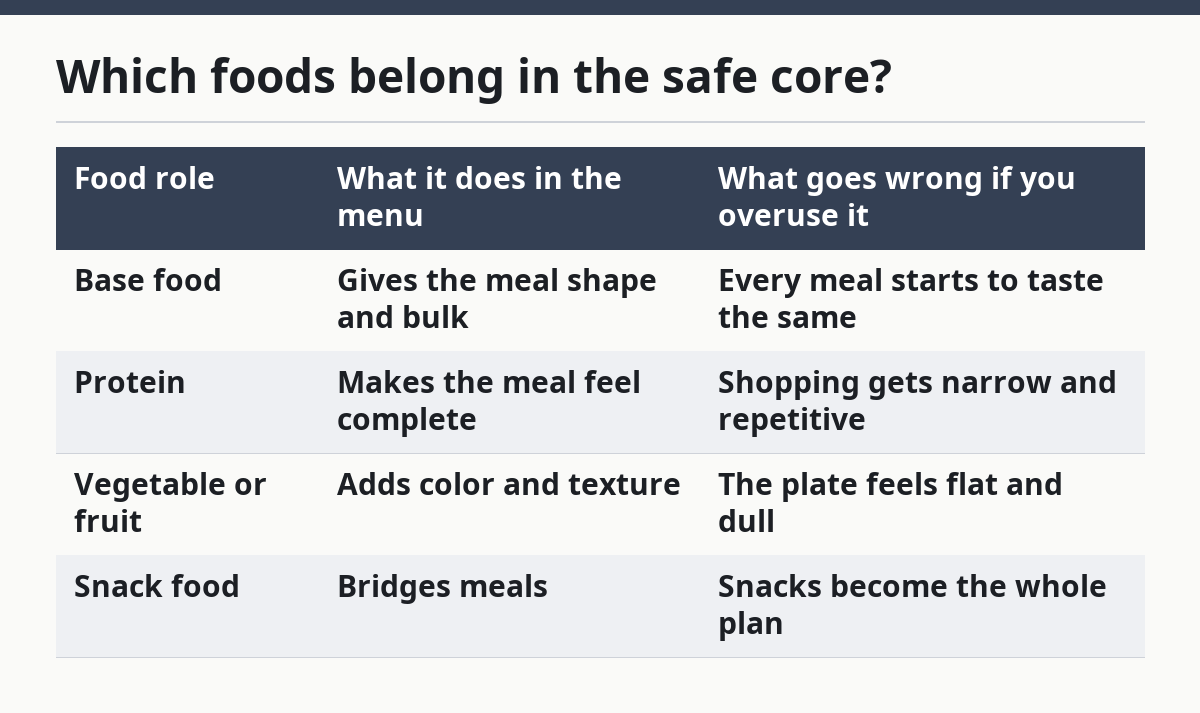
Here is a simple way to compare how each food role behaves in a rotation menu:
| Food role | What it does in the menu | What goes wrong if you overuse it |
|---|---|---|
| Base food | Gives the meal shape and bulk | Every meal starts to taste the same |
| Protein | Makes the meal feel complete | Shopping gets narrow and repetitive |
| Vegetable or fruit | Adds color and texture | The plate feels flat and dull |
| Snack food | Bridges meals | Snacks become the whole plan |
A safe core should also match your shopping cycle. If you buy the same handful of items every week, you can repeat meals without needing a new grocery list each time. That lowers the planning load and keeps the system usable on a busy day. According to the NHS, repeating a small set of familiar foods can make meal planning more sustainable, which is the point here.
This is where many generic menus go wrong. They list too many safe foods and too few actual meals. A long list looks helpful, but a working rotation menu needs repetition, not just options. If the list is too big, the plan falls apart by Wednesday. A histamine intolerance diet is easier to live with when the foods are organized into a usable routine.
The right core is also personal. A food that is safe for one person can still be a bad fit if it is expensive, hard to prep, or unpleasant in the same form twice a week. This page is not for anyone who wants a giant master list of foods; it is for someone who wants a menu that survives ordinary life.
How do you stop boredom without changing the whole plan?
You stop boredom by changing the meal theme, not the entire ingredient list. Small shifts in form, serving style, and meal timing give a menu variety without adding risk or extra shopping.
Use these switches one at a time:
- change a bowl into a plate
- change a warm meal into a cold one when that fits your foods
- change breakfast into lunch if the same ingredients work both ways
- change the side, not the main food
- repeat the same protein with a different starch
- move a meal to a different day in the cycle
A theme meal helps because it gives the meal a clear job. Soup night, bowl night, simple plate night, and snack-for-dinner night all feel different even when the ingredients stay close. That is useful when you need routine but do not want the menu to taste like copy-paste.
The trick is to keep the change small enough that the shopping list barely moves. If every new idea requires 6 new ingredients, the plan becomes a project. A rotation menu should reduce work, not create a second job.
Boredom also shows up when the same food appears in the same slot every week. If oatmeal is always breakfast and rice is always dinner, the menu can feel tighter than it really is. Swap the slot sometimes. Put a breakfast food into an afternoon meal or turn a dinner base into lunch. The food changes less than the feeling of the meal.
What should a weekly rotation chart look like?
A weekly rotation chart should be short enough to read in 30 seconds and specific enough to shop from. If it takes a full page of notes, it is probably too complicated for a low histamine routine.
A practical chart usually has 4 columns: day, meal, core foods, and swap note. That format lets you keep the structure while leaving room for a small change. A swap note can say “use same base, different side” or “repeat from Tuesday if shopping is light.”
Here is a simple model:
- Monday: theme meal A
- Tuesday: theme meal B
- Wednesday: repeat Monday with one change
- Thursday: fallback meal
- Friday: theme meal C
- Saturday: repeat Tuesday or use backup
- Sunday: simpler reset meal
That kind of chart is useful because it shows your repeat meal cycles without pretending every day needs its own recipe. It also helps you see where shopping cycles may be too tight. If the same ingredient is used on 5 days in a row, the menu may be easy to shop for but hard to enjoy.
A good chart also protects you from the most common mistake: overplanning. People often build a menu that looks impressive for 1 week and impossible by week 3. A smaller chart wins because it can be repeated. Repetition is not a flaw here; it is the system. A meal rotation chart should work like a tool, not a display piece.
If you want the whole meal-planning framework around this, the rotation chart should sit inside a broader planning method, not replace it. The chart is one tool, not the whole answer.
What mistakes make the menu feel boring fast?
The biggest mistake is making the menu too narrow, and that usually costs you either enjoyment or consistency. If you repeat the same 3 meals in the same order every week, boredom arrives fast. If you chase too many new meals, the plan turns unstable and harder to shop for.
A few common mistakes stand out:
- Too many ingredients, too few meals. The menu looks varied but does not function as a routine.
- Same meal, same slot. The body learns the pattern and the meal starts to feel stale.
- No backup meal. One rough day can break the whole week.
- No shopping cycle. The menu depends on ingredients you do not buy often enough.
- Copying a general meal plan. A normal meal plan often ignores the repetition limits people feel with histamine issues.
The cost of these mistakes is not just boredom. It is also more decisions, more food waste, and more chances to abandon the plan. A rotation menu should lower pressure, not create it.
The fix is usually smaller than people expect. Keep the same base and change the theme. Keep the same protein and change the side. Keep the same menu length and edit one meal at a time, not the whole chart. A 2-week cycle with 5 reliable meals often works better than a long list that looks complete but never gets used.
This is the part where a lot of generic advice falls short. It tells you to “add variety” without saying how little variety may be enough. In this kind of menu, a small change is often the right change.
FAQ
How do you keep low histamine meals from getting boring?
You keep low histamine meals from getting boring by changing the meal format, not by rebuilding the menu every week. A theme meal, a different side, or a new meal slot can make the same safe foods feel fresh. A 2-week cycle usually gives enough repeat space without making the plan dull.
What is a rotation menu for histamine intolerance?
A rotation menu for histamine intolerance is a repeating meal plan built from a short list of trusted foods. It lets you cycle meals on purpose instead of deciding from scratch each day. A practical version uses a meal rotation chart, a small safe core, and a few fallback meals.
How many meals should be in a rotation?
A rotation menu usually works best with a small number of meals that can repeat cleanly. The exact count depends on your shopping cycle and how much variety you need, but the menu should still feel easy to recall and easy to shop for. If the list is too long, it stops behaving like a rotation.
How do I know if my rotation is too repetitive?
Your rotation is too repetitive if you start dreading the next meal before the week is over. That usually means the same foods are showing up in the same format too often. Change one element first, such as the theme, the side, or the meal time, before you add a new recipe.
Can one meal work in more than one slot?
Yes, one meal can work in more than one slot if the ingredients fit and the meal still feels different enough to eat twice. A breakfast food can become lunch, or a dinner base can become a simple midday plate. That kind of reuse helps the menu stay short while still feeling varied.
Drafted with AI; not yet reviewed by a person.