Last updated: November 19, 2026
Quick Answer: Build a low histamine prep schedule around workdays with 2 prep blocks per week, plus 1 short midweek reset, so you can match meals to your calendar and keep food fresher. This article explains How to Build a Low Histamine Prep Schedule Around Workdays with a practical, calendar-first system that fits workdays, commutes, and real fatigue.
Key Takeaways
- Map work hours first, then place food tasks in the lightest openings.
- Keep work, meal choices, and grocery items in separate tools.
- The quickest prep uses simple foods you can cook, cool, and serve in one cycle.
- Break cooking and cooling into three steps: cook, portion, chill.
A low histamine prep schedule around workdays starts with fewer, shorter sessions: one shopping run, one main prep block, and one midweek reset. The meal prep schedule should match your calendar, your commute, and the meals you actually eat on busy weekdays.
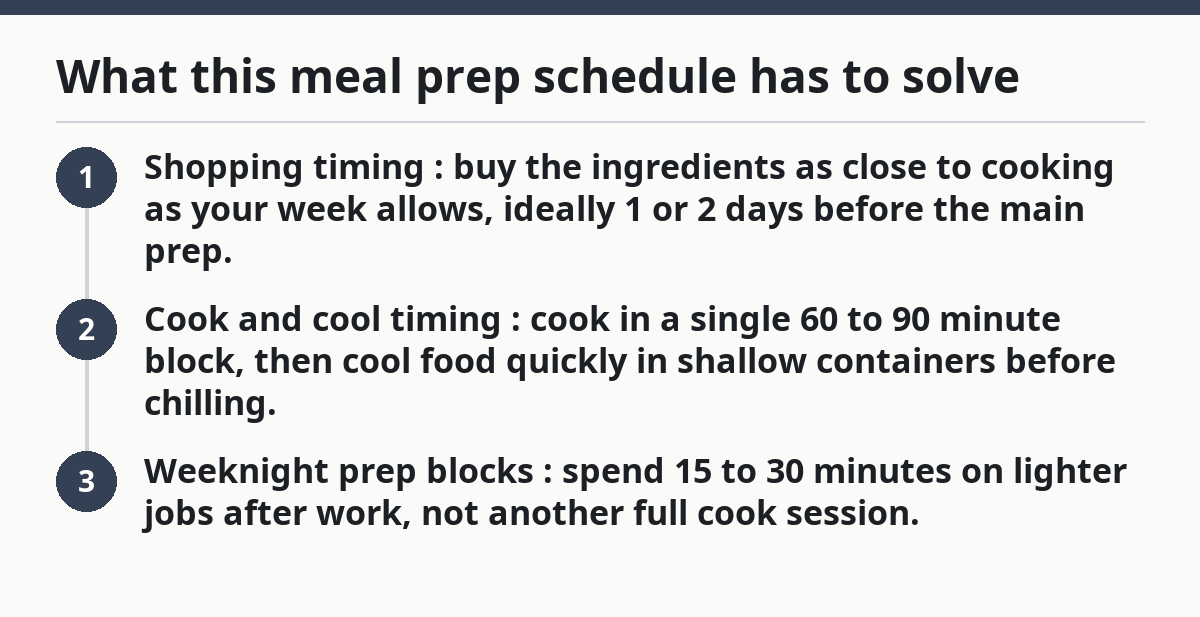
What this meal prep schedule has to solve
This meal prep schedule has to protect food freshness without asking for a Sunday marathon. The point is not to cook everything at once; it is to spread the work across 2 to 3 prep blocks so the food lands in the fridge or freezer at the right time. That matters because histamine can rise as food sits, especially in cooked leftovers kept too long in the refrigerator.
A workday-friendly schedule usually has three parts:
- Shopping timing: buy the ingredients as close to cooking as your week allows, ideally 1 or 2 days before the main prep.
- Cook and cool timing: cook in a single 60 to 90 minute block, then cool food quickly in shallow containers before chilling.
- Weeknight prep blocks: spend 15 to 30 minutes on lighter jobs after work, not another full cook session.
The easiest version is a calendar-based plan that treats dinner as the anchor meal. For example, if Tuesday and Thursday are long days, make Monday the main cook day, Wednesday the reset day, and Friday the restock day. A meal planner and a shopping list do the heavy lifting here. If the plan fits your actual clock timing, you will use fewer shortcuts that backfire, like reaching for random leftovers or skipping dinner and overeating later. If you have a medical reason to follow a low histamine diet, a clinician or dietitian can help you adjust the plan safely.
This kind of schedule is not for someone who wants a freezer full of 10 different recipes. It is for someone who needs a repeatable rhythm and less decision fatigue, not culinary variety every night. For related planning help, see the meal prep basics guide and the low histamine meal plan.
How do I build a low histamine prep schedule around my workdays?
You build it by mapping your hardest work hours first, then assigning food tasks to the least strained slots. Start with your work calendar, then place prep around the days when you have the best 45 to 90 minute window. That gives the schedule a job: survive the week, not win it.
Before you set the rhythm, check practical guidance from the USDA Food Safety and Inspection Service and FoodSafety.gov on cooling and storing leftovers.
Use this order:
- Mark your workdays, commute, and any late meetings on a 7-day calendar. The result should show your 2 tightest evenings and your 1 most flexible evening.
- Choose your main prep day, ideally a day off or the least crowded evening, and reserve 60 to 90 minutes. That block handles the base items you will eat in the next 1 to 3 days.
- Assign one short backup block of 15 to 25 minutes for washing produce, portioning protein, or packing lunch containers. That keeps the next workday from turning into a scramble.
- Place shopping 1 to 2 days before the main prep block if you can, so produce and meat spend less time waiting in the fridge. The result is better freshness and less waste.
- Set a hard stop for cook and cool time. Hot food should move into shallow containers, roughly 2 inches / 5 cm deep, so it can chill faster before storage.
- Schedule one midweek review, usually 10 to 15 minutes, to decide what gets eaten first and what gets frozen. That decision reduces last-minute guessing on a tired worknight.
A simple example: if you work Monday through Friday with two late nights, the schedule might be shopping on Saturday morning, the main prep on Sunday afternoon, a 20-minute reset on Wednesday night, and a Friday check-in to clear the fridge. If your energy drops after work, move the heavier chopping to the weekend and reserve weeknights for packing and reheating only. For another workday-friendly structure, the workday meal plan page shows a similar routine.
The best schedule is the one that prevents the “I have ingredients but no usable dinner” problem. It should also leave room for real life: meetings, fatigue, or a commute that runs long. A weekly meal planner can help keep those decisions visible.
What should go in the calendar, meal planner, and shopping list?
The calendar should hold the work, the meal planner should hold the decisions, and the shopping list should hold the ingredients. If those three are mixed together, the system gets messy fast.
The calendar needs only the logistics: shopping day, prep block, reset block, and the nights when you cannot cook. The meal planner needs the menu decisions: which protein, which starch, which vegetables, and which meal gets eaten first. The shopping list should be grouped by store section so you move once through produce, proteins, pantry items, and packaging.
A low histamine shopping list is usually short and repetitive on purpose. That is not a flaw; it is a safeguard against decision fatigue. If you know you do better with the same 4 breakfasts and 3 lunches, the list should reflect that instead of a fantasy menu.
A practical list might include:
- a protein for the first 1 to 3 meals
- a second protein for freezing, if that fits your routine
- 2 to 3 vegetables that keep well for the week
- one starch, such as rice or potatoes, if those fit your plan
- breakfast items you can assemble in under 5 minutes
- freezer-safe or fridge-safe batch containers with tight lids
Choose containers you can stack and label. Glass works well if you want to move straight from fridge to microwave, but it is heavier. BPA-free plastic is lighter for work bags, but it can stain and hold odors. Either way, pick a size that matches a single serving so you do not keep opening a larger container multiple times.
This is also where common allergens matter. If your meal planner includes eggs, dairy, wheat, soy, sesame, fish, shellfish, peanuts, or tree nuts, write them next to the item before you shop. If you need a substitute, use the obvious swap your diet already allows: yogurt for a dairy-free yogurt, wheat pasta for rice or corn pasta, soy sauce for coconut aminos if soy is an issue. For a medical diet, confirm swaps with a clinician or dietitian if you are already working with one. See also the low histamine foods list and batch cooking containers.
Which foods fit the fastest workday prep?
The quickest workday prep usually uses foods that can be cooked, cooled, and eaten in the same cycle without extra handling. That means simple proteins, plain starches, and vegetables that hold their texture for at least 24 hours.
For many people, the most workable pattern is:
- one protein cooked plain
- one starch cooked in a pot or rice cooker
- two vegetables that can be roasted or steamed in the same pan
- one snack item that requires no assembly
That pattern reduces rework. You are not building a separate dinner for every night; you are building parts that can be mixed and matched. A tray of roasted carrots and zucchini, a pot of rice, and a pan of chicken can become lunch boxes, dinner plates, or a quick grain bowl.
The trade-off is repetition. A low histamine schedule that is friendly to workdays is often boring by design. If the plan depends on elaborate sauces, it usually adds more cleaning, more leftovers, and more time in the fridge before food is eaten. That is a poor fit for someone who gets home tired.
Use a 30 to 45 minute cook window for one-pan meals and a 10 to 20 minute window for assembly tasks. If you have an oven, roast at a moderate temperature that cooks evenly without burning the edges; if you use a stovetop, keep pans simple and avoid crowding so the food cooks through. The exact temperature depends on the recipe, but the schedule depends on the clock: you need a result that can cool and store before the evening runs away.
This section is not for someone who wants a long list of “maybe” foods. It is for someone who needs a shortlist that can survive a Monday-to-Friday rhythm and still leave room for changing appetite. For recipe ideas that fit this format, visit the low histamine recipes page.
How do I handle cook and cool timing without making the day longer?
You handle cook and cool timing by splitting the job into three short moves: cook, portion, chill. That keeps the kitchen from becoming a 3-hour project on a school night or after a late shift.
Keep this sequence tight:
- Cook food in a 60 to 90 minute window, depending on how many items are on the stove at once.
- Portion into shallow containers, about 2 inches / 5 cm deep, so heat escapes faster.
- Move the containers to the fridge as soon as steam has dropped and the food is no longer piping hot.
A common mistake is leaving a full pot on the counter “to cool off later.” That costs freshness and burns time because the food still needs to be packed. The better move is to portion while the food is still manageable, then label the containers with the date. If you cook for several days, freeze the servings you will not eat soon. That is especially useful when your workweek is packed and you only need 2 or 3 fridge meals.
Another mistake is trying to make every container identical. It sounds efficient, but it can backfire if you end up with 6 lunches and no breakfasts, or the reverse. A better split is to prep by meal type: 2 or 3 main meals, 2 breakfasts, and 1 backup portion. That gives you flexibility when a meeting runs late or you skip a meal.
If you want a standard to aim for, use a kitchen routine that treats cooling as part of cooking, not as an afterthought. The meal is not finished when the pan turns off; it is finished when the food is safely packed and the next 24 hours are planned.
For food safety details on cooling and storage, the U.S. Department of Agriculture’s Food Safety and Inspection Service and FoodSafety.gov both publish practical guidance on handling leftovers.
Which weeknight prep blocks actually save energy?
The weeknight prep blocks that save energy are the ones that remove decisions, not the ones that create a second cooking shift. A 15 to 30 minute block can be enough if it only does one job.
The most useful weeknight tasks are:
- moving 1 meal from freezer to fridge
- washing and drying produce
- portioning snack items
- packing tomorrow’s lunch
- checking whether anything needs to be eaten first
That short block works because it uses your remaining attention while it is still available. It also keeps the kitchen from becoming cluttered with random half-finished tasks. If you try to cook a full dinner, wash containers, and restock the pantry on the same tired evening, the schedule becomes too heavy.
A good rule is to keep weeknight prep under 30 minutes and keep it away from the hour you already know is hardest. For some people that means right after work, before they sit down. For others it means after dinner, once the next day’s lunch is packed.
This is where the meal planner earns its keep. If the planner says “Tuesday dinner: leftover rice bowl” and “Wednesday lunch: prepped protein box,” there is nothing to think about at 7 p.m. That reduced decision load is the real benefit, and it matters more on workdays than on weekends.
One honest limitation: this system is not ideal if your job gives you unpredictable shifts, overnight work, or travel most weeks. In that case, the schedule needs a different structure than a standard Monday-to-Friday rhythm.
For more system-level planning, the hub on histamine-friendly meal prep systems can help connect this schedule to broader routines.
Common mistakes that make low histamine prep harder
The biggest mistakes are overcooking, overplanning, and underpacking. Each one adds work instead of removing it.
Overcooking looks efficient on paper, but it leaves you with too much food sitting around. The cost is time in the fridge and more pressure to eat the same meal repeatedly. The fix is to prep only the number of servings you can realistically finish in 1 to 3 days, then freeze the rest if freezing fits your plan.
Overplanning happens when the menu has too many separate dishes. The cost is a long shopping list, a crowded fridge, and a prep day that runs past your energy limit. The fix is to repeat components across meals. One tray of vegetables, one cooked starch, and one protein can cover several plates.
Underpacking happens when you do not prepare the containers, labels, or lunch bag before the week starts. The cost is food that gets forgotten or left behind. The fix is to keep your batch containers, marker, and shopping list in one place so packing takes 5 minutes, not 20.
There is also a mistake specific to workdays: saving all the effort for Sunday. That feels disciplined, but it makes Monday and Tuesday vulnerable. A better schedule has at least one small reset during the workweek, even if it is only 10 minutes.
This approach is wrong for anyone who needs daily cooking for personal preference or medical direction. It is also wrong if your symptoms require a much stricter plan than a general low histamine routine. In that case, a clinician or dietitian can help shape the schedule around your actual tolerance.
How many prep sessions should I plan each week?
Two prep sessions are usually enough for a realistic workweek. One longer session handles the main cooking, and one shorter session handles restocking, packing, or a freezer swap.
If your workdays are long, the second session can be only 15 to 20 minutes. The goal is not to cook twice; it is to keep the plan from collapsing by Thursday.
What should I prep first on busy weeks?
Prep the food you will eat first on busy weeks. That usually means the most perishable items and the meals for the next 1 to 3 days, not the whole week at once.
After that, fill in the freezer portions or shelf-stable items. This order protects freshness and gives you a usable backup when work runs long.
How do I fit meal prep into a work schedule?
Fit it by tying each task to a specific clock time, not to a vague free evening. A 20-minute wash-and-pack block after dinner, a 60-minute cook block on the least busy day, and a 10-minute midweek reset are easier to keep than a single “prep day” with no limits.
Use your calendar, not your memory, so the schedule holds when the workweek gets messy.
Drafted with AI; not yet reviewed by a person.