Last updated: November 19, 2026
Quick Answer: Low Histamine Ingredient Shopping and Selection — The Complete Guide usually works best as a 3-step cart: plain produce, plain starches, and unseasoned proteins. Keep the first cart to 3 to 5 foods per section, and buy only what you can cook or freeze within 24 to 48 hours.
Low histamine shopping and selection is mostly about freshness, processing, and label reading: choose foods that are plain, recently packed, and minimally aged, then skip ingredients that tend to accumulate histamine or trigger histamine release. For Low Histamine Ingredient Shopping and Selection — The Complete Guide, the safest cart is usually built from a short list of fresh proteins, simple grains, and washed produce, but the best cart is the one that fits the person’s symptoms, schedule, and tolerance for food change.
I write from the perspective of a nutrition writer who has spent years reading food labels, food allergy guidance, and histamine intolerance resources, and Low Histamine Ingredient Shopping and Selection — The Complete Guide works best when you buy the least complicated version of the food that still fits your meals.
Key takeaways
- Histamine shopping is less about a magic ingredient list and more about avoiding aging, fermentation, long storage, and hidden add-ins.
- “Fresh” beats “processed,” but only if you handle it fast enough to use or freeze it.
- Label traps matter: vinegar, yeast extract, soy sauce, citrus flavoring, and “natural flavors” can turn a safe-looking product into a bad fit.
- The best cart for one person may be wrong for another if they react to gluten, dairy, salicylates, FODMAPs, or preservatives too.
- If symptoms are severe, a structured elimination plan should be discussed with a qualified clinician or dietitian, not guessed at aisle by aisle.
What a low-histamine cart actually looks like

A low-histamine cart is built around foods that are plain, low on processing, and easy to verify. That means apples or pears instead of fruit mixes, plain rice instead of seasoned rice, and fresh meat or fish only if it will be cooked soon or frozen right away. The point is not to chase a perfect “safe” list; the point is to reduce the number of moving parts that can raise histamine or trigger a reaction.
The biggest shopping mistake is shopping by category instead of by condition. A packaged food can be low ingredient, but if it is fermented, aged, smoked, cured, or left sitting open in the deli case, it may be a poor choice. Histamine is not only in ingredients; it also rises as food ages. That is why a plain chicken breast from a fresh case and a marinated chicken breast with a 12-ingredient label are not equivalent, even though both are “chicken.” If you are unsure whether a product fits a strict elimination phase, consult a qualified clinician or dietitian before using it as a test food.
This is also why the low-histamine version of grocery shopping is more disciplined than a normal anti-inflammatory cart. You are not just buying “healthy foods.” You are buying foods with shorter ingredient lists, shorter storage times, and fewer hidden acids, spices, and cultured ingredients. The Center for Food Safety and Applied Nutrition at the U.S. FDA explains label reading rules for packaged foods, and the Academy of Nutrition and Dietetics has practical guidance on food hypersensitivities; both are worth keeping open while you shop.
Two good reference points:
- U.S. FDA food labeling basics: https://www.fda.gov/food/food-labeling-nutrition
- Academy of Nutrition and Dietetics on food allergy/intolerance topics: https://www.eatright.org/
The real question is not “What is low histamine?” It is “What can I buy this week that I can actually eat safely by Friday?”
Which store sections are the first places to shop?
The produce, freezer, and center-aisle basics are often the first places to shop because each gives you a different kind of control: produce gives freshness, freezer gives time, and center-aisle staples give simplicity. That order matters because low histamine ingredient shopping and selection is mostly about reducing uncertainty.
Start in produce with single-ingredient items that are easy to inspect and easy to rinse. Lettuce, cucumbers, carrots, zucchini, broccoli, apples, pears, and grapes are common starting points because they are plain, easy to pair, and usually not processed in a way that adds histamine risk. The catch is that produce quality can vary by day, and bruised or overripe fruit is a weaker choice than firm, intact produce. Pre-cut melon, mixed fruit cups, and salad kits are convenient, but they are also the kind of products where freshness varies and added dressings can introduce vinegar or citrus.
The freezer aisle wins for long-term control. Frozen vegetables, plain frozen fruit, and unseasoned proteins are often easier to manage than fresh items because freezing slows spoilage. A 2023 USDA FoodKeeper update and related food safety guidance both emphasize that storage time changes food quality and safety, especially for perishables. The downside is simple: you must check the ingredient panel on every bag. Some frozen products are clean and some are coated, sauced, or seasoned. A bag that says “vegetables” on the front can still contain onion powder, spice blends, or sauces that are not a good fit.
Center-aisle staples are useful when you keep them plain. Rice, quinoa, oats if tolerated, and simple pasta can anchor meals without adding much risk. A plain rice bag with one ingredient is easier to manage than a grain mix with herbs, acids, and flavor packets. The trade-off is that shelf-stable does not mean automatically safe; some grains and snacks include yeast, malt flavoring, tomato powder, or vinegar-based seasoning.
What to prioritize first:
- Whole produce with intact skin or leaves
- Plain frozen vegetables and fruit
- Single-ingredient grains
- Plain oils, salt, and simple herbs if tolerated
- Fresh proteins you will cook or freeze immediately
The least safe impulse buy is the item with the most marketing. “Power,” “zesty,” “street-style,” and “marinated” usually mean more ingredients, not more safety.
How do I read labels for histamine triggers?

You read labels by looking for aging, fermentation, acids, extracts, and flavor systems before you even worry about calories or macros. That is a fast way to spot a product that may be technically “healthy” but not low histamine.
The first red-flag group is fermented or aged ingredients: vinegar, soy sauce, miso, tempeh, sauerkraut, kefir, yogurt cultures, kombucha, cured meats, aged cheese, fish sauce, and yeast extract. Not every person with histamine intolerance reacts to every one of these, but they are common problems because they either contain histamine or are associated with histamine production. If you are still early in the process, it is usually smarter to avoid them during the trial phase than to test ten variables at once. If you are uncertain, consult a clinician or dietitian before treating a fermented product as safe for you.
The second group is hidden flavoring. “Natural flavors” is not a histamine ingredient by itself, but it tells you very little about what is actually inside the product. Citrus-derived flavor, spice blends, and smoke flavor can all create issues for some people. Onion and garlic powder are not histamine, but they often appear in products that are already heavily seasoned or aged enough to be risky in practice. If a label has a long seasoning paragraph, treat it as suspect.
The third group is acidic or preserved products. Citric acid, ascorbic acid, and certain preservatives are not automatic exclusions for everyone, but they show up often enough in packaged foods that they deserve a pause. The same is true of tomato-based ingredients, vinegar, and pickled items. These are common troublemakers because they are either histamine-rich themselves or they sit in the part of the diet that tends to be more reactive.
A clean label is usually short. A very short label is not always safe, but a long one with four spices, two acids, a sauce base, and a “natural flavor” line is not where I would start.
The practical rule:
- If it has 1 to 3 ingredients, read it carefully.
- If it has a flavor profile in the name, assume it may carry hidden ingredients.
- If it is fermented, aged, smoked, cured, or pickled, skip it during a strict phase unless a clinician has told you otherwise.
For formal label rules on ingredient ordering and naming, the U.S. FDA’s food labeling page is the right standard reference.
Which ingredients are usually the safest starting point?
The safest starting point is plain food with no aging, culturing, or heavy seasoning. That usually means fresh or frozen vegetables, simple starches, plain oils, and freshly cooked proteins that are used quickly.
For produce, many people start with lettuce, cucumber, carrots, zucchini, cauliflower, apples, pears, and blueberries. That is not a promise that every one of these will work for every person. Histamine intolerance varies, and some people react more to certain fruits, some to certain vegetables, and some to the amount eaten. But these are common “first trial” choices because they are simple, easy to shop, and easy to cook around.
For starches, plain rice is the workhorse. White rice is especially useful because it is bland, versatile, and easy to portion. Quinoa is another option for some people, though it is not always tolerated as well as rice. Oats can fit, but only if you tolerate them and only if the package is plain. A flavored instant oats packet is a different food from a plain rolled oat container.
For proteins, fresh poultry and some freshly cooked meats are often used by people following a low-histamine approach, but the timing matters. Histamine rises with storage, so leftovers that sit for several days can become a problem even if the original ingredient was fine. That means buying smaller portions can be more useful than buying bulk packs. Fish is especially tricky because freshness matters so much; if the seafood case is not turning over quickly, skip it.
For fats and seasonings, simple olive oil, salt, and a few fresh herbs are usually easier to handle than bottled sauces. If a recipe only works because of a bottled dressing, it is probably not a good anchor recipe for a strict phase.
A useful mindset is “plain first, varied later.” The more ingredients you stack in the first two weeks, the harder it gets to identify the real trigger.
What should I avoid at the grocery store?
Avoid products that are aged, fermented, cured, smoked, heavily seasoned, or built around sauces. Those are the shopping patterns most likely to cause trouble.
The biggest avoid category is processed protein. Salami, pepperoni, deli meats, smoked fish, canned fish that has been stored open, and marinated meats are all poor starting points because processing and storage time both matter. A fresh-cut chicken breast is not the same thing as a seasoned rotisserie bird, even if both live in the same case. The rotisserie bird is often exposed to spice blends and longer holding time.
The next avoid category is fermented dairy and fermented condiments. Yogurt, kefir, aged cheeses, sour cream alternatives with cultures, vinegar-based dressings, mustard-heavy sauces, soy sauce, tamari, miso, and most pickles are common problem foods. Some people tolerate one or two of these, but a beginning cart should not rely on exceptions.
The third avoid category is convenience food. Frozen entrées, instant noodle cups, seasoned rice pouches, boxed stuffing, flavored crackers, and snack mixes often include yeast extract, seasoning blends, hydrolyzed proteins, or tomato-based powders. These ingredients are hard to see at a glance and easy to underestimate.
The fourth avoid category is the produce item that is technically whole but functionally overripe or damaged. Bananas with heavy speckling, soft avocados, moldy berries, bruised peaches, and slimy greens are worse choices than firmer counterparts. Histamine risk is not only about the label. It is also about how the food has aged before it hits your kitchen.
If a food is only appealing because it is already seasoned, that is usually the wrong food for a low-histamine phase.
A simple shopping method that actually works in one trip
The most reliable shopping method is to build your cart in three passes: base foods, protein, and backup foods. That keeps the cart from filling up with random “safe-sounding” items that do not form real meals.
First, choose base foods. Pick two or three starches and two or three vegetables you know are plain. Examples: rice, oats, and potatoes; carrots, zucchini, and lettuce. These are the foods you will rely on when everything else feels risky. Keep them boring on purpose. A low-histamine cart is not the place for novelty.
Second, choose protein. Buy only as much as you can cook or freeze very soon. If your schedule means you will not cook for two days, smaller packages are better than family-size trays. That is not a moral point; it is a histamine-management point. The longer protein sits in the fridge, the less useful it becomes.
Third, choose one backup layer. This could be frozen vegetables, a second starch, or a plain snack such as rice cakes if you tolerate them. The backup layer prevents a late-night emergency from turning into a bad food decision. A lot of “failed” low-histamine plans fail because the person runs out of safe food and reaches for convenience instead.
A realistic starter cart often looks like this:
- 1 plain starch for breakfasts or sides
- 1 plain starch for dinners
- 3 vegetables
- 2 fruits
- 1 to 2 protein choices
- 1 backup snack
- 1 plain fat source
- salt and one or two tolerated herbs
This method works because it reduces decision fatigue. It also makes it easier to spot the foods you are actually reacting to, since the cart is not crowded with ten different sauces and seasonings.
When does a “safe” ingredient stop being safe?
A safe ingredient stops being safe when storage, ripeness, or preparation changes it. That is the part most beginner guides leave out, and it is the part that causes the most frustration.
A tomato that seems fine in the store may become a problem once it is fully ripe. A cut apple may be fine right away but less useful after it sits too long. Cooked meat can be fine on day one and not fine after repeated reheating or several days in the fridge. Food does not stay static after purchase, and histamine sensitivity is often sensitive to that change.
This is why freezer space is one of the best tools in a low-histamine kitchen. Freezing slows the aging process and gives you more control over timing. If you buy fresh protein or produce and know you will not use it within a short window, freeze it in portions. That is not the same as buying frozen convenience food. It is simply a way to preserve the food you selected on purpose.
Storage containers matter too. Small portions are easier to cool quickly than large batches. Large pots of soup or stew can stay warm too long in the middle, which is a poor setup for anyone who needs tight food control. A shallow container cools faster than a deep one. That is a practical kitchen detail, not a theory.
The most honest summary is this: low-histamine shopping is not one decision. It is a chain of decisions from store shelf to fridge shelf to plate.
The honest side-by-side: fresh, frozen, and packaged staples
Fresh wins for ingredient simplicity, frozen wins for timing control, and packaged staples win for pantry stability. The right choice depends on how strict the diet is and how fast the food will be used.
| Criteria | Fresh produce and proteins | Frozen or plain packaged staples | Winner for this condition |
|---|---|---|---|
| Ingredient transparency | Usually best when unseasoned and whole | Can be excellent if single-ingredient, but labels vary | Fresh, for the simplest reading |
| Timing control | Short window before quality drops | Longer window because freezing slows spoilage | Frozen, for busy schedules |
| Risk of hidden add-ins | Low in whole items, higher in deli or marinated cases | Moderate if the bag includes seasoning or sauce | Fresh, for whole foods |
| Convenience | Requires more prep | Often easier to portion and store | Frozen, for weeknight use |
| Storage stability | Shorter in the fridge | Much better in the freezer or pantry | Frozen, for backup planning |
| Best for strict elimination phase | Strong choice if you can cook quickly | Strong choice if it is plain and unseasoned | Tie, depending on access |
| Best for unpredictable symptoms | Can be harder to manage if storage is inconsistent | More predictable if portions are frozen promptly | Frozen |
| Risk of overbuying | Higher because fresh food spoils sooner | Lower if you portion and freeze well | Frozen |
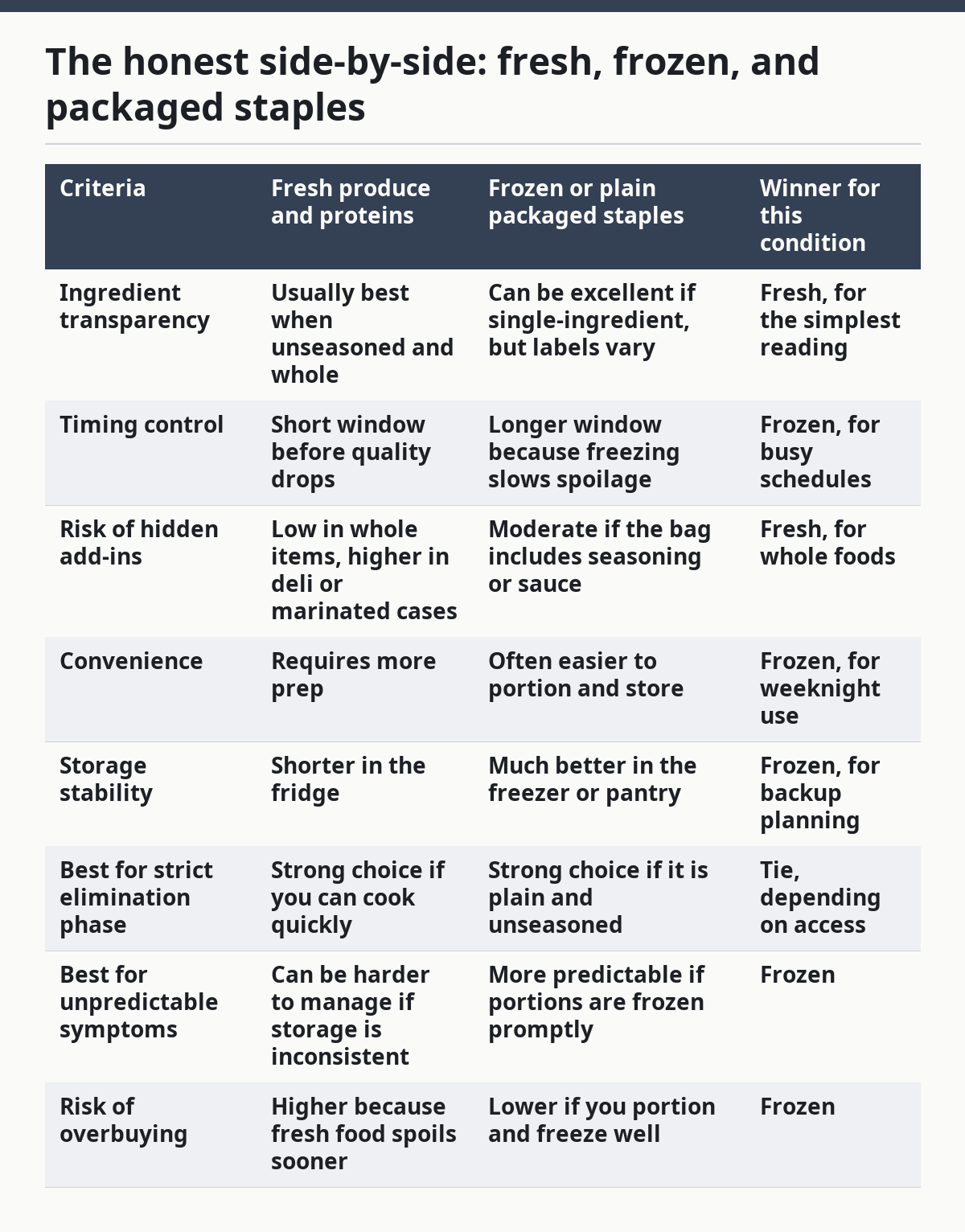
Fresh is the better pick for readers who can shop often, cook quickly, and tolerate a narrower set of plain foods. Frozen is the better pick for anyone who needs more control over timing, especially if the fridge tends to become a graveyard of produce or leftovers. Packaged staples are useful, but only when the ingredient panel stays short and boring.
The main weakness of fresh shopping is spoilage. The main weakness of frozen shopping is label creep. The main weakness of packaged pantry goods is that “simple” on the front often hides a long list on the back.
Which choice is right for your situation?
The right choice is the one that matches your schedule, symptom pattern, and tolerance for cooking. If those three do not line up, the wrong ingredient can look safe and still fail you.
Choose fresh-first shopping if you cook often, eat within 24 to 48 hours, and want the shortest possible ingredient list. That approach is best for someone who can buy smaller amounts of produce and protein several times a week. It is not great for a household that relies on batch cooking or irregular meal timing.
Choose frozen-first shopping if you need predictable backup food and do not want to gamble on fridge life. That is the stronger choice for busy workweeks, limited store access, or anyone who reacts badly to food that has sat for too long. The drawback is that you have to become picky about bagged ingredients, because frozen meals and sauce packs can be full of troublemakers.
Choose packaged staples only when the label is genuinely clean and the food is plain enough to serve as a base. This is useful for rice, oats, plain crackers, or simple pasta, but it is not the best route for flavored mixes. The mistake here is overtrusting convenience.
Choose a very strict cart if symptoms are active and the trigger picture is unclear. In that phase, you want fewer foods, not more. That is the time for repetitive meals, simple seasonings, and close attention to food age. It is not the time for experimentation with “healthy” snack bars, fermented condiments, or trendy pantry items.
The strongest recommendation is plain and repetitive at first. Variety is pleasant, but clarity is more useful than novelty when symptoms are still being sorted out.
When should you rethink the low-histamine approach entirely?
You should rethink the approach when the diet is becoming so restricted that meals are no longer practical, nutritionally adequate, or emotionally sustainable. A low-histamine plan can help, but it is not meant to become a permanent list of fear foods without supervision.
The first warning sign is a cart that keeps shrinking. If only five or six foods feel safe and the list keeps getting smaller, that is the point to involve a dietitian or clinician familiar with food intolerance. A restrictive pattern can create nutrient gaps, especially if protein, calcium, or fiber start dropping out. The second warning sign is symptom confusion: if every meal feels like a test and every reaction seems random, the issue may not be histamine alone.
The third warning sign is that shopping has become impossible to do safely because the label reading burden is too high. If every package requires 10 minutes of detective work and you still end up guessing, the diet may need structure, not more self-policing. A professional can help sort out whether the problem is histamine intolerance, another food intolerance, a mast cell issue, or something else entirely. That matters because the shopping advice changes depending on the actual diagnosis.
A fourth reason to pause is if the plan is affecting family meals or leading to avoidance of entire food groups without a plan for replacement. That is where a short-term elimination strategy and a long-term nutrition strategy are not the same thing.
The low-histamine approach works best as a tool, not an identity. If it stops making your life more livable, it needs adjustment.
Verdict: what to buy and what to skip
Choose fresh, plain ingredients if you can cook them quickly and keep your cart simple. Choose frozen, single-ingredient staples if you need more storage time and fewer last-minute decisions. Neither works well if you are buying fermented foods, marinated proteins, or heavily seasoned convenience items while still trying to sort out triggers.
Choose fresh-first if you shop often and want the shortest path from store to plate. Choose frozen-first if your schedule is unpredictable or leftovers tend to sit too long. Neither if your diet has become so narrow that you are relying on guesswork, because that is the point to bring in a clinician or dietitian.
FAQs
What are the safest foods to buy first on a low-histamine diet?
Start with plain rice, simple vegetables, and fresh or frozen unseasoned proteins. Those foods are easy to inspect, easy to cook, and less likely to hide vinegar, sauces, or aged ingredients. Keep the first cart short so you can see what actually works.
Is frozen food okay if I’m trying to eat low histamine?
Yes, frozen food can be one of the best options if it is plain and unseasoned. Freezing helps slow spoilage, which matters because histamine can rise as food ages. The catch is that frozen convenience meals often contain sauces, spice blends, or preservatives that do not fit a strict phase.
Are tomatoes, citrus, and vinegar always off limits?
No, not for every person, but they are common trigger foods and are often avoided during a strict elimination phase. The issue is not only histamine content; it is also that these foods show up in products with other high-risk ingredients. If you are still figuring out your pattern, they are usually poor first choices.
How do I know if a packaged food is safe enough?
A short ingredient list is a good start, but the label also needs to be free of fermented, aged, cured, smoked, or heavily flavored components. If the product depends on seasoning blends, vinegar, yeast extract, or sauces, it is usually not a strong first-phase choice. When in doubt, the plainer food is the safer shopping decision.
Should I keep leftovers on a low-histamine diet?
Only if you can cool them quickly and eat them soon. Leftovers can become less suitable as they sit, especially meat and fish. Smaller portions, shallow containers, and prompt freezing are more useful than letting food linger in the refrigerator for several days.
Drafted with AI; not yet reviewed by a person.