Last updated: November 19, 2026
Quick Answer: choose frozen produce with 1 ingredient, no sauce, no seasoning, and a bag that still looks sealed and dry. For How to Choose Low Histamine Frozen Vegetables and Fruit, that simple rule is usually the best starting point because it keeps the label short and the package easy to check. For general label guidance, see the FDA Nutrition Facts label and the USDA FoodKeeper app.
Key takeaways
- Plain frozen produce is the easiest starting point: 1 ingredient, no added sauce, no seasoning.
- Single-ingredient bags are usually simpler to screen than mixed blends.
- Avoid icing, syrup, glaze, cheese sauce, herb butter, and other extras.
- Check the package for tears, heavy frost clumps, wet spots, or broken seals.
- Frozen broccoli, green beans, blueberries, mango, peas, and cauliflower are the kinds of items that fit this approach best when the label stays clean.
What makes frozen produce a safer pick?
Frozen produce is a safer pick when the label is short and the package is intact. The goal is not to find a magic “low histamine” logo; it is to choose the least altered version of the food, with the fewest added ingredients and the least chance of handling damage.
That means starting with foods that are already simple in their frozen form: frozen broccoli, frozen green beans, frozen blueberries, frozen mango, frozen peas, and frozen cauliflower. These are the kinds of items that often come in plain bags or boxes, without sauces or seasoning mixes. A plain ingredient list is easier to scan on a phone in a store aisle than a long panel with several unfamiliar add-ins.
The same rule applies to package format. A sealed, dry bag with loose pieces is a better fit than a bag where the contents are stuck together in a hard block from thawing and refreezing. Heavy frost can also be a warning sign that the package has been opened, stored poorly, or exposed to temperature swings. The USDA notes that frozen foods kept at 0°F stay safe indefinitely, but storage problems can still affect quality and packaging, so checking the bag still matters (USDA FoodKeeper).
If the produce has been coated in syrup, sauce, glaze, or seasoning, it stops being a simple frozen produce choice. That matters on this page because the goal is low histamine grocery shopping, not a list of every frozen food that happens to contain fruit or vegetables. If you want a broader framework, the low histamine shopping guide covers store-level choices in more detail.
How do I read the ingredient list fast?
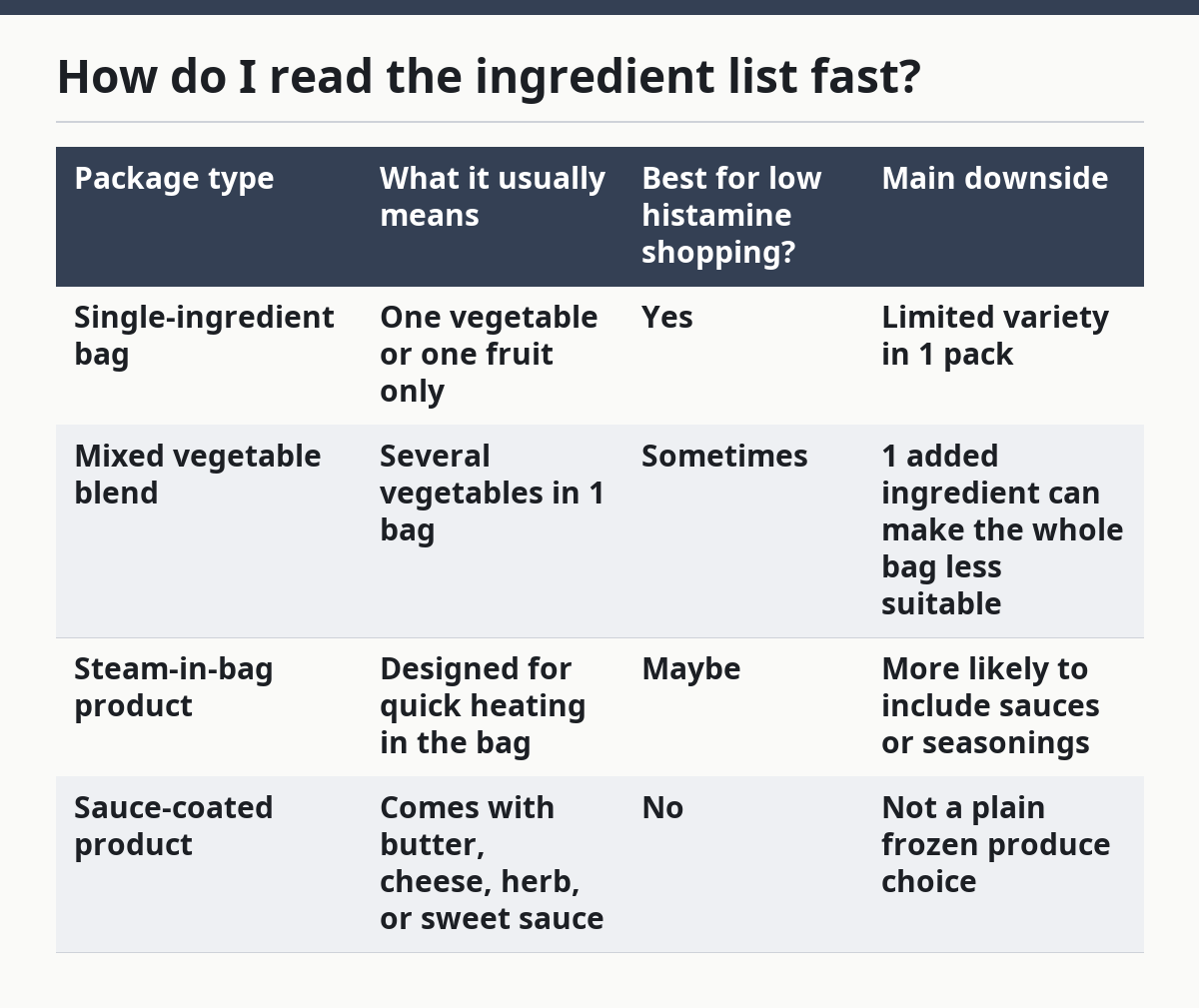
You read the ingredient list fast by looking for 1 named produce item and stopping there. If the bag says “broccoli,” “green beans,” “blueberries,” “mango,” “peas,” or “cauliflower” and nothing else, that is the cleanest version of the product.
A plain label can still hide extra ingredients in a mix. Words like sauce, seasoning, butter, cheese, sugar, syrup, salt solution, oil, and glaze are the first things to notice because they change the food from simple frozen produce into a prepared product. If the package says “with sauce” anywhere on the front, treat that as a cue to turn it over and inspect the ingredient panel before buying. If you are unsure how to interpret the panel, consult a registered dietitian or other qualified professional.
The easiest habit is to scan the back first, not the front. Front-of-package words often focus on taste or convenience, while the ingredient list tells the truth in plain print. One ingredient is the cleanest standard. Two ingredients may still be simple, but they deserve a second look because the second item is often salt or sugar, which you may want to avoid if you are trying to keep the food as plain as possible.
This is also where fruit and vegetables differ in a useful way. Frozen blueberries and frozen mango are often sold plain, but fruit can also show up in sweetened or glazed packs. Frozen peas, broccoli, green beans, and cauliflower are more likely to appear in vegetable blends, which means the list can get longer fast. For more label-reading help, see the ingredient list guide.
| Package type | What it usually means | Best for low histamine shopping? | Main downside |
|---|---|---|---|
| Single-ingredient bag | One vegetable or one fruit only | Yes | Limited variety in 1 pack |
| Mixed vegetable blend | Several vegetables in 1 bag | Sometimes | 1 added ingredient can make the whole bag less suitable |
| Steam-in-bag product | Designed for quick heating in the bag | Maybe | More likely to include sauces or seasonings |
| Sauce-coated product | Comes with butter, cheese, herb, or sweet sauce | No | Not a plain frozen produce choice |
Which package formats are easiest to trust?
The easiest package formats to trust are plain bags and plain boxes with no sauce packet, no seasoning packet, and no separate glaze or topping. A single-ingredient bag of frozen broccoli or frozen green beans is usually simpler to vet than a steam-in-bag product that has a flavor packet hidden inside.
For fruit, the same rule holds. Frozen blueberries and frozen mango are often sold in plain bags, which makes them simple to screen. When fruit comes in a tray, pouch, or resealable bag with added syrup, it becomes harder to tell at a glance whether it still fits your plan. If you want the least complicated choice, look for the version that says only the fruit name and maybe 1 basic handling note.
Package format matters because it changes what you have to inspect. A box can hide a liner bag, a bag can hide a seasoning packet, and a steam-in-bag format can hide cooking instructions that distract from the ingredient panel. None of those formats is automatically bad. The issue is that each extra layer gives you 1 more place where an add-in can hide.
This is why a plain format often works best for a simple shopping routine. A plain, sealed bag with a short ingredient list is easier to shop than a “special” format that promises convenience. If you are choosing frozen produce for a low histamine routine, convenience is useful only when it does not bring extra ingredients with it. The frozen food safety guide gives more storage basics.
How do I check the bag before I buy?
You check the bag by looking for a clean seal, dry packaging, and produce that has not clearly thawed and refrozen. The package itself can tell you a lot before you even read the ingredient list.
Use this short procedure in the aisle:
- Pick up the bag and check the front for the exact product name. You want a plain name such as frozen broccoli or frozen blueberries, not a sauce-heavy blend.
- Turn the package over and read the ingredient list first. If there is more than 1 item, identify every extra ingredient before you decide.
- Look at the seal and seams. If the package looks damaged, put it back and choose another one.
- Squeeze the package lightly. Hard frozen clumps, wet spots, or a block of ice can mean the food has warmed and refrozen.
- Check for heavy frost inside the bag. A little frost is common, but a thick white coating can point to poor storage or repeated temperature changes.
- Choose the bag that stays dry, flat, and easy to separate by touch. That usually gives you the cleanest purchase.
This process matters because package damage can undo a good ingredient list. A perfect single-ingredient bag loses value if the seal is broken or the contents look badly thawed. The same is true of a box that looks puffed, crushed, or damp.
The practical standard is simple: if the package looks uncertain, choose another one. There is often another bag of peas, cauliflower, or blueberries in the freezer case, and the better one is usually the one that looks untouched.
What frozen vegetables and fruit are easiest to start with?
The easiest frozen produce to start with is the plain version of the shortest ingredient list you can find. Frozen broccoli, frozen green beans, frozen peas, and frozen cauliflower are good vegetable starting points because they are common, simple, and often sold without sauces.
Frozen blueberries and frozen mango are the clearest fruit choices when the ingredient list stays plain. These 2 are often easy to recognize on the package and easy to vet because the label does not need much else. If the package adds sugar, syrup, or glaze, it stops being the plain fruit version and should be treated as a different product. If that is a concern for you, a dietitian can help you decide how strict to be.
A useful rule is to prefer foods that still look like the original plant. Broccoli should look like florets, green beans should look like beans, peas should look like peas, cauliflower should look like florets or small pieces, blueberries should look like whole berries, and mango should look like pieces or chunks. That visual match does not replace the ingredient list, but it helps you spot when a product has been processed into something less plain.
This section is also where a honest limitation matters: not every frozen vegetable or fruit can be judged by the same standard if it is already mixed with other foods. A mixed bag can still be useful in a home kitchen, but it is harder to treat as low histamine produce because you are now evaluating a blend, not a single item. For related food-choice basics, see the low histamine foods page.
What should I skip on the label?
You should skip any frozen produce with sauce, glaze, seasoning, or a long ingredient list. Those extras change the product from plain frozen produce into a prepared food, and that is usually the wrong direction for a low histamine shopping list.
The main label traps are easy to spot once you know them. “Cheese sauce,” “butter sauce,” “herb seasoning,” “sweetened,” “in syrup,” “glazed,” and “seasoned blend” all signal that the food has been altered. Even a short list can be a problem if the added ingredient is the very thing you are trying to avoid.
There is also a packaging trap. Steam-in-bag products are not always bad, but they often make it harder to see the full ingredient story at a glance. If the front of the package is designed around cooking convenience, read the back with extra care. A quick dinner format can still be the wrong choice if it contains added flavoring.
This is the point where it helps to be strict. A product that is “close enough” is not the same as a plain frozen produce choice. If you are choosing food for a low histamine pattern, the safer route is to leave the almost-right bag on the shelf and buy the plain one.
For a broader shopping system, this page fits inside the full low histamine grocery method in the hub on low histamine shopping and ingredient vetting. That larger guide covers the bigger store pattern; this page stays focused on frozen produce. The shopping hub and ingredient vetting guide cover related decisions.
What is the safest way to shop this aisle?
The safest way to shop this aisle is to buy plain, single-ingredient frozen produce in an undamaged package and ignore anything dressed up as a convenience food. That rule works for most frozen broccoli, green beans, blueberries, mango, peas, and cauliflower.
Start with a short list before you enter the freezer section. If you already know you want 1 vegetable and 1 fruit, you are less likely to get distracted by mixed bags and flavored products. The freezer aisle rewards speed, because doors open and close, frost builds up, and the packages get jostled. A quick, focused choice is better than a long browse.
It also helps to keep your standard simple: 1 ingredient, no sauce, no seasoning, no syrup, no broken seal. If a package fails any 1 of those checks, do not try to talk yourself into it. The cost of a bad choice is not just money; it is also the time spent sorting out a food that should have stayed on the shelf.
This page is not for someone who wants a ready-to-heat meal, a flavor packet, or a sweetened fruit side. Those products belong in a different shopping category. This page is for the person who wants plain frozen produce and wants to choose it fast, cleanly, and with the fewest label surprises.
What should I avoid in frozen produce blends?
Avoid blends that include sauces, seasoning, or a long list of extra ingredients. A mixed bag can look simple on the front and still contain several add-ins on the back, which makes it harder to keep the food plain.
Are plain frozen vegetables better than steam-in-bag products?
Plain frozen vegetables are easier to screen than steam-in-bag products. Steam-in-bag items can be useful for convenience, but they are more likely to hide seasoning, butter, cheese, or other extras that do not fit a plain low histamine produce choice.
How do I tell if frozen fruit has added ingredients?
Read the ingredient list and look for sugar, syrup, glaze, or anything beyond the fruit itself. Frozen blueberries and frozen mango are often sold plain, but fruit products can still carry sweeteners or coatings that make them a different choice.
Drafted with AI; not yet reviewed by a person.