Last updated: November 19, 2026
Quick answer: Low histamine egg-free baking substitutes usually work best when you match the replacer to the job: flaxseed meal or chia seed gel for binding, applesauce for moisture, and baking soda plus an acid for lift. Honestly, the best pick depends on what you are making — cookies, muffins, quick breads, or a layered cake.
Key takeaways
- Eggs do three jobs in baking: they bind, add moisture, and help with rise.
- For chewy cookies, a flaxseed meal binder or chia seed gel usually holds together better than applesauce alone.
- For tender cakes and muffins, applesauce can replace some of the egg moisture, but it can also make batter denser if you use too much.
- Baking soda helps with lift, but it is not a full egg replacement on its own; it needs an acid such as cream of tartar, lemon juice, or vinegar.
- Rice flour and tapioca starch can improve structure in egg-free batter, especially when you want a lighter crumb.
- Egg-free baking can be a poor fit for recipes that depend on a lot of egg foam, such as angel food cake, unless the recipe is rebuilt around a different structure.
What eggs do in baked goods, and why that matters here
Eggs do three separate jobs, and low histamine baking goes better when you swap the right one instead of chasing a magic fix. One egg usually adds binding, moisture, and a bit of lift; copy only one of those, and the result can turn crumbly, wet, or flat.
Binding is the part most readers notice first. Without it, a cookie may split when you lift it from the tray, or a muffin may crumble at the first bite. Moisture matters too, but too much can make batter spread or turn gummy. Lift is the trickiest piece because eggs trap air and help cakes rise. That is why an egg-free brownie can succeed with very little trouble, while a sponge cake can fall apart if you swap in the wrong thing.
Low histamine baking does not treat all substitutes equally. Flaxseed meal and chia seed gel are strong binders for many recipes, but each brings its own flavor and a bit of texture. Applesauce helps when the batter needs softness, yet it is not a strong binder and can weigh a cake down if the recipe already has a lot of liquid. Baking soda gives lift, but only when there is enough acid in the batter to activate it. Rice flour and tapioca starch help create structure in gluten-free or low-histamine-style baking because they change how the crumb sets as it bakes.
According to the U.S. Food & Drug Administration, baking soda needs an acid to produce carbon dioxide; that is why it works best in recipes designed around that reaction. The wrong move is to treat every baked good the same way. If symptoms, ingredient tolerance, or dietary needs are complicated, consult a qualified professional or registered dietitian and use a reliable source rather than guessing. Baking blind can backfire fast.
Which egg replacer works best for cookies?
Flaxseed meal usually works well for cookies because it gives the dough the grip and chew that eggs normally supply. A common starting point is 1 tablespoon ground flaxseed mixed with 3 tablespoons water, left to thicken for about 10 minutes. Chia seed gel can do the same job at the same 1:3 ratio, but it leaves visible flecks and a slightly firmer bite.
Cookies need structure more than lift, so this is where low histamine egg-free baking substitutes are easiest to use. For a drop cookie, flaxseed meal often beats applesauce because applesauce adds water without enough binding power. If you use applesauce in a cookie, the dough may spread too much, bake up soft in the middle, and lose the crisp edge you wanted.
A practical cookie setup looks like this:
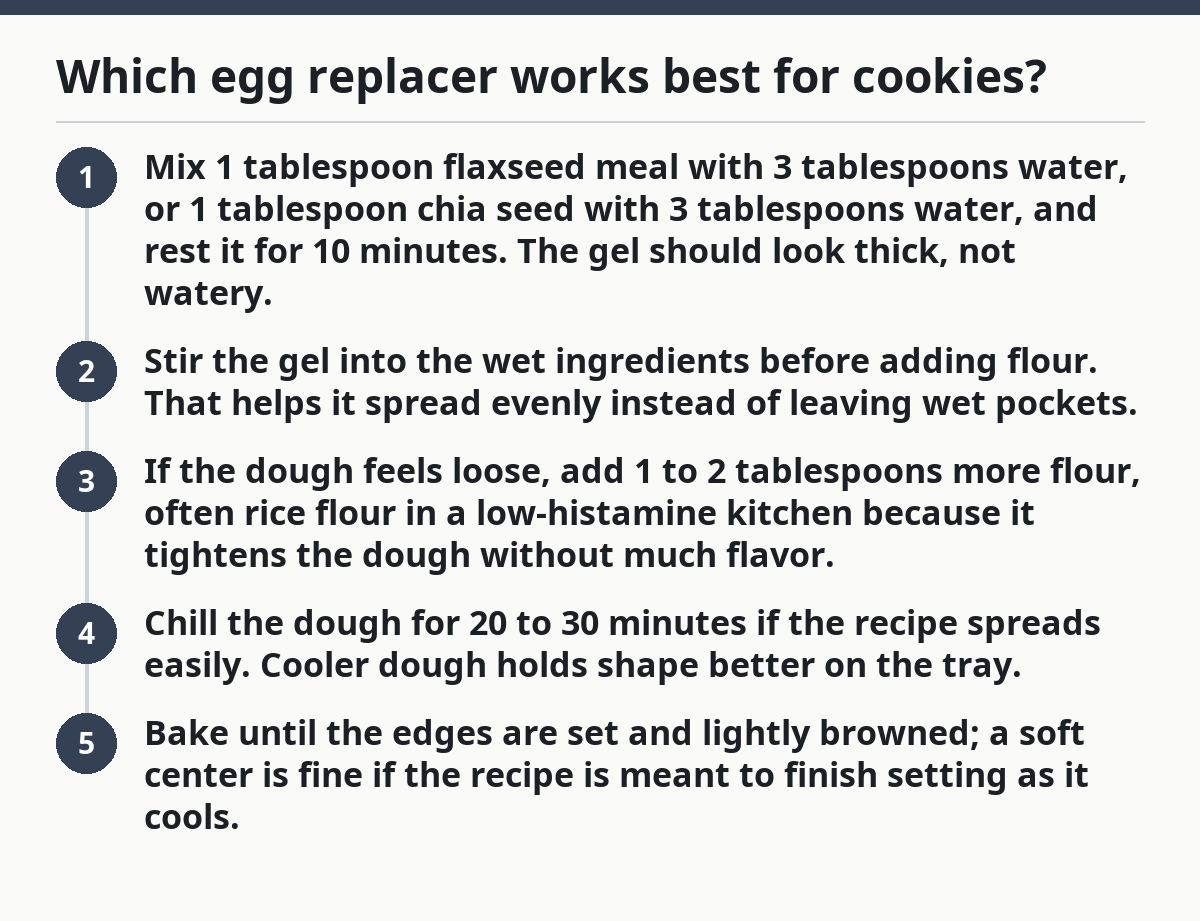
- Mix 1 tablespoon flaxseed meal with 3 tablespoons water, or 1 tablespoon chia seed with 3 tablespoons water, and rest it for 10 minutes. The gel should look thick, not watery.
- Stir the gel into the wet ingredients before adding flour. That helps it spread evenly instead of leaving wet pockets.
- If the dough feels loose, add 1 to 2 tablespoons more flour, often rice flour in a low-histamine kitchen because it tightens the dough without much flavor.
- Chill the dough for 20 to 30 minutes if the recipe spreads easily. Cooler dough holds shape better on the tray.
- Bake until the edges are set and lightly browned; a soft center is fine if the recipe is meant to finish setting as it cools.
This method is not great for very delicate, crisp cookies that rely on egg white for a dry snap. It is also a weak match for recipes that need a lot of aeration, such as meringue cookies. For those, the structure problem is bigger than a simple egg swap.
How do you replace eggs in cakes and muffins without making them heavy?
Use applesauce for moisture and baking soda for lift, then add a binder like flaxseed meal if the batter needs more structure. Cakes and muffins are where low histamine egg-free baking substitutes fail most often, because one substitute usually cannot carry all the weight.
Applesauce is the easiest moisture replacement in quick breads and muffin batters. A typical swap is 1/4 cup applesauce for one egg, but that trade-off works best when the recipe already has enough fat and flour to support the extra moisture. Unsweetened applesauce is the cleaner choice because added sugar can push a cake toward a sticky crumb, and sweetened versions can complicate flavor. Apples are also a common histamine-friendly choice for many bakers, though tolerance is individual.
Baking soda does not replace eggs by itself, but it can help a batter rise when paired with an acid. If a recipe contains an acidic ingredient, such as lemon juice or vinegar, 1/4 teaspoon baking soda can help create a lighter crumb in a small batch. Without that acid, the soda has little effect and can leave an alkaline, soapy taste. That is a classic mistake in egg-free baking.
For muffins, a hybrid often works better than a single substitute:
- 1/4 cup applesauce for moisture
- 1 tablespoon flaxseed meal mixed with 3 tablespoons water for binding
- 1/4 teaspoon baking soda with a visible acid in the batter for lift
This combination is not perfect. It can make the crumb slightly denser than an egg-based version, and it does not produce the lofty dome that egg-rich muffins sometimes have. But it is more reliable than using applesauce alone.
Cakes need even more care. If the recipe is a simple loaf or snack cake, rice flour plus tapioca starch can help the crumb set without turning gritty. If the cake is meant to be tall and airy, egg-free replacement is harder, and the result may be closer to a tender tea cake than a celebration layer cake. Truthfully, that trade-off matters.
Binding options that hold shape in low histamine baking
Flaxseed meal, chia seed gel, and a starch-flour blend are the most useful binders, but each one changes texture in a different way. The right binder depends on whether you want chew, softness, or a cleaner crumb.
Flaxseed meal is a practical binder for everyday egg-free baking. It is ground seed, so the particles swell when mixed with water and act like a glue. It works especially well in cookies, bars, and muffins. The downside is flavor: flax has a nutty, earthy note that can show up in pale cakes or lightly flavored cookies.
Chia seed gel behaves similarly, but it thickens more visibly and can create a speckled crumb. That can be fine in hearty muffins or spiced loaves, but less appealing in vanilla cake. Chia also has a firmer, more gelatinous feel than flax, which can help a crumb hold together but can read as slightly chewy if overused.
Rice flour and tapioca starch are not egg substitutes in the narrow sense, but they help the structure that eggs would normally support. Rice flour gives body. Tapioca starch adds elasticity and a bit of stretch, which is useful when a batter feels too fragile. In gluten-free baking, that pairing often matters as much as the binder itself. A cake made with only a seed gel can still collapse if the flour mix is too heavy or too wet.
A useful rule: if the baked good needs to be sliced, lifted, or packed in a lunchbox, reach first for flaxseed meal. If the recipe needs a smoother bite and the seed specks are unwelcome, chia seed gel or a rice flour–tapioca starch blend may fit better. If the recipe already has strong flavor, such as cinnamon, cocoa, or banana, flax is often less noticeable than in a plain vanilla cake.
Leavening support: what baking soda can and cannot do
Baking soda helps a batter rise, but it cannot replace the structure and emulsifying work of eggs on its own. It is the lift partner, not the whole substitute.
This matters because some egg-free recipes rise poorly for a simple reason: the batter has no reliable gas release. Baking soda needs an acid to react. In a batter that includes lemon juice, vinegar, or another acidic ingredient, the soda can produce enough bubbles to lighten the crumb. In a batch with no acid, it may sit there doing little, except leaving an off flavor if too much is used.
For low histamine baking, keep the amount modest and match it to the recipe. A small quick bread or muffin batter may only need 1/4 teaspoon to 1/2 teaspoon baking soda, but only if the ingredient list already contains an acid. If the recipe is not acidic, a different leavening plan is needed rather than piling on more soda.
This is where many generic articles get the problem wrong. They list baking soda as though it is an egg replacement. It is not. It does one narrow job well: it helps create lift in the right chemical setup. Without binders such as flaxseed meal or chia seed gel, and without a flour base that sets firmly enough, the bubbles disappear before the crumb finishes baking.
Rice flour and tapioca starch help here too, because the batter needs a framework that can hold those bubbles long enough to set. In a cake batter, a ratio that includes both can improve the final slice, while a very dense batter with only seed gel may bake up heavy no matter how much soda is used. According to the Cleveland Clinic, people with histamine intolerance often need individualized dietary guidance, which is another reason not to rely on one generic substitution for every recipe. One-size-fits-all falls apart here.
Common mistakes that ruin egg-free bakes
Using applesauce as a full egg swap is the most common mistake, and it usually produces a wet, dense crumb. Applesauce is a moisture replacement first and a binder second, so it is a poor choice for recipes that need strong structure. Use it in small amounts, then add flaxseed meal or chia seed gel if the recipe needs to hold together.
Another mistake is using too much chia. Chia seed gel can make batter thick very fast, and an over-thick batter often bakes into a gummy center. If the batter turns paste-like after the gel goes in, loosen it with a little more liquid or reduce the chia next time.
A third mistake is forgetting the role of acid when baking soda is involved. If a recipe uses 1/2 teaspoon baking soda but no acidic ingredient, the rise may be weak and the taste may be flat or alkaline. In that case, the fix is not just more soda; it is a properly balanced formula.
A fourth mistake is expecting all recipes to respond the same way. Cookies are usually forgiving. Muffins are manageable. Layer cakes are harder because they need more lift and a finer crumb. One egg-free formula rarely performs equally well in all three. That is why low histamine egg-free baking substitutes should be chosen by baked good type, not by habit.
If a recipe depends on foamed egg whites, the wrong substitute can waste an expensive batch of ingredients and an hour of oven time. Angel food cake, chiffon cake, and some macarons fall into that category. Those recipes are not ideal targets for a simple egg swap.
A simple way to choose the right substitute
Choose the substitute by function first: binder, moisture, or lift. That keeps low histamine egg-free baking from turning into guesswork.
Start with the recipe’s shape. For a cookie or bar, choose a binder first, usually flaxseed meal or chia seed gel. For a muffin or quick bread, combine moisture support with a binder, often applesauce plus flaxseed meal. For a cake, pay attention to both structure and lift, which means a seed gel plus careful use of baking soda and acid, along with a flour base that can set cleanly.
Then decide how much flavor the substitute can bring. Flaxseed meal works best in darker or stronger-flavored bakes. Chia seed gel is better when a little speckling is acceptable. Applesauce belongs in tender, moist batters rather than crisp or chewy ones. Rice flour and tapioca starch help when the crumb needs support but should not be the whole recipe by themselves.
A useful shortcut:
- Cookies: flaxseed meal first
- Muffins and quick breads: applesauce plus flaxseed meal
- Cakes: chia seed gel or flaxseed meal, plus baking soda only where acid is present
- Delicate airy cakes: usually not a good fit for simple egg-free substitution
For broader recipe planning, this page fits into the larger set of histamine-friendly recipe building blocks. That matters because egg-free baking is only one part of the job; flour choice, sweetener choice, and leavening all change the result. See also our guide to low histamine baking basics, histamine-friendly flour swaps, and egg-free baking tips.
According to the Academy of Nutrition and Dietetics, individualized nutrition advice is often the safest route when food reactions are involved, especially if you are adjusting multiple ingredients at once.
What can replace eggs in low histamine baking?
Flaxseed meal, chia seed gel, and applesauce are the most useful replacements, but they do different jobs. Flaxseed meal and chia seed gel are better for binding, while applesauce mainly adds moisture. Baking soda can support rise when the recipe also contains an acid, and rice flour or tapioca starch can help with structure in some batters.
Which low histamine substitute works best for cookies?
Flaxseed meal is often the best all-around choice for cookies. It helps the dough hold together without making it as wet as applesauce can. Chia seed gel also works, but it can leave a firmer, more speckled cookie, which is not ideal if you want a smooth crumb.
How do I keep baked goods from falling apart without eggs?
Use a binder, not just a moistener. A 1 tablespoon flaxseed meal to 3 tablespoons water gel, rested for about 10 minutes, gives the batter more grip than applesauce alone. In cakes, that kind of binding works best when the flour base is also strong enough to set properly.
Drafted with AI; not yet reviewed by a person.