Last updated: November 19, 2026
Quick Answer: In about 60 seconds, you can screen an ingredient list for hidden high histamine triggers by checking the first 5 ingredients, then scanning for fermented words, vinegar, yeast extract, preservatives, and vague seasoning terms. Ingredient labels can hide fermented ingredients, preservatives, spice blends, and flavorings that set off histamine symptoms even when the front of the package looks harmless. How to Read Ingredient Lists for Hidden High Histamine Triggers starts with the back panel, because that is where the real information lives.
The quickest practical way to read an ingredient list is to scan for the trouble words first, then check the order and the form of the ingredient.
The steps below show what to flag in packaged foods, condiments, broth, and spice mixes before you buy or eat.
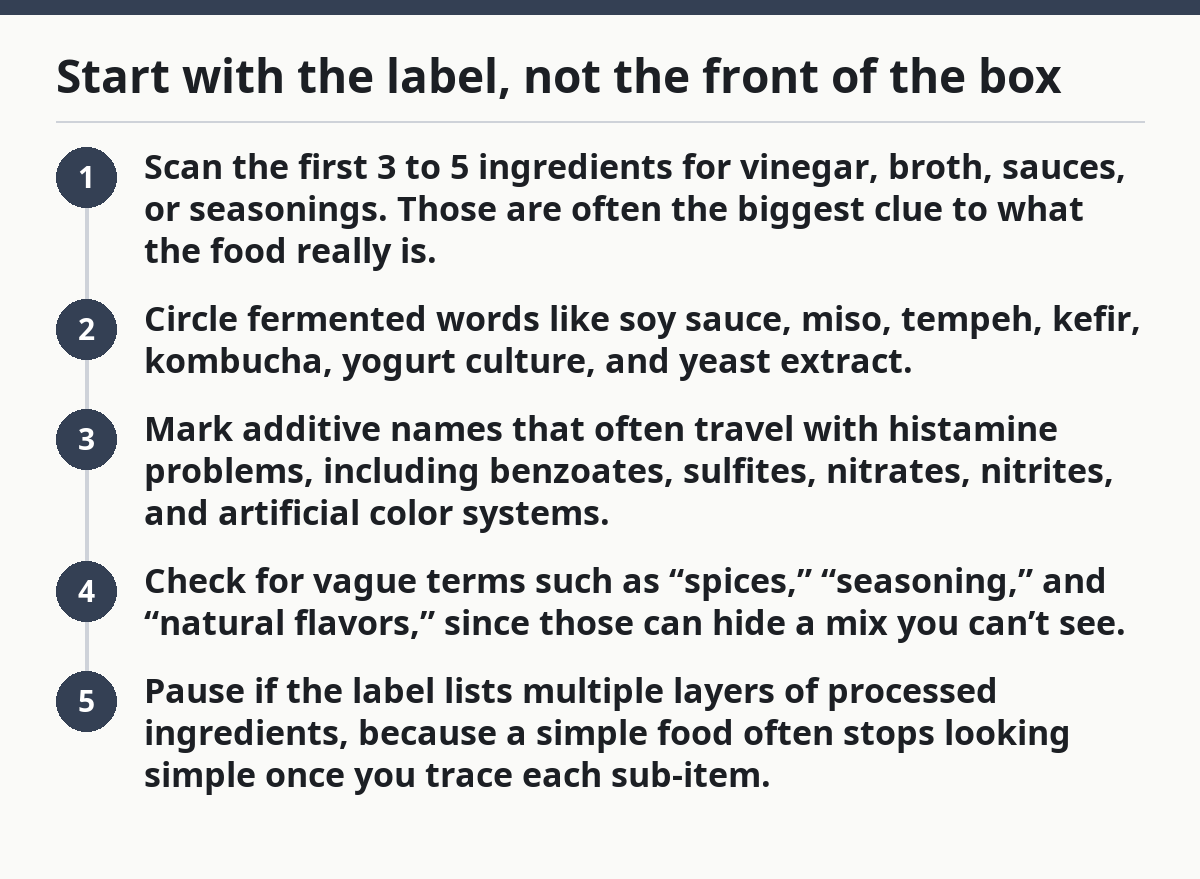
Start with the label, not the front of the box
Picture this: you’re holding a jar of sauce, and the front says “simple ingredients” while the back list runs for eight lines. The back panel is where hidden histamine triggers live, and the ingredient list tells the real story.
Therefore, read the ingredient panel first, then look at the Nutrition Facts if you still need them. Most trigger clues sit in plain text: vinegar, yeast extract, natural flavors, spices, and preservatives such as sodium benzoate or sulfites. If a packaged food has a short list of clean items, that helps; if the list contains several processed sub-ingredients, your risk may go up.
Use this order every time:
- Scan the first 3 to 5 ingredients for vinegar, broth, sauces, or seasonings. Those are often the biggest clue to what the food really is.
- Circle fermented words like soy sauce, miso, tempeh, kefir, kombucha, yogurt culture, and yeast extract.
- Mark additive names that often travel with histamine problems, including benzoates, sulfites, nitrates, nitrites, and artificial color systems.
- Check for vague terms such as “spices,” “seasoning,” and “natural flavors,” since those can hide a mix you can’t see.
- Pause if the label lists multiple layers of processed ingredients, because a simple food often stops looking simple once you trace each sub-item.
Because of that, the first line of defense is not memorizing every trigger. It is learning to spot the few words that most often signal a problem.
Which ingredients are common hidden triggers?
Common hidden triggers are fermented ingredients, vinegar, yeast extract, broths, and preservative systems. Those are the labels I watch first on packaged foods, condiments, and spice mixes, because they show up often and they hide well.
The reader usually gets tripped up by ordinary-looking words that point to a deeper process. Vinegar can sit inside ketchup, mustard, pickles, relishes, salad dressing, and barbecue sauce. Broth can appear in soups, gravy mixes, stuffing mixes, and frozen meals. Yeast extract can make a savory food taste richer without sounding risky.
Here’s the catch: the label may not say “histamine.” It often says the ingredient that tends to go with it.
- Fermented items: soy sauce, tamari, miso, tempeh, kombucha, sauerkraut, cultured dairy, and some pickled products
- Acidified items: vinegar, cider vinegar, wine vinegar, malt vinegar, citric-acid-heavy sauces, and pickled condiments
- Flavor boosters: yeast extract, autolyzed yeast, hydrolyzed protein, bouillon, stock, and broth powder
- Preservatives: sodium benzoate, potassium benzoate, sulfites, sodium metabisulfite, and related compounds
- Seasoning blends: “spices,” “seasoning,” “natural flavors,” and “flavoring” when the exact mix is hidden
A useful habit is to ask one question: what process made this taste stronger? Fermentation, curing, long aging, and heavy flavor boosting are common places to look, especially when you are trying to avoid hidden triggers. If you are unsure what a term means for your situation, consult a qualified health professional.
How do I spot fermented ingredients on packaging?
Fermented ingredients are usually easy to spot once you know the word families, and they often hide inside sauces, marinades, and dairy products. The clearest clue is any ingredient that sounds cultured, aged, brewed, or extracted from a yeast or microbe.
Look for these terms on the panel:
- Fermented: fermented soy, fermented rice, fermented bean paste
- Cultured: cultured milk, cultured cream, cultured dextrose
- Aged: aged cheese, aged vinegar, aged hot sauce, aged sausage
- Brewed: brewed vinegar, brewed soy sauce, brewed malt flavor
- Yeast-based: yeast extract, autolyzed yeast, brewer’s yeast
- Microbe-based starters: live and active cultures, starter culture, bacterial culture
A label can also hide fermentation in a sub-ingredient. For example, a “flavoring” or “seasoning” can include a fermented base, but the package may not spell that out. That makes simple products like broth cubes, sauce packets, and savory crackers worth a second look.
If you need a hard rule, use this one: if the ingredient sounds like it came from a vat, a barrel, or a culture tank, slow down. That doesn’t mean every fermented ingredient is a trigger for every person. It does mean fermented ingredients deserve a red pen before anything else.
The European Food Information Council’s ingredient-label guidance is a useful general reference for how compound ingredients are listed. The U.S. FDA also explains how ingredients must appear on packaged food labels in its labeling rules and guidance. The CDC’s food safety pages are also a practical reference for understanding how food handling and processing affect what you eat.
Read spice mixes and “natural flavors” like a detective
Spice mixes and natural flavors are where ingredient labels get slippery, and they can hide a lot inside one short line. That matters because seasoning blends are common in chips, crackers, soup packets, deli meats, broth, and frozen dinners.
A plain-looking “spices” label can include onion powder, garlic powder, paprika, chili, celery seed, and sometimes more processed helpers. “Natural flavors” is even murkier. It can cover a broad mix that does not tell you whether a broth, yeast extract, fermented base, or spice solvent sits inside it. The label is legal; it is not generous.
Read those words in context:
- “Spices” alone means the company is not listing the full blend
- “Seasoning” often means salt, spice, sugar, and flavor enhancers are mixed together
- “Natural flavors” can hide a savory base, a smoke note, or a fermented support ingredient
- “Spice extractives” or “extract” can mean concentrated flavor from a source you may not tolerate
On the flip side, not every spice blend is a problem. A single-ingredient jar like cumin or turmeric is easier to judge than a taco packet with 15 sub-items. The issue is not the word “spice” by itself. The issue is the unknown mix that comes with it.
Because of that, many readers waste time by focusing on the obvious base food and missing the seasoning line, even though that line is doing the damage. If you are building a personal list of safe products, a related guide on low histamine ingredient selection and label reading can help you compare brands more quickly.
Watch for preservatives in condiments and broth
Preservatives matter because condiments and broth are built to last, and shelf life often brings ingredient systems that bother sensitive people. The first names to notice are sulfites, benzoates, nitrites, and nitrates.
You’ll see them in places that do not feel risky at first glance: if a product looks like an everyday staple, it can still hide several trigger words, so if you are sensitive, consider checking with a qualified health professional before making it routine.
- Broth and bouillon: cubes, powders, cartons, and ramen seasoning packets
- Condiments: ketchup, mustard, relish, steak sauce, salad dressing, and hot sauce
- Processed meats: deli meat, bacon, sausage, and cured poultry
- Snack coatings: flavored chips, crackers, and roasted nuts
- Bottled sauces: barbecue sauce, teriyaki sauce, marinades, and stir-fry sauce
A broth label can be especially deceptive. It may look like a simple kitchen staple, but many versions include yeast extract, “natural flavors,” onion or garlic powders, and preservatives in one short list. That is why broth belongs on the careful-reading list, not the automatic-buy list.
The better move is not to chase every additive name. Start with the names you can see and the products you already know cause trouble. If a condiment uses vinegar plus yeast extract plus “spices,” treat it as a higher-risk label than a jar with three plain ingredients. If you need help deciding what that means for your symptoms, consult a qualified health professional.
The FDA’s food-labeling pages and the EU’s ingredient-label rules are useful references for how additives and compound ingredients are presented. Those sources won’t tell you your personal trigger, but they do tell you where the wording comes from.
What order should I read an ingredient list in?
Read the ingredient list from top to bottom, but stop first at the first five items, because that is where the main formula usually lives. The label order matters: ingredients are listed by weight, so the first few items tell you what the food mostly is.
Here is the practical reading order I use:
- First five ingredients: check for broth, vinegar, fermented bases, sugar, and spice blends.
- Middle ingredients: look for yeast extract, flavoring, preservatives, and acids.
- Last ingredients: scan for preservatives, colors, and processing aids that can still matter in a sensitive person.
- Sub-ingredients: open every parenthesis or nested list, because the risky item may be buried there.
- Product type: remember that a sauce, dressing, or soup concentrate is more likely to carry trigger words than a plain raw ingredient.
A short label can still be a problem if one of those first five ingredients is a compound food. A long label is not always worse, but it gives you more places to catch a hidden trigger before you buy.
The mistake I see most often is reading only the front claim: “natural,” “simple,” “made with herbs,” or “homestyle.” Those phrases do not list ingredients. The back panel does.
Common mistakes that hide trigger words
Common mistakes usually come from speed, not care, and they cost people the chance to catch the trigger before it gets home. The biggest one is treating familiar foods as safe without reading the exact version on the shelf, so it helps to check the label every time, even for a product you bought before.
These are the repeat offenders:
- Skipping condiments: ketchup, mustard, relish, hot sauce, and salad dressing often carry vinegar and preservatives
- Trusting “natural”: natural flavors and natural seasonings can still hide broth or fermented components
- Missing sub-ingredients: a season blend can include a trigger even if the main food name looks plain
- Ignoring broth: boxed broth, bouillon, stock, and soup base are often more processed than they seem
- Assuming “spices” is neutral: it may be fine, or it may be a mixed seasoning packet with several hidden pieces
The trade-off is simple. The more convenience a food offers, the more often it uses blended ingredients. A homemade tomato sauce may have a short label. A jarred sauce usually won’t.
If you only change one habit, change this one: read the ingredient list before you read the health claim. That turns label reading from guesswork into a fast screen.
For a broader map of ingredient choice and label reading, the hub on low histamine ingredient selection and label reading can sit alongside this guide.
A 60-second label check you can repeat at the store
A 60-second check is enough to catch most hidden high histamine triggers if you know what to hunt. The point is not perfection; the point is to rule out the obvious problem words before the item lands in your cart.
Use this quick routine:
- Turn the package over and read the full ingredient list, not the front panel.
- Spot fermented words first: soy sauce, vinegar, miso, yeast extract, cultured, aged, or brewed.
- Scan for preservatives next: sulfites, benzoates, nitrates, nitrites, or anything with “metabisulfite.”
- Check for vague blends: spices, seasoning, natural flavors, flavoring, or extract.
- Decide whether the product is a plain food or a processed mix, because the second one hides more.
This is the right filter for packaged foods, spice mixes, condiments, and broth. It is not a guarantee that a food will suit you, and it is not a diagnosis tool. It is a label-reading tool.
The hard part is restraint. Once you know the trigger words, it is tempting to keep reading every label like a puzzle. That can burn time fast. A better habit is to build a short personal “stop list” and move on when you see it.
Key Takeaways
- The back panel matters more than the front claim.
- Fermented words, vinegar, broth, yeast extract, and preservative names deserve the fastest scan.
- “Spices,” “seasoning,” and “natural flavors” are not transparent; they need context.
- Condiments, broth, and spice mixes hide more trigger clues than plain single-ingredient foods.
- A fast top-to-bottom read catches more problems than memorizing every possible additive.
Which ingredients are common hidden triggers?
The most common hidden triggers are fermented ingredients, vinegar, yeast extract, broth, and certain preservatives. Those words show up often in condiments, sauces, soup bases, spice mixes, and packaged meals. A label that uses several of them at once deserves extra caution.
What should I look for on a label first?
Look for the first five ingredients, then scan for fermented words, preservative names, and vague seasoning terms. The first few items tell you most of the story because they make up the bulk of the product by weight. After that, check any parentheses or sub-ingredients.
How do I spot fermented ingredients on packaging?
Look for words like fermented, cultured, aged, brewed, yeast extract, starter culture, and live cultures. Those terms often show up in sauces, dairy foods, condiments, and savory mixes. If the ingredient sounds like it came from a fermentation step, read the rest of the panel before you buy it.
Drafted with AI; not yet reviewed by a person.