Last updated: November 19, 2026
Key Takeaways
- A low histamine-friendly spice blend usually has a short, plain ingredient list that is easier to trace.
- Read the ingredient list first, because the front label can be vague while the back list names the real ingredients.
- Salt blends are not automatically a problem, but they need a closer read.
- Compare two spice mixes by checking the first few ingredients, the salt content by position, and the number of unnamed extras.
Spice blends can hide garlic powder, dried herbs, salt blends, and anti-caking agents that matter when you’re checking for low histamine-friendly ingredients. The ingredient list is usually the fastest way to judge a spice blend, not the front label. The steps below show you how to sort a better blend from a risky one in a minute or two.
What makes a spice blend more or less low histamine-friendly?
A low histamine-friendly spice blend is one that keeps the ingredient list short, plain, and easy to trace. The safest quick read is often single-ingredient spices, salt, and dried herbs with no flavor systems, no yeast extract, and no vague “natural flavors.”
Since you’re trying to make sense of labels before dinner, the back panel is where the real story sits.
Start with the basics:
- Short lists are easier to judge than blends with 10 or 12 items.
- A named spice, like cumin or paprika, is clearer than a flavor mix.
- Salt-only blends are simpler than barbecue-style seasoning packets with sweeteners, acids, and preservatives.
- Garlic powder is common in blends, but it can be a problem for people who react to it or to the allium family.
The truth is, the label does not tell you how a food will behave in every body. It only tells you what’s inside. For a low histamine kitchen, that is enough to make a first pass.
If you want a broader framework for reading labels, the hub on low histamine ingredient selection and label reading belongs in your open tabs too. For related guidance, see low histamine ingredient selection, reading food labels for histamine, and safe pantry staples. This page stays narrow: spice blends, jar labels, and packet mixes.
Step 1: Read the ingredient list before you read the flavor name
Read the ingredient list first, because the name on the front can be vague while the back list names the real ingredients. A “Italian seasoning” jar may be simple; a “taco seasoning” packet may be a long list of extras.
Here’s the catch: the front panel often sells the taste, not the content. The back panel tells you whether you are looking at one dried herb, a salt blend, or a mix with hidden add-ins.
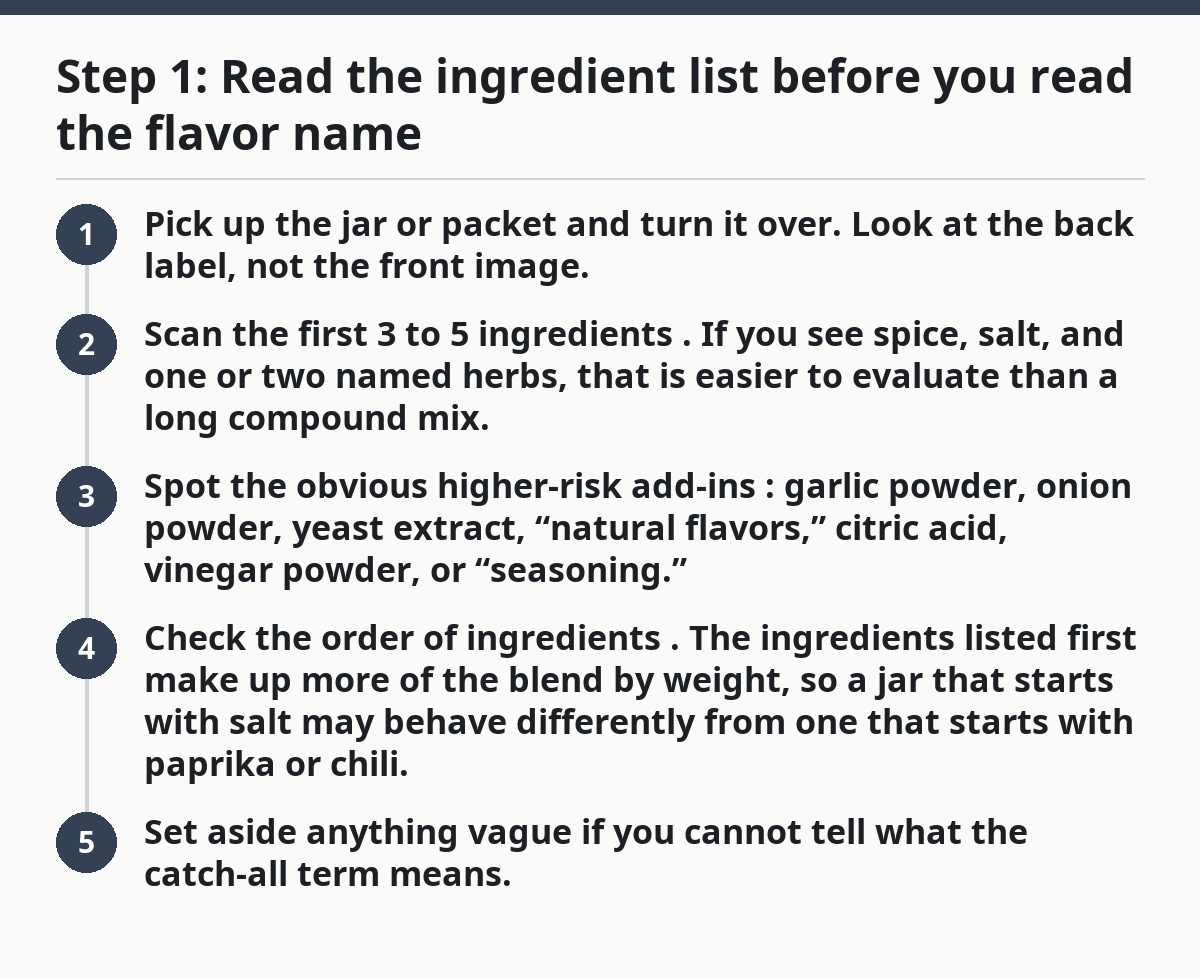
- Pick up the jar or packet and turn it over. Look at the back label, not the front image.
- Scan the first 3 to 5 ingredients. If you see spice, salt, and one or two named herbs, that is easier to evaluate than a long compound mix.
- Spot the obvious higher-risk add-ins: garlic powder, onion powder, yeast extract, “natural flavors,” citric acid, vinegar powder, or “seasoning.”
- Check the order of ingredients. The ingredients listed first make up more of the blend by weight, so a jar that starts with salt may behave differently from one that starts with paprika or chili.
- Set aside anything vague if you cannot tell what the catch-all term means.
A short, named list is usually the better starting point, especially when you are comparing brands quickly in the aisle.
Which ingredients in spice blends are the ones I watch first?
The ingredients I watch first are garlic powder, onion powder, yeast extract, “natural flavors,” citric acid, and vinegar powder, because they often sit in blends that look simple from a distance. Salt blends are not automatically a problem, but they need a closer read.
When you compare two seasoning packets with the same front label and very different back panels, the differences usually show up fast. One may have salt, paprika, and dried oregano. The other may have salt, sugar, garlic powder, onion powder, citric acid, and “spices.”
You do not need to memorize every possible trigger. You just need a short list of repeat offenders.
Watch for these patterns:
- Garlic powder: common in savory blends, but not a low-histamine friend for everyone.
- Onion powder: same problem as garlic for many cooks.
- Yeast extract: often used for savory depth; it can complicate a simple ingredient check.
- Natural flavors: too vague to judge quickly.
- Acids like citric acid or vinegar powder: not always an issue, but they deserve a slower look if you are already sensitive.
- Spice extracts or flavoring: these can hide more than plain dried spices do.
A plain salt blend with one herb is easier to trust than a packet with a long flavor system. That does not make the longer list bad by default. It just makes it harder to sort fast, and speed matters when you are shopping at 6 p.m.
How do I compare two spice mixes?
Compare two spice mixes by checking the first few ingredients, the salt content by position, and the number of unnamed extras. The mix with the shorter, clearer list is usually the easier low histamine-friendly choice.
When you put two spice jars side by side, the contrast is often obvious. One may say oregano, basil, thyme, marjoram, rosemary, and salt. The other may say salt, sugar, garlic powder, onion powder, spices, citric acid, and natural flavors. Same aisle, very different label logic.
Use this quick comparison:
- Count the non-spice extras. Fewer extras usually means less guesswork.
- Look for named herbs and spices. “Paprika” is clearer than “spices.”
- Check for garlic and onion early in the list. If they sit near the top, they are doing a lot of the work.
- Watch for salt-heavy blends. They may be fine for flavor, but they can crowd out the actual herbs.
- Notice any sweeteners or acids in blends that should have been simple.
A blend with a very short list can still be wrong for you if it contains a known trigger. On the flip side, a longer list may still be workable if every item is plain and familiar. The label tells you the structure. You supply the tolerance.
What are the hidden triggers in seasoning packets and jars?
The hidden triggers in seasoning packets and jars are the words that sound harmless but hide a mixed formula, especially “seasoning,” “flavor,” and “natural flavors.” They can also include anti-caking agents, starches, or spice extracts that make a blend harder to judge.
A seasoning packet for a one-pan dinner can look convenient until you flip it over and find a dozen ingredients, some of them easy to read and some of them built to stay vague.
Here are the usual trouble spots:
- Seasoning packet: often more processed than a spice jar, with salt, sugar, flavorings, and anti-caking agents.
- Natural flavors: broad label term, not a clear ingredient by itself.
- Spice blend: can be honest, but it can also hide a long formula.
- Anti-caking agents: these help powder flow, and many are not the main issue, but they show you the blend has been engineered.
- Added acids or extracts: they may not matter to everyone, but they can matter when you are trying to keep the ingredient list plain.
A spice jar with a lid and a paper label is often easier to read than a seasoning packet sealed in a foil sleeve. That packaging difference does not prove anything by itself. It just changes how much label work you need to do.
Should I trust salt blends?
Salt blends can be useful, but I trust them only after I check whether salt is the main ingredient and what the rest of the blend contains. A simple salted herb mix is easier to judge than a flavored salt with garlic powder, onion powder, and “spices.”
When you need something fast for potatoes, rice, or vegetables, a shaker marked “seasoned salt” looks convenient, but that convenience usually comes with extra ingredients.
Use this filter:
- If the label is mostly salt plus one herb, it is easier to review.
- If the label says seasoned salt or flavored salt, expect more add-ins.
- If garlic or onion appear high on the list, it is probably not a plain salt blend.
- If the blend includes sugar, smoke flavor, or acids, treat it like a processed seasoning, not a pure spice.
- If you react easily or have a complex history with seasonings, consider checking with a registered dietitian or other qualified clinician before using a new blend.
The trade-off is simple. Salt blends save time, but they hide more structure than a single spice does. That makes them a decent backup, not the first place I’d start if you are building a low histamine pantry from scratch.
For more context on additives and packaged seasonings, see food additives overview and how to build a low histamine pantry.
Why single-ingredient spices are the cleanest label read
Single-ingredient spices are the cleanest label read because there is less to decode and fewer hidden extras to miss. A jar that contains only cumin, cinnamon, oregano, or turmeric is easier to sort than any mixed blend.
When you open the cabinet and see a row of jars, the jar with one ingredient wins on clarity alone.
Here’s why that matters:
- You can tell what you are actually adding to the pan.
- You can avoid surprise garlic or onion without reading a long list.
- You can compare spices one by one instead of guessing about a mix.
- You can build your own blend later from ingredients you already tolerate.
If you are buying for the first time, start with single-ingredient spices and a plain salt. That gives you control. It also lets you test one ingredient at a time in normal cooking, which is far easier than trying to untangle a commercial blend with half a dozen moving parts.
A common mistake is assuming “natural” means simple. It doesn’t. Another is assuming a short ingredient list is always safe; it may still contain garlic powder or another ingredient that matters to you.
How do I shop faster without missing the details?
Shop faster by using a fixed label routine: front name, back list, top ingredients, hidden triggers, then the fallback to single ingredients. A quick 30-second routine is enough to reject most questionable blends without reading every word twice.
You do not need a food scientist’s workflow. You need a repeatable filter that works in a bright aisle under fluorescent light.
Use this routine:
- Read the back label and find the ingredient list.
- Check the first 3 ingredients for salt, garlic powder, onion powder, or vague flavor terms.
- Scan for hidden triggers like yeast extract, natural flavors, acids, or spice extracts.
- Choose the plainest option if two blends are close.
- Default to single-ingredient spices when the label gets muddy.
A small note on packaging: spice jars and seasoning packets often look similar from the shelf, but packets are more likely to carry fillers and broader flavor systems. If you are standing there uncertain, the jar with the shorter list is usually the cleaner read.
The biggest mistake is letting the front panel make the decision for you. The front says “taco,” “Italian,” or “herb.” The back says whether the blend is clear enough for your kitchen.
FAQ
What should I avoid in spice blends?
I would start by avoiding blends that hide garlic powder, onion powder, yeast extract, “natural flavors,” or vague terms like “seasoning.” Those ingredients do not always cause a reaction, but they make a low histamine-friendly read much harder. If the list is long and unclear, a single-ingredient spice is the safer place to start.
Are all seasoning packets a problem?
No, not all seasoning packets are a problem. Some are just salt, dried herbs, and spices, while others add sugar, acids, yeast extract, and flavor systems. The packet format itself is not the issue; the ingredient list is. Read the back panel first, and treat the packet as questionable until you know what is inside.
How do I compare two spice mixes?
Compare the first few ingredients, the number of extras, and whether the blend names its herbs plainly. A mix with cumin, oregano, and salt is easier to judge than one that says “spices,” garlic powder, onion powder, and natural flavors. If one label is clearer, shorter, and more specific, that one usually wins for label reading.
Drafted with AI; not yet reviewed by a person.