Last updated: November 19, 2026
Low histamine meal timing and storage is the difference between eating a meal right away and letting histamine build in it for hours, days, or weeks. Quick answer: if you want the simplest starting point, use a 1–2 day fridge window and freeze anything you will not eat within that window. The tables and steps below settle what to do the same day, what to refrigerate, and what to freeze. In this guide, Low Histamine Meal Timing and Storage — The Complete Guide means the practical rules for cooking, chilling, refrigerating, freezing, and reheating food so you can keep timing as predictable as possible.
If histamine is a problem for you, I’ve spent years writing about food handling, kitchen safety, and symptom-trigger food patterns, and the big mistake is almost always the same: treating “fresh” as a feeling instead of a storage plan. If you are using this guide for low histamine meal timing and storage, the aim is to make the clock visible, not guessable.
Key Takeaways
- Cooked food gets riskier the longer it sits warm, especially meat, fish, rice, and broth.
- Fast cooling matters more than fancy recipes.
- Small containers cool faster than one big pot.
- Freezer storage is often safer than “a few more days in the fridge.”
- Leftovers are not automatically off-limits, but they need a strict time and temperature plan.
- Fermented foods, aged meats, and long-simmered sauces are common troublemakers for histamine-sensitive people.
Why meal timing matters more than the recipe
Picture this: you’ve made a simple chicken-and-rice dinner, left the pot on the counter while you answer messages, then put it in the fridge three hours later. The recipe may be plain, but the timing is now the issue. Histamine can rise as food sits, especially in protein-rich leftovers.
The practical rule is shorter room-time, colder storage, smaller portions. That matters most for foods that start with more histamine risk: fish, meat, cooked beans, stock, tomato sauce, and anything fermented. The ingredient list helps, but storage decides the rest.
Here’s the catch: “low histamine” is not the same as “safe forever.”
The most useful frame is:
- cook or open food
- cool it quickly
- eat it soon
- freeze what won’t be eaten soon
For low histamine meal timing and storage, that order beats any long food list. A plain meal left out for 2 hours is often a worse bet than a more complex meal cooled and frozen fast.
What is the best meal timing for low histamine eating?
The most practical meal timing is to eat foods as close to cooking as possible and keep leftovers on a short clock. That means fresh breakfast and lunch, then dinner from either a recent same-day cook or a properly frozen portion.
A practical routine looks like this:
- Cook once, eat once when you can.
- If you make extra, cool and store within about 1–2 hours rather than letting food drift through the afternoon.
- Use leftovers the next day if they were chilled quickly.
- Freeze portions you won’t use by the next day or two.
The right schedule still depends on how reactive you are. Some people do fine with next-day leftovers from a clean fridge and fast cooling. Others do better with almost no leftover hold time at all. If your symptoms are unpredictable, shorten the window first before changing the menu.
A useful daily pattern:
- Breakfast: fresh eggs, oatmeal, or fruit you tolerate.
- Lunch: fresh-cooked or thawed-from-frozen protein.
- Dinner: cook enough for one planned leftover meal, then chill the rest fast.
- Next day: eat the leftover once, or freeze what remains.
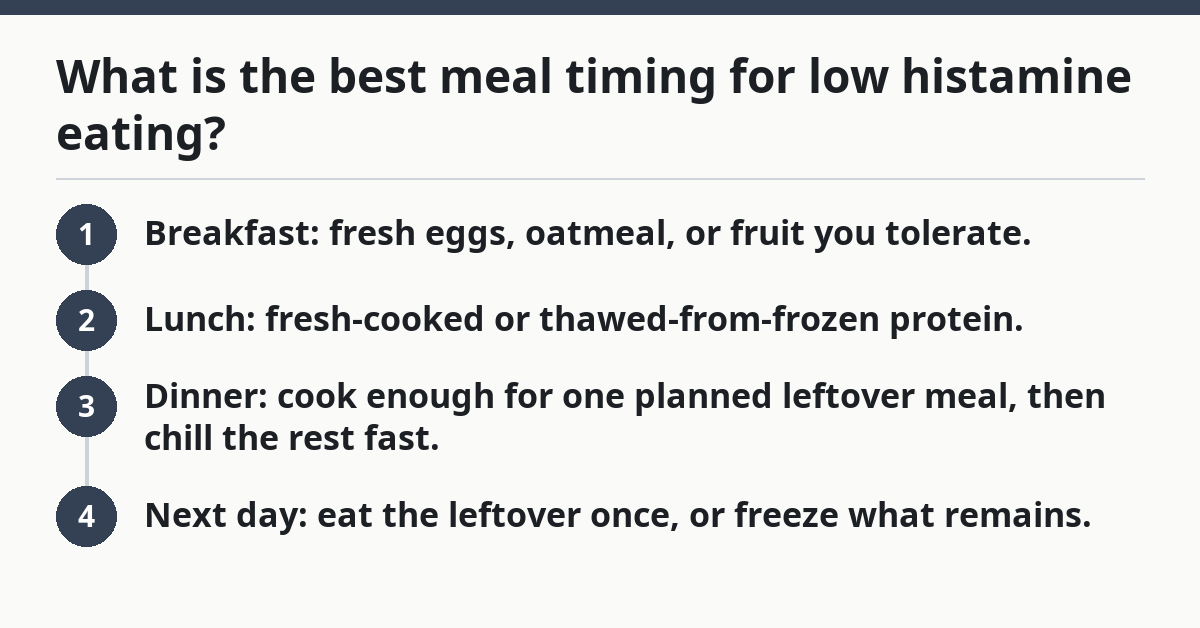
That is not glamorous, but for low histamine meal timing and storage it gives you a repeatable routine. It also keeps you from building a week’s worth of “maybe okay” food in the fridge.
How long can low histamine leftovers stay in the fridge?
Leftovers should stay in the fridge only as long as they are still cold, promptly chilled, and smell, look, and handle normally; for many sensitive people, that means 1–2 days is safer than stretching them longer.
Here’s the catch: refrigeration slows histamine buildup, but it does not stop it. A cold fridge is not a time machine. If you are already sensitive, “safe for regular food safety” and “safe for your symptoms” are not always the same thing.
A better way to think about fridge time:
- Same day: best for highly reactive people.
- Next day: often the shortest practical leftover window.
- Beyond 48 hours: more caution, especially for meats, fish, broth, and mixed dishes.
Food that tends to turn faster:
- cooked fish
- chicken and turkey
- ground meat
- stews and soups
- rice dishes
- tomato-based sauces
Food that often holds a little better:
- whole vegetables
- plain grains
- baked potatoes
- fresh fruit cut just before eating
The quality signs matter too. If a food has been in the fridge for a while and now tastes sharper, smells off, or looks dull and wet instead of fresh, that’s a bad sign. For a low histamine plan, I would not stretch a questionable leftover just because the date on the container looks fine.
For low histamine meal timing and storage, the general food-safety guidance still points in the same direction: rapid chilling and cold storage. The U.S. Food and Drug Administration and the U.S. Department of Agriculture both give detailed cold-storage advice for leftovers and perishable foods.
- FDA food safety: https://www.fda.gov/food/buy-store-serve-safe-food
- USDA leftovers guidance: https://www.foodsafety.gov/food-safety-charts/cold-food-storage-charts
What foods need the fastest storage plan?
Foods with more protein and more time spent sitting are the ones that need the fastest storage plan. Fish is the clearest example, followed by meat, broth, and mixed dishes with sauce.
Picture this: you’ve made salmon, roasted chicken, and a pot of tomato sauce in the same evening. All three are fine in the pan, but they do not age the same way in storage. Fish and broth usually deserve the shortest path from stove to fridge to plate.
The foods that deserve special caution:
- Fish and seafood: eat right away if possible; freeze fast if not.
- Cooked meat: cool quickly in shallow portions.
- Soups and stews: split into small containers so the center cools.
- Rice and grains: get them cold fast, then reheat once.
- Egg dishes: store promptly and eat soon.
A few foods are often better handled as “prepare and freeze” instead of “cook and save”:
- meat sauces
- casseroles with tomato
- chili
- stock-based soups
- leftover grilled protein
The reason is simple. Those foods combine several histamine-risk factors: protein, moisture, and time. If you can freeze a portion the same day, that is usually the cleaner move.
On the flip side, some meals are naturally easier:
- a fresh bowl of oats
- a salad assembled from crisp ingredients
- plain rice cooked and cooled fast
- roasted root vegetables eaten the same day
The more a dish sits in liquid, the more you need to manage time. Dry, fresh, and simple usually wins. That is why low histamine meal timing and storage works best when the meal plan and the container plan are designed together.
How should you cool food before refrigerating it?
You should cool food fast, spread it out, and move it into the fridge as soon as it stops steaming hard. The goal is to get hot food out of the danger zone without leaving it out so long that histamine rises.
A good cooling routine:
- Divide large batches into shallow containers.
- Remove lids for a short time if needed so steam escapes.
- Set hot pots in a safe cool-water bath if appropriate.
- Put food into the fridge once it is no longer dangerously hot.
- Label it if you need to track what to eat first.
The detail most people miss is container size. One deep container traps heat in the center. Several small containers cool far better. That matters for rice, stew, curry, soup, and meat sauce.
A second mistake is putting a giant hot pot straight into the fridge and calling it done. That can warm nearby food and slow cooling in the middle of the batch. Small portions fix that.
Good cooling habits also help with symptom control because they reduce the time food spends warm before refrigeration. If you are sensitive, this is one of the few variables you can control every single day. In low histamine meal timing and storage, cooling is the step that makes the rest of the plan usable.
What storage method works best: fridge or freezer?
The freezer is the better choice when you won’t eat the food soon, and the fridge is the better choice only for very short storage. If you are deciding between “keep it cold for later this week” and “freeze it now,” freeze it now.
Picture this: you’ve made a large batch of soup and know you’ll only eat one portion tomorrow. The rest does not need to audition for three more days in the fridge. Freeze it in flat, single-meal containers and save yourself the guesswork.
Use the fridge when:
- the food will be eaten within a day or two
- the batch was cooled fast
- the recipe is simple and low-risk
- the food is not fish, broth, or heavily sauced protein
Use the freezer when:
- you made extra portions
- you won’t eat the leftovers within 24–48 hours
- the dish includes meat, fish, or broth
- you want a backup meal that stays more predictable
The freezer also gives you better control over timing. Instead of letting food age in the refrigerator for several days, you stop the clock. That is often the most practical move for histamine-sensitive eaters.
A few freezer habits help:
- freeze in meal-size portions
- flatten bags when possible
- label the date and contents
- thaw in the fridge, not on the counter
- reheat once, then eat
Frozen low histamine meals can make the diet livable. You do not need to cook every single meal from scratch if you plan the freezer on purpose, and low histamine meal timing and storage becomes easier when frozen portions are part of the routine.
What are the biggest storage mistakes that raise histamine risk?
The biggest mistake is treating leftover handling like ordinary meal prep. For a low histamine plan, the wrong storage habit can matter as much as the wrong ingredient.
Picture this: you’re trying to save time, so you leave food out during cleanup, pack it later, and eat the same container for several days. That workflow is common. It’s also exactly where people get tripped up.
The most common mistakes are:
- leaving food out too long before chilling
- storing too much food in one deep container
- using leftovers for too many days in a row
- reheating the same portion more than once
- saving fish, broth, or meat “just a little longer”
- confusing “refrigerated” with “low histamine”
Reheating deserves special mention. Reheating does not remove histamine that may already be in the food. It can kill bacteria, but that is not the same thing. So the safer move is to prevent buildup by storage, not to hope heat fixes it later.
Another mistake is loading the fridge with a dozen mixed leftovers and then forgetting which one was cooled first. If your symptoms are inconsistent, a simple label with date and dish can save a lot of second-guessing.
If your freezer is full and your fridge is crowded, that is a sign to simplify meals rather than push storage longer. Long storage is usually the enemy, not the solution. That is the point where low histamine meal timing and storage has to become more deliberate, not more flexible.
A simple low histamine meal timing plan for one day
A simple plan is: cook fresh at one meal, eat one leftover meal within a short window, and freeze anything extra the same day. That keeps the schedule predictable without turning the kitchen into a science lab.
Here’s a practical one-day template:
- Morning: fresh breakfast with low-risk ingredients.
- Midday: thawed frozen portion or a fresh lunch.
- Evening: cook dinner with one extra portion.
- After dinner: chill the extra portion fast and store it for tomorrow.
- Next day: eat the leftover once, or freeze it if plans change.
If you need a stricter version, make one day a “cook day” and the next day a “eat-from-freezer day.” That reduces the number of times food passes through room temperature and makes meal timing easier to repeat.
A few meal ideas fit this structure better than others:
- plain chicken with rice and carrots
- turkey patties with zucchini
- oats with tolerated fruit
- baked potato with fresh protein
- soup portioned and frozen the same night
The key is not the exact menu. It’s the clock. If the clock stays short, the food choices become much easier to manage. That is why low histamine meal timing and storage is often more helpful than another long ingredient list.
When should you be stricter than the general rules?
You should be stricter when your symptoms are active, your fridge runs warm, or your food includes the highest-risk items like fish, broth, and long-cooked sauces. In those cases, the safest plan is shorter storage, faster cooling, and fewer leftovers.
Picture this: you’ve had several flare days in a row and you’re trying to figure out what changed. This is when “usually fine” habits stop being useful. The right move is to tighten storage for a week and see whether that gives you cleaner results.
Be stricter if:
- you react quickly to leftovers
- you have no reliable thermometer for the fridge
- the food sat out during a long dinner or event
- the dish includes seafood or bone broth
- you’re already stacking multiple trigger foods in one day
At that point, the best plan may be very plain:
- fresh-cooked meals
- same-day portions
- frozen backups
- no multi-day leftovers
That sounds restrictive, and it is. But it also removes one of the biggest hidden variables in a low histamine pattern: time.
If you have a medical diagnosis, persistent reactions, or weight loss from food restriction, talk with a qualified clinician or dietitian. A food log helps, but it does not replace medical care.
The Honest Verdict: what to do first
Choose fresh cooking plus fast freezing if you need the most reliable low histamine system and you cannot trust leftovers for more than a day. Choose short fridge storage if you tolerate next-day leftovers and can cool food quickly and cleanly. Neither works well if you keep fish, broth, or meat in the fridge for several days and hope reheating will save it.
That is the real split. Not “fresh versus leftovers” in theory — but how much storage time your body seems to tolerate in practice.
My recommendation is plain:
- start with one-day leftovers
- freeze what you won’t eat soon
- keep the hottest-risk foods on the shortest clock
- tighten the plan further if symptoms stay noisy
A low histamine kitchen works best when it is boring. Boring means predictable. Predictable means fewer surprises on the plate and fewer guesses in the fridge.
FAQ
Can I meal prep for low histamine eating?
Yes, but it works best as cook-and-freeze meal prep, not “cook on Sunday and eat all week.” If you prep meals, portion them quickly and freeze most of them the same day. That keeps the storage window short and usually works better than long refrigerated batches.
Are leftovers always bad for histamine intolerance?
No, leftovers are not automatically bad. The problem is time, temperature, and food type. A leftover that was cooled fast and eaten the next day is very different from a stew that sat around, was reheated several times, and stayed in the fridge for days.
Is the fridge cold enough to stop histamine from forming?
No, the fridge slows the problem, but it does not stop it. Cold storage is still useful, because it buys you time and reduces risk, but the safest approach is to shorten storage and freeze what you won’t eat soon.
What foods should I freeze instead of refrigerate?
Freeze fish, meat, broth, stew, soup, and sauced dishes if you won’t eat them soon. Those foods age faster in the fridge and are more likely to become a problem for people who are sensitive to histamine. Flat, single-meal portions work best.
How do I know if a leftover is too old for me?
If the food has been in the fridge longer than your usual safe window, smells off, has changed texture, or came from a high-risk dish, skip it. For many people with histamine issues, the safest move is to decide before eating that anything questionable goes out, not into the microwave.
Drafted with AI; not yet reviewed by a person.