Last updated: November 19, 2026
Key Takeaways
- The strongest single portions are foods that freeze as one unit and reheat without turning soft.
- Foods with stable texture, moderate moisture, and no need for crunch usually freeze best in portions.
- You portion food for the freezer by serving it in the amount you’ll actually eat, cooling it fast, and packing it flat or compact so it freezes quickly.
- Freezer bags work well for many single-serve foods, while muffin tins work well for very small or soft portions that need a shape first.
Individual portions freeze best when the food already holds its shape, stays moist after thawing, and can be packed in 1-serving sizes without needing a full reheating session. The topic “Which Foods Freeze Best as Individual Portions?” comes down to foods that keep their texture in the freezer and still work as single portions later. The best bets are cooked grains, cooked chicken, cooked vegetables, soups, muffin tins, and freezer bags. This guide sorts them by how well they freeze, how easy they are to portion, and what goes wrong if you pick the wrong food.
The foods that freeze best as individual portions
The foods that freeze best as individual portions are foods that freeze as a solid unit and reheat without turning to paste. That usually means dense, cooked foods with low water bleed, not crisp raw produce or cream-heavy dishes.
Picture this: you’ve got one lunch to save, not a whole batch, and you want it to thaw cleanly in a fridge or microwave. That’s the real test. Foods that pass usually fit into a single serving without breaking apart or drying out.
- Cooked grains like rice, quinoa, farro, and barley.
- Cooked chicken in bite-size pieces or shredded form.
- Cooked vegetables that were roasted, steamed, or blanched.
- Soups that are broth-based and not cream-heavy.
- Muffin-tin portions of sauces, broths, or soft foods.
- Freezer-bag packs for flat, stackable portions.
Here’s the catch: the food does not have to be perfect after freezing, just usable. A grain bowl with soft vegetables is a better candidate than a salad. A soup with beans is better than a dairy sauce that splits. The goal is defrost flexibility—something you can thaw one serving at a time without a second cooking step turning into a rescue mission.
These foods also support meal component freezing, which is useful if you want to build lunches later instead of freezing full meals now.
Which foods freeze best as individual portions, and which do not?
The foods that freeze best as individual portions are the ones with stable texture, moderate moisture, and a shape that does not depend on crispness. Foods that rely on crunch, emulsions, or fresh water content usually come back soft or separated.
Picture this: you open the freezer at 7 a.m. and want one portion that will still look like food at noon. That rules out anything that turns grainy, watery, or limp after thawing. It also rules out foods that have to be portioned with a knife while half-frozen.
Better candidates:
- Cooked grains in 1-cup or 1 1/2-cup portions.
- Cooked chicken cut or shredded into meal-size amounts.
- Cooked vegetables such as broccoli, carrots, green beans, cauliflower, and peppers.
- Soups with broth, beans, lentils, or vegetables.
- Muffin-tin portions of purees, sauces, or broth cubes.
Poor candidates:
- Fried foods with a crisp coating.
- Raw lettuce, cucumber, and similar high-water produce.
- Cream sauces that split.
- Pasta that was already soft before freezing.
- Potatoes meant to stay fluffy and crisp.
The truth is, the freezer is kinder to structure than to texture. A carrot keeps its shape better than a tomato slice. A chicken thigh stays useful; a breaded cutlet often loses the thing people liked about it. If texture matters more than convenience, freeze that food only if you can accept a softer result.
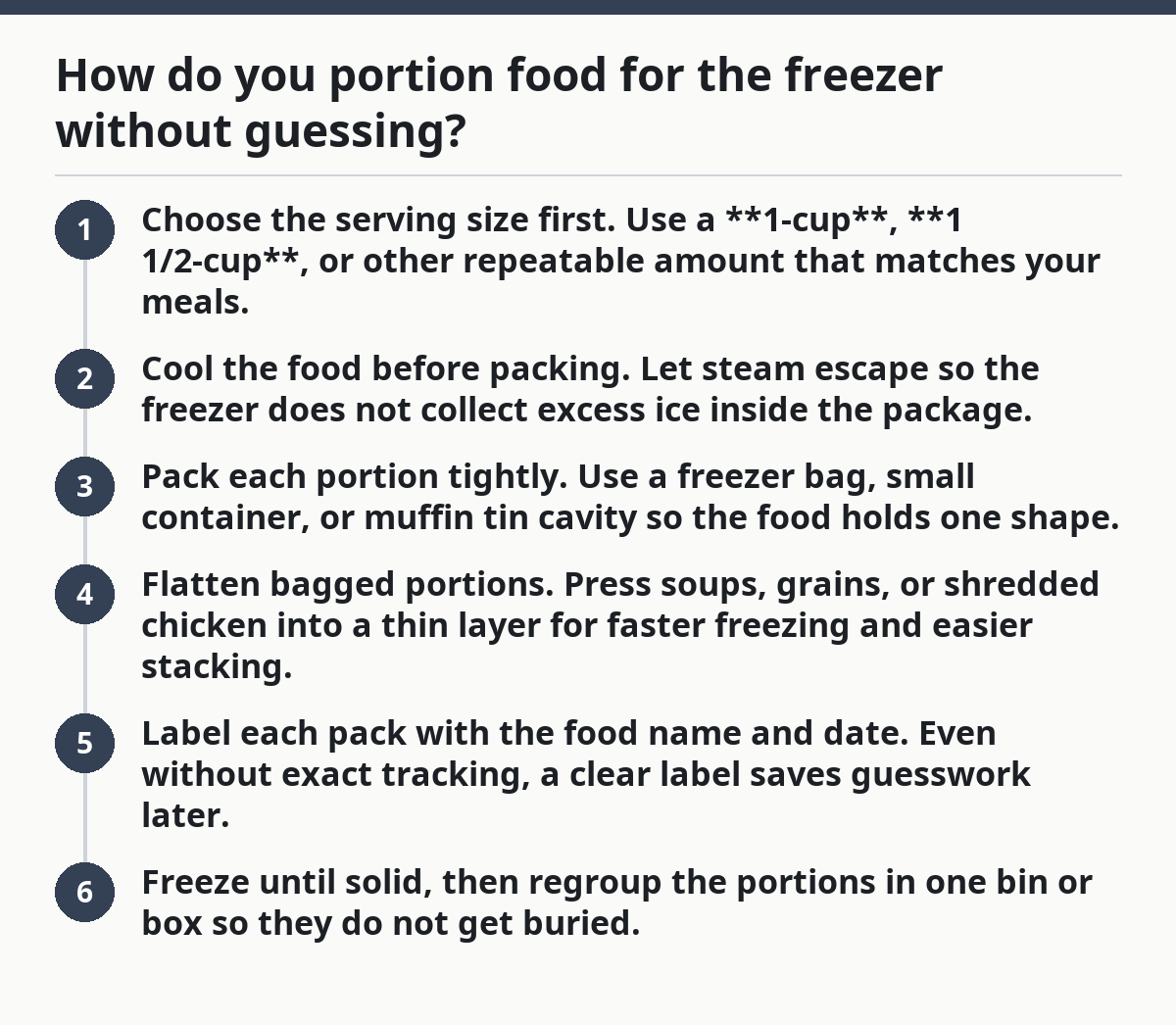
How do you portion food for the freezer without guessing?
You portion food for the freezer by serving it in the amount you’ll actually eat, cooling it fast, and packing it flat or compact so it freezes quickly. A simple method works better than trying to eyeball every batch.
Picture this: you’ve cooked one pan of food and want six grab-and-go servings. You need the portions to be the same size, easy to stack, and simple to reheat later without breaking the container or the microwave.
- Choose the serving size first. Use a **1-cup**, **1 1/2-cup**, or other repeatable amount that matches your meals.
- Cool the food before packing. Let steam escape so the freezer does not collect excess ice inside the package.
- Pack each portion tightly. Use a freezer bag, small container, or muffin tin cavity so the food holds one shape.
- Flatten bagged portions. Press soups, grains, or shredded chicken into a thin layer for faster freezing and easier stacking.
- Label each pack with the food name and date. Even without exact tracking, a clear label saves guesswork later.
- Freeze until solid, then regroup the portions in one bin or box so they do not get buried.
A flat freezer bag works well for soups and grains because it saves space and thaws faster than a deep container. A muffin tin helps when you want small, repeatable amounts of sauce, stock, or pureed food. That kind of portioning is especially useful for meal component freezing, where one serving is all you need.
What storage method works best for single-serve freezing?
Freezer bags work well for many single-serve foods, while muffin tins work well for very small or soft portions that need a shape first. The right choice depends on whether you want stackability, speed, or a rigid form.
Picture this: you have a freezer drawer with limited room and a lot of loose portions to fit. The storage method decides whether you end up with neat stacks or a frozen lump you have to pry apart with a spoon.
Freezer bags work best for:
- Cooked grains in flat, frozen sheets.
- Cooked chicken that will be used in soups, wraps, or grain bowls.
- Cooked vegetables that can lie in a thin layer.
- Brothy soups that freeze without a lot of solids in a deep block.
Why they work well:
- They use less space than rigid tubs.
- They freeze faster when pressed flat.
- They thaw quickly in cold water or overnight in the fridge.
Drawbacks:
- They can leak if not sealed well.
- They crush delicate pieces.
- They are awkward for chunky foods that need structure.
Muffin tins work best for:
- Small soup add-ins.
- Broth, sauce, pesto, or puree.
- Tiny side portions that you want to pop out and bag later.
Drawbacks:
- They take a full tray of freezer space.
- Frozen portions can be hard to release if the tin is not lined.
- They are less useful for chunky meals like chicken and grains.
The most practical setup for many people is a mix: freeze the food in a muffin tin when you need little blocks, then move those blocks into freezer bags once they’re firm.
Which freezer-friendly textures hold up the best?
The best freezer-friendly textures are dense, moist, and already cooked through, because they keep their shape and do not depend on crisp edges or fresh snap. Soft is fine. Watery and crunchy are the troublemakers.
Picture this: you thaw a lunch and the grains are still separate, the chicken still slices, and the vegetables still have some body. That is the texture win. You do not need restaurant quality. You need food that still behaves like food.
Best textures for single portions:
- Separate grains that are cooked, drained, and not mushy.
- Shredded or diced chicken that stays moist after reheating.
- Tender vegetables like carrots, peas, broccoli, and cauliflower.
- Brothy soups that do not depend on cream.
- Smooth purees that can be frozen in exact amounts.
Textures that often fail:
- Crisp coatings that go soft.
- Leafy greens that collapse.
- Raw high-water vegetables that turn slushy.
- Milk- or cream-heavy sauces that split.
The best way to protect texture is to stop cooking before the food gets overly soft. If the grains are already sticky, freezing will not fix them. If the vegetables are already limp, they usually come back worse. The freezer preserves the starting point; it does not improve it.
That’s why the strongest candidates for individual food portions are foods that can tolerate a little softness without losing their job on the plate.
What makes a food bad for one-serving freezing?
A food is bad for one-serving freezing when it depends on crispness, contains a lot of free water, or falls apart into something you would not want to portion again after thawing. The freezer exposes weak textures fast.
Picture this: you pull out one portion and realize it has fused into a block, or worse, thawed into a watery mess. That usually means the food was never a good fit for small-portion freezing in the first place.
Common mistakes:
- Freezing foods while they are still hot, which creates extra ice and soggy texture.
- Packing portions too large, which slows thawing and wastes time.
- Freezing foods that need crunch, like fried coatings or fresh salad vegetables.
- Mixing everything together when one component freezes well and another does not.
- Leaving too much air in freezer bags, which encourages freezer burn.
What to do instead:
- Cool food before packing.
- Freeze in single-serving sizes you can use in one meal.
- Keep crisp components separate from soft ones.
- Use flat bags for flexible foods and muffin tins for tiny portions.
- Move frozen blocks into labeled bags once solid.
The freezer works best on foods that keep their structure over time. If you want a wider system for building portions, the hub on low histamine freezer systems is the better next stop because it shows how to organize the whole process without repeating the same prep work.
The best choices by meal component
The best meal components to freeze individually are grains, protein, and vegetables, because each one keeps a different part of a meal useful without forcing you to freeze the whole plate. That gives you more ways to mix and match later.
Picture this: one night you want chicken and rice, the next night soup, and the next day a bowl with vegetables on the side. Individual portions make that possible without three separate cooking sessions.
Best component choices:
- Cooked grains: rice, quinoa, barley, farro.
- Cooked chicken: shredded, diced, or chopped.
- Cooked vegetables: roasted carrots, broccoli, cauliflower, green beans, peppers.
- Soups: broth-based soups that can be reheated as a lunch or starter.
- Muffin-tin portions: stock, sauce, puree, or small add-ins.
Why this works:
- Grains give you bulk.
- Chicken gives you protein.
- Vegetables give you volume and color.
- Soups give you a full meal in a bowl.
- Muffin-tin portions let you freeze tiny amounts without waste.
This approach also helps with defrost flexibility. You can thaw one bag of chicken, one flat pack of grains, or two muffin-tin cubes of sauce instead of committing to a full casserole. That matters when appetite changes from day to day, or when you only need one component for lunch.
For more on food safety and freezer handling, see the USDA on freezing foods and the FDA on safe food storage times.
FAQ
Can I freeze one serving at a time?
Yes, freezing one serving at a time is one of the smartest ways to use the freezer. It works best with foods that can sit in flat bags, small containers, or muffin tins without losing shape. The key is to portion before freezing, not after thawing, so you do not have to re-divide a large batch later. For planning, the FDA recommends keeping freezer temperatures at 0°F (-18°C).
Which foods become mushy after freezing?
Foods with a lot of water or a fragile texture often become mushy after freezing. Leafy greens, fresh cucumbers, crisp salads, and many fried foods are the common troublemakers. Creamy sauces can also split, which changes both texture and look. If a food depends on crunch, it is usually a poor freeze candidate.
What is best to freeze in small portions?
The best foods to freeze in small portions are cooked grains, cooked chicken, cooked vegetables, soups, and purees. These foods hold up well in 1-serving sizes and thaw with fewer surprises. If you want the easiest setup, use freezer bags for flat portions and muffin tins for tiny amounts you need to pop out later.
Drafted with AI; not yet reviewed by a person.