Last updated: November 19, 2026
Quick Answer: Low Histamine Freezer Meal Labels and Rotation System in 4 parts
Low Histamine Freezer Meal Labels and Rotation System works best when every container shows four things: meal name, pack date, portion count, and a use-first note. A simple rotation system keeps older food in front, newer food behind it, and a meal log as the backup when labels get covered in frost.
Low histamine freezer labels are the fastest way to know what a meal is, when it went into the freezer, and what should be eaten first.
What a low histamine freezer label needs to say
A low histamine freezer label needs four things: dish name, pack date, portion count, and a clear eat-first cue. That is enough to stop the usual freezer confusion without turning every container into a legal document.
On a freezer label, I would put:
- Meal name: “Turkey rice soup” is better than “soup.”
- Date packed: use one format only, such as 2026-01-14 or 14 Jan 2026. Do not mix formats.
- Portions: “2 servings” or “4 lunch boxes.”
- Rotation note: “Use by next,” “Family dinner,” or “Front bin.”
For low histamine meal prep, the label should also warn you about any ingredient that matters to your household. That might be “contains egg,” “contains dairy,” or “contains fish.” If you know a substitute was used, write it on the label too, such as “oat milk instead of cow’s milk.” For common allergens, keep the note short and visible; the freezer is not the place for guesswork.
A label maker gives the cleanest result, especially on smooth freezer-safe containers. If the label maker runs out or you are labeling cardboard trays, masking tape and a permanent marker work fine. Use a broad strip of masking tape, not a tiny scrap, so the date can still be read when the container gets cold and damp. The goal is legibility at arm’s length, not a perfect look.
This page is about the organization system itself, not the cooking, container choice, or menu planning. It fits with the larger histamine-friendly meal prep systems hub because the real problem is not freezing food; it is remembering what belongs to which week.
How should I label freezer meals so I can rotate them fast?
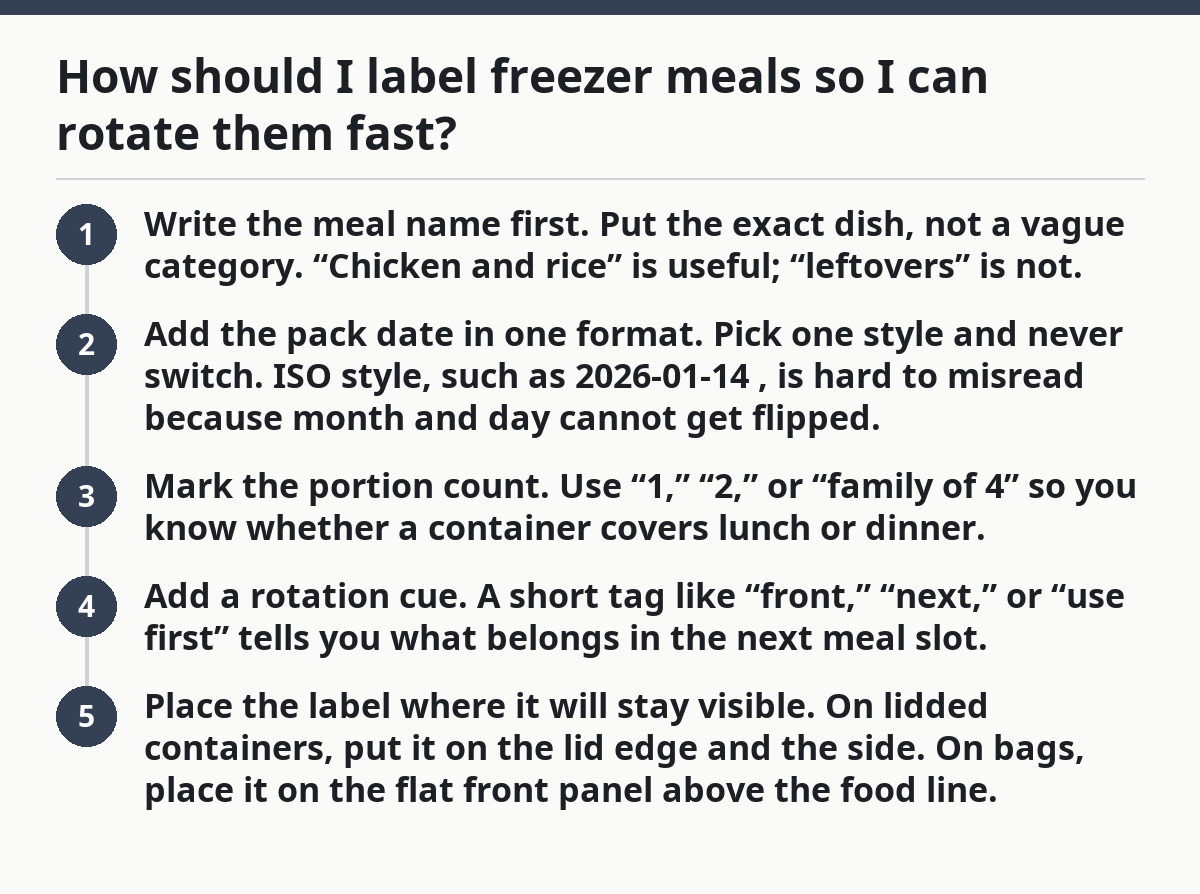
Label freezer meals with one consistent template so your eye can scan them in under 5 seconds. I would use the same order every time: meal name + pack date + portions + use-first note.
Here is a practical format:
- Write the meal name first. Put the exact dish, not a vague category. “Chicken and rice” is useful; “leftovers” is not.
- Add the pack date in one format. Pick one style and never switch. ISO style, such as 2026-01-14, is hard to misread because month and day cannot get flipped.
- Mark the portion count. Use “1,” “2,” or “family of 4” so you know whether a container covers lunch or dinner.
- Add a rotation cue. A short tag like “front,” “next,” or “use first” tells you what belongs in the next meal slot.
- Place the label where it will stay visible. On lidded containers, put it on the lid edge and the side. On bags, place it on the flat front panel above the food line.
The reason for this order is simple: the name tells you what the food is, the date tells you age, and the portion count tells you whether it solves today’s meal. If the label maker prints too small, go up one size. A 12 mm tape width is easier to read than a narrow strip when the container is packed tightly in a freezer bin.
This is also where many systems go wrong. A label that only says “chicken” saves almost no time. A label that says “Chicken soup, 2026-01-14, 2 portions, use next” lets you choose in seconds.
If you use masking tape, press it onto a dry spot and write with a marker that will not smear on cold plastic. A freezer bin helps here because the label sits where you can see it without moving ten items.
The rotation system that stops old meals from hiding
The rotation system that works best is first in, first out, with a visible front row and a written meal log. New meals go behind older ones, and the oldest meals stay easiest to reach.
The basic rule is straightforward: the meal that was packed first should be the meal you see first. That does not happen by accident in a freezer. It happens when the bin or shelf has a set order.
Use this layout:
- Front zone: meals that should be eaten in the next 1 to 3 days.
- Middle zone: meals packed after the front zone.
- Back zone: freshly frozen meals that must wait.
- Separate bin or spot: special items such as broth, sauces, or allergen-containing meals that need extra attention.
If the freezer is a chest freezer, use freezer bins or shallow baskets so the older meals do not disappear under new ones. In an upright freezer, assign one shelf or one shelf section to “next up” meals. The point is not perfect storage; it is visual priority.
A meal log makes the system stronger. Keep it on paper, in a notes app, or on a clipboard stuck to the freezer door. List:
- meal name
- date packed
- portions
- location, such as “top bin” or “left shelf”
- date moved to front, if it changed position
That extra note matters because low histamine meal prep often depends on timing. If a meal is moved from back to front on Tuesday, you do not want to rely on memory on Friday. The log tells you what was cooked when and what is supposed to be used first.
This system is not for someone who wants to toss anything anywhere and “figure it out later.” It only works if the labels and the bin order match.
How do I keep a meal log without making it annoying?
A meal log stays useful when it takes less than 1 minute per meal to update. If it takes longer, it will stop getting filled out, and the freezer will become a guessing game again.
Use one of these two formats:
- Paper clipboard: one page per week, taped to the freezer or pinned nearby.
- Notes app: one note titled “Freezer meals,” with the newest entries at the top.
The simplest entry line is:
Meal name — date packed — portions — location
Example:
Turkey rice soup — 2026-01-14 — 2 portions — front bin
If you want to track rotation more closely, add one more field:
Moved to front — 2026-01-18
That extra line is useful when the freezer is full and the front row changes often. It can help prevent the common mistake of thinking a meal is older than it really is because it has been sitting in the same visible spot for a week; if timing matters for your household, consider checking it with a clinician or dietitian.
A meal log also helps when labels get damaged by condensation, freezer burn, or a spilled sauce. If the writing on one container fades, the log still tells you what is inside and whether it belongs in the next meal cycle.
I would not make the log complicated. Do not add nutrition notes, recipe steps, or a full ingredient list unless you truly need that for allergy management. The more fields you add, the more likely the log becomes clutter. For a low histamine freezer system, the useful data are date, portion, and position.
If multiple people use the freezer, assign one person to update the log after each cooking session. That can reduce the usual “I thought someone else wrote it down” problem, especially if your household agrees on one shared notebook or app note.
Date tracking, portion tracking, and container coding
Date tracking, portion tracking, and container coding work together to keep the freezer readable at a glance. Each one solves a different problem, and skipping any one of them creates confusion.
Date tracking answers: when was this cooked or frozen?
Portion tracking answers: how many meals does it cover?
Container coding answers: where does it belong in the rotation?
For date tracking, use one format only. ISO style is clean and unambiguous: 2026-01-14. If you prefer day-month-year, use it everywhere, such as 14 Jan 2026. Do not mix “01/14/26” and “14/01/26,” because that is how meals get mislabeled in a hurry.
For portion tracking, write the number in plain sight. “1 dinner,” “2 lunches,” or “4 side portions” is enough. This matters because low histamine meals are often portioned to reduce repeated handling. If a container holds two servings, you want to know that before you thaw it.
For container coding, color, tape, or shelf position can act as a simple code:
- Blue sticker = lunch portions
- Yellow sticker = dinner portions
- Red marker line = use first
- Top shelf = current week
- Freezer bin A = oldest meals
A label maker is best when you want the code to last. Masking tape is best when you want to change the code quickly. Marker is best when the container itself is not reused often. The most practical system is the one you will actually maintain.
This is also where to mark obvious allergens. If one container holds a dairy-based sauce and another does not, a small “contains dairy” note on the label can help prevent mistakes later; if your household uses different meal rules, check them with a professional. If your household needs a different substitute, write it once on the label and once in the meal log so the same meal can be identified even after the tape peels.
Common labeling mistakes that wreck the rotation
The most common labeling mistakes are vague names, mixed date formats, and labels that can’t be read without moving the container. Each one costs time, and the first two can cost a meal if you have to thaw the wrong item to find out what it is.
Mistake 1: Writing “leftovers.”
This hides the actual meal name and turns the freezer into a memory test. Write the dish name instead, even if it is plain.
Mistake 2: Using one label for too much information.
A crowded label is hard to read through frost. Keep the label to the essentials and move the rest into the meal log.
Mistake 3: Writing the date in different formats.
If one container says 03/04/26 and another says 04/03/26, the system has failed. Use one format only.
Mistake 4: Putting labels where they rub off.
Put the label on a flat, dry surface.
Mistake 5: Forgetting portion size.
Without portion tracking, a one-serving container can get treated like a family meal, so it helps to label the serving count clearly and review it with your household’s meal planning routine.
Mistake 6: Not syncing the log with the label.
If the label says one date and the log says another, use the log only if it was updated the same day. Otherwise, the system becomes unreliable.
The fix is boring but effective: standardize the label, keep a separate meal log, and put the oldest meals in the easiest-to-reach spot. A freezer bin does more work than a stack of loose containers because it creates a visible queue.
This system is not ideal for someone who rarely repeats meals or who freezes only one or two items a month. It shines when there are enough meals in the freezer that memory stops being enough.
What a simple weekly reset looks like
A simple weekly reset keeps the label system accurate in about 10 minutes. You do not need to empty the freezer; you only need to re-sort the front row and update the log.
Start by pulling the front bin or front shelf section forward. Read every label and separate meals into three groups:
- Eat this week
- Keep for later
- Move out of the rotation
Then do the following:
- Check the oldest dates first. Put the earliest pack date in front.
- Move the next 2 to 4 meals into the “use first” zone. The exact number depends on freezer size.
- Cross-check the meal log. Make sure the front row matches what the log says.
- Replace any unreadable labels. If the tape is peeling or the marker has faded, relabel immediately.
- Reset one empty space. Leave room for the next batch so new meals do not get piled on top.
If you prep a lot at once, this weekly reset can help prevent the “freezer avalanche” where newer meals bury older ones; if your household has complex dietary needs, it is worth confirming the routine with a dietitian or other professional. A small amount of order maintenance is easier than thawing a mystery container.
The cleanest systems use the same tools every week: label maker for permanent labels, masking tape for quick changes, marker for temporary notes, meal log for backup, and freezer bin for physical order. That combination is simple enough to keep going and specific enough to work.
Key takeaways
- Use one label format every time so meal names, dates, and portions are easy to scan.
- Put the oldest meals in the most visible spot and mark them as use-first.
- Keep a separate meal log as backup when labels fade, peel, or get covered.
- Track portions and dates together so you do not thaw the wrong amount.
- A freezer bin or shelf zone matters as much as the label because rotation is physical, not just written.
What should be written on freezer labels?
A freezer label should show the meal name, the date it was packed, the portion count, and a short rotation note like “use first” or “front bin.” If the meal contains a common allergen such as dairy, egg, or fish, add that too. A label maker, masking tape, and a marker all work if the writing stays legible in the freezer.
How do I rotate freezer meals?
Rotate freezer meals by using first in, first out: older meals go in front, newer meals go behind them. Keep one freezer bin, shelf section, or basket for the next meals to eat, and update a meal log when something is moved. The goal is to make the oldest dated meal the easiest one to grab.
Drafted with AI; not yet reviewed by a person.