Last updated: November 19, 2026
Quick answer: use 3 steps for How to Store Opened Jars and Packaged Staples well—seal the food in a clean, dry container, keep moisture out, and label the opening date. Store opened jars and packaged staples in airtight containers, keep moisture out, label the date, and use clean utensils every time. That is the basic answer for rice, oats, flour, nut butter, syrup, and other opened pantry foods that still need to stay usable, not just “out of the way.”
Key takeaways
- Air and moisture do most of the damage, so the lid matters as much as the food.
- A clean spoon or scoop keeps crumbs, water, and old food bits out of the container.
- Date labels help you use the oldest opened items first without guessing.
- Some packages can stay in their original bag if the bag can close tightly; others need a harder container.
- If a jar smells odd, shows mold, or has visible spoilage, storage tricks are not the fix.
What should stay in the original package?
Opened packaged staples can stay in the original package only if the package closes tightly and blocks moisture well enough for the food inside. A thin cereal bag is not the same as a zip-top freezer bag, and a folded paper flour sack is not enough once the bag has been opened.
For rice, oats, flour, and similar dry goods, the original bag is often the weak point. A rigid container with a tight lid gives better protection from humid air, pantry pests, and accidental spills. For a jar of nut butter or syrup, the original jar is usually fine if the lid still seals well and the rim stays clean.
A good rule is simple: if the package opens and closes badly, move the food. If the container already has a sturdy screw top or snap lid and the food is dry or sticky rather than crumbly, keeping it in place can work.
The trade-off is convenience. A rigid container takes more shelf space than a folded bag, and it is harder to see the exact amount left. That is the cost of better protection. This approach is not for someone who wants every opened staple to stay in a flimsy bag and still last as long as a sealed one, because that usually fails in a humid kitchen.
For general food-handling guidance, USDA’s FoodKeeper resource is a useful reference point: FoodKeeper. It is a reminder that storage depends on both the food type and the package around it.
How do I seal opened jars and bags well?
You seal opened jars and bags by closing them against air, then checking that the closure actually holds. That means a jar lid that turns down firmly, a clip or band that closes a bag tightly, or a transfer into a container with a snug seal.
For jars, wipe the rim before you close the lid. A sticky ring of syrup or nut butter can stop the lid from sealing flat. For bags, push out excess air before folding, clipping, or zipping. Less trapped air means less chance that the contents pick up odors, stale notes, or moisture.
For dry staples like rice, oats, and flour, a 1-step change often helps more than any fancy gadget: move the food into a clean, dry container with a lid that shuts fully. For sticky staples like nut butter and syrup, keep the original jar if the lid still tightens well and the threads are clean.
A comparison helps:
| Food type | Best storage move | Why it helps | Main drawback |
|---|---|---|---|
| Rice | Tight-lidded dry container | Blocks humidity and pests | Uses more shelf space |
| Oats | Tight-lidded dry container or sealed bag | Keeps flakes from going stale | Harder to portion from a bulk bag |
| Flour | Airtight container | Limits moisture and odor pickup | Extra container to wash |
| Nut butter | Original jar with clean rim | Keeps the product contained and easy to scoop | Messy lids can fail to seal |
| Syrup | Original jar or bottle with tight cap | Prevents leaks and sticky residue | Cap threads can gum up fast |
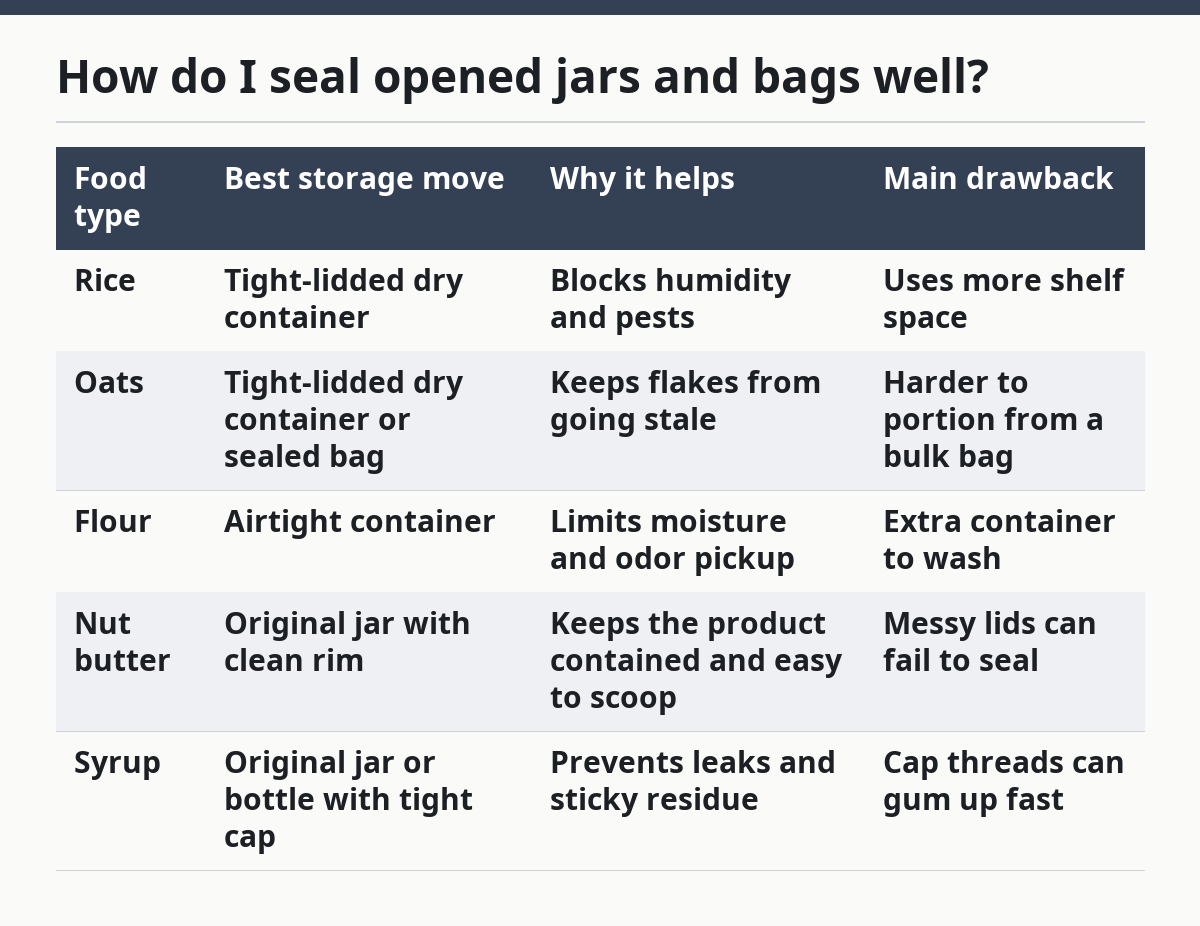
That comparison matters because “sealed enough” is not the same for every food. A jar of syrup can stay usable in the original bottle, while flour usually needs a better barrier than a folded sack. A one-size answer is wrong for this topic.
How should I handle rice, oats, flour, nut butter, and syrup?
You handle rice, oats, flour, nut butter, and syrup by matching the container to the food’s texture and the way you scoop it. Dry, dusty foods need moisture protection. Sticky foods need clean rims and lids that do not get caked shut.
Rice and oats do well in dry containers with wide mouths or easy-pour lids. That makes scooping simpler and reduces spills, which matters because a spilled grain on the shelf can attract pests. Flour benefits from a tight lid and a smooth interior, since corners trap residue.
Nut butter needs clean edges around the lid and a utensil that does not carry crumbs or wet droplets back into the jar. Syrup needs the same kind of care, because a sticky cap turns into a leak point if residue builds up on the threads. If the cap no longer closes cleanly, move the syrup to a container with a better lid.
These foods are not equal in how fast they suffer. Flour and oats can pick up moisture and odor. Nut butter and syrup are more forgiving about dryness, but they are messy if the top is dirty. That is why the best container is not always the fanciest one; it is the one that matches the food.
This page is about keeping opened pantry foods usable, not about deciding whether a low histamine leftover should be saved. That is a different question with different risks.
What is the best way to label opened staples?
The best practical way to label opened staples is to write the opening date on the container or package the same day you open it. A simple piece of masking tape and a marker is enough.
The date matters because opened food is no longer a mystery box. Once a bag of flour, a tub of oats, or a jar of nut butter is open, the clock is about your own kitchen conditions, not just the printed package date. If you open several similar items in one week, labels stop you from reaching for the wrong one first.
Put the label where you can read it without lifting the container. The front or lid works better than the bottom. If the food is moved into a new container, transfer the date too. If you add a second batch to the first container, write the new date as well so the older portion does not disappear at the back.
A date label also helps you notice waste. If a container stays in the pantry for months after opening, that is a sign the format is wrong or the food is bought in too large a size. The fix may be a smaller package, not a better marker.
The FDA’s home food-safety pages are a useful starting point for safe handling and storage habits: FDA food safety at home. Even simple label habits fit the same logic: know what you have, when it was opened, and how it has been handled.
How do I keep moisture and pests out?
You keep moisture and pests out by closing the container fully, storing it away from heat, and avoiding repeated long openings in a humid room. Moisture is the enemy of dry staples, and a half-closed bag is an open invitation to stale food and insects.
For rice, oats, and flour, choose a container with a lid that sits flat and stays shut after daily use. A loose clip on a bag may hold for a day, but it is weaker over time. If the pantry is damp, a more rigid container gives better protection than the original packaging.
Do not leave measuring cups or spoons sitting in the container. A damp scoop can carry moisture straight into the food. A crumb-covered spoon can do the same with contamination. Clean tools matter as much as the lid because the lid only helps if the food inside stays dry and clean.
Keep opened jars upright and away from sinks, dishwashers, or stove steam. A jar of syrup or nut butter near steam can collect condensation on the lid and threads, which shortens usable life faster than most people expect. If the pantry shelf gets warm, move the food to a cooler cabinet.
Which storage mistakes shorten usability fastest?
The fastest way to ruin opened pantry staples is to mix moisture, crumbs, and poor sealing in the same container. That combination makes food stale, clumpy, or mold-prone long before it should be.
The biggest mistake is using the wrong container for the job. A thin bag with a weak fold is poor protection for flour or oats. Another mistake is scooping with a wet spoon into a jar of nut butter or syrup. Even a small amount of water can change the top layer and make the lid messy.
A third mistake is leaving the lid sticky. Syrup, nut butter, and similar foods can dry around the threads and stop the cap from closing properly. Once that happens, the container leaks air and becomes annoying to open and close, so it sits half-used in the pantry.
The last mistake is ignoring the date. An unlabeled opened jar looks fine until it has been ignored for too long. If the container has been open for a while and you cannot tell when it was opened, the safest move is to inspect it closely before use.
This storage method is wrong for anyone who wants to rescue badly handled food or keep opened staples usable with no attention at all. It still requires a clean lid, dry utensils, and a quick check before each refill.
When should I move an opened staple into a new container?
You should move an opened staple into a new container when the original package no longer closes tightly, the lid is damaged, or the food needs better moisture protection than the package can give. That is especially true for rice, oats, and flour.
A new container is also useful when the opening is awkward. A wide-mouth jar or bin makes scooping easier than a crumpled bag. If the package tears, the seal fails, or the food catches pantry odors, the old package has stopped doing its job.
Choose a clean, dry container with a lid that fits the food’s size. Too much empty space in a huge bin can make the contents harder to manage, while a too-small container encourages spills. The goal is practical storage, not a perfect match in shape or style.
If a jar or package has visible spoilage, strong off odors, mold, or signs of pests, better storage is not the answer. That food should not be treated as usable just because it was once sealed. This article is about keeping good staples usable, not reversing spoilage.
FAQ
Do opened pantry foods need labels?
Yes, opened pantry foods should be labeled with the opening date. A small strip of tape and a marker is enough for most jars and bags.
The label helps you rotate rice, oats, flour, nut butter, and syrup before they sit too long in the pantry. It also keeps similar containers from getting mixed up when several are open at once.
What containers work best for dry staples?
Tight-lidded containers work best for dry staples like rice, oats, and flour. The lid should close flat and stay shut after repeated use.
Rigid containers usually protect better than folded bags because they block moisture and are harder for pests to get into. A clean, dry container is more important than a fancy brand or shape.
How can I keep opened jars safe to use?
Keep opened jars safe to use by wiping the rim, closing the lid tightly, and using a clean utensil every time. A dry spoon or knife keeps crumbs and water out of the jar.
Store the jar upright, label the opening date, and watch for leaks, stuck lids, or visible spoilage. If the jar no longer seals well, move the contents to a better container or stop using it if spoilage is present.
Drafted with AI; not yet reviewed by a person.